Machinery · Agricultural machinery
Fertilizer Spreader
Also known as: Broadcast spreader, Fertilizer applicator
A fertilizer spreader distributes solid granular or pelleted fertilizer across a field, typically by broadcasting it in a fan pattern from spinning discs or metering it through a boom, to supply nutrients to a growing or planned crop.
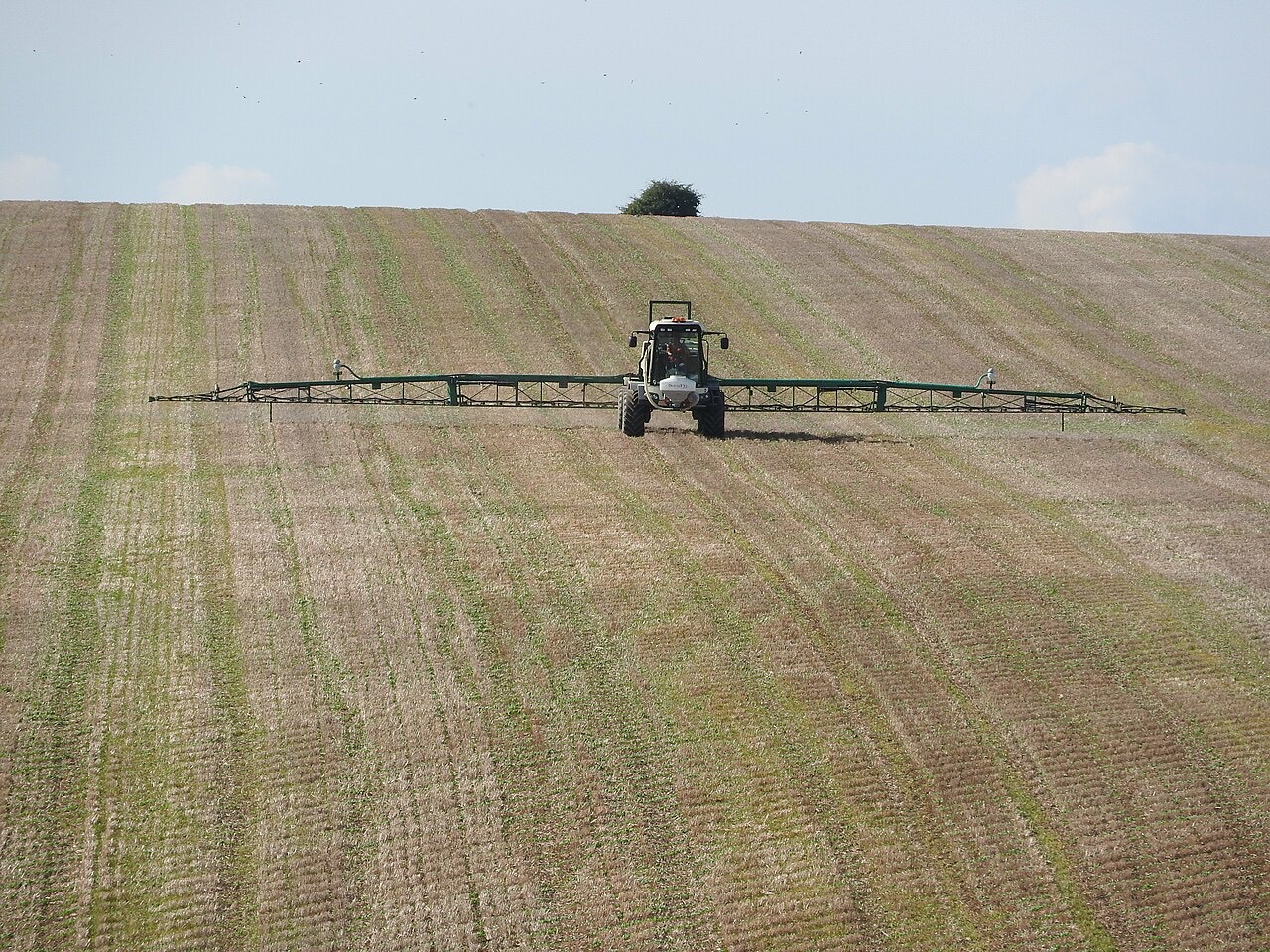
A fertilizer spreader applies solid fertilizer materials — granular, pelleted, or crystalline products such as urea, compound NPK fertilizers, or lime — across a field at a set rate. Most broadcast spreaders use one or more spinning discs to fling fertilizer outward in a fan-shaped pattern, while boom-type and pneumatic spreaders instead meter product to individual outlets across a wider, more evenly defined working width.
Because nutrient placement and rate accuracy directly affect crop response and the risk of nutrient loss to the environment, spreaders are calibrated to the specific fertilizer product being applied, since granule size, density, and shape all influence how far and how evenly material is thrown.
What a fertilizer spreader is
A fertilizer spreader is built to move a measured quantity of solid material from a hopper to the soil surface across a working width, distinguishing it from sprayers, which handle liquid products, and from seed drills and planters, which place seed rather than nutrients.
How it works
- Fertilizer is loaded into a hopper feeding a metering mechanism
- The metering system releases product onto spinning discs or into a distribution boom at a controlled rate
- Spinning discs fling material outward in a fan pattern, or boom outlets distribute it across the working width
- Application rate is adjusted according to ground speed and the target rate per unit area
Role in the production cycle
Fertilizer spreading typically occurs before planting to build base soil fertility, and again during the season as top-dressing to meet crop nutrient demand at key growth stages, particularly for nitrogen. Accurate, even application supports uniform crop growth and helps limit both under- and over-application relative to crop need.
Spreaders are increasingly integrated with precision-agriculture tools, using GPS guidance for accurate pass spacing and variable-rate control to vary application across zones of a field with different soil fertility or yield potential.
Types and variations
- Spinning-disc broadcast spreader
- Uses one or two rotating discs to fling fertilizer in a wide fan pattern; common for general broadcast application.
- Pneumatic spreader
- Uses an air stream to carry metered fertilizer to individual outlets across a boom, giving more even distribution across wide widths.
- Boom spreader
- Distributes material through a series of outlets along a boom rather than by centrifugal throw.
Considerations
Uneven fertilizer distribution — from poor calibration, wind drift, or mismatched settings for a given product — can create visible striping in crop growth and contributes to nutrient loss where product lands off-target, including near watercourses or field margins.
Relationships
Evidence-backed connections in the knowledge graph.
Farming systems
Related topics
Scope & limitations
Geographic scope: General overview of fertilizer spreaders as used in mechanised nutrient application worldwide. Equipment scale and configuration vary by farm size and region.
- This entry describes spreader function and types in general terms; it does not specify application rates, which are crop-, soil-, and product-specific.
- Environmental and regulatory limits on fertilizer application timing and rate vary by region and are not detailed here.
Sources
This article draws on the following authoritative sources. See our sources & methodology for how they are selected.
- [1]Iowa State University Extension and Outreach (opens in a new tab)High
Iowa State University Extension and Outreach
Cited for: Fertilizer spreader calibration and application accuracy
- Type:
- University extension service
- Jurisdiction:
- United States (Iowa)
- Accessed:
- 2026-07-12
- [2]USDA ARS — Agricultural Research Service (opens in a new tab)Authoritative
USDA Agricultural Research Service (ARS)
Cited for: Nutrient application equipment research context
- Type:
- Government agency
- Jurisdiction:
- United States
- Accessed:
- 2026-07-12
- [3]AHDB — Agriculture and Horticulture Development Board (opens in a new tab)High
Agriculture and Horticulture Development Board (AHDB)
Cited for: Nutrient management and application guidance context
- Type:
- Government agency
- Jurisdiction:
- United Kingdom
- Accessed:
- 2026-07-12
- [4]FAO — Food and Agriculture Organization (opens in a new tab)Authoritative
Food and Agriculture Organization of the United Nations (FAO)
Cited for: Role of fertilizer application equipment in crop production
- Type:
- Intergovernmental organization
- Jurisdiction:
- Global
- Accessed:
- 2026-07-12