Machinery · Agricultural machinery
Seed Drill
A seed drill places seed at a controlled depth and spacing in rows, opening a furrow, metering seed into it, and covering it in one pass, giving more even establishment than broadcasting seed by hand or machine.
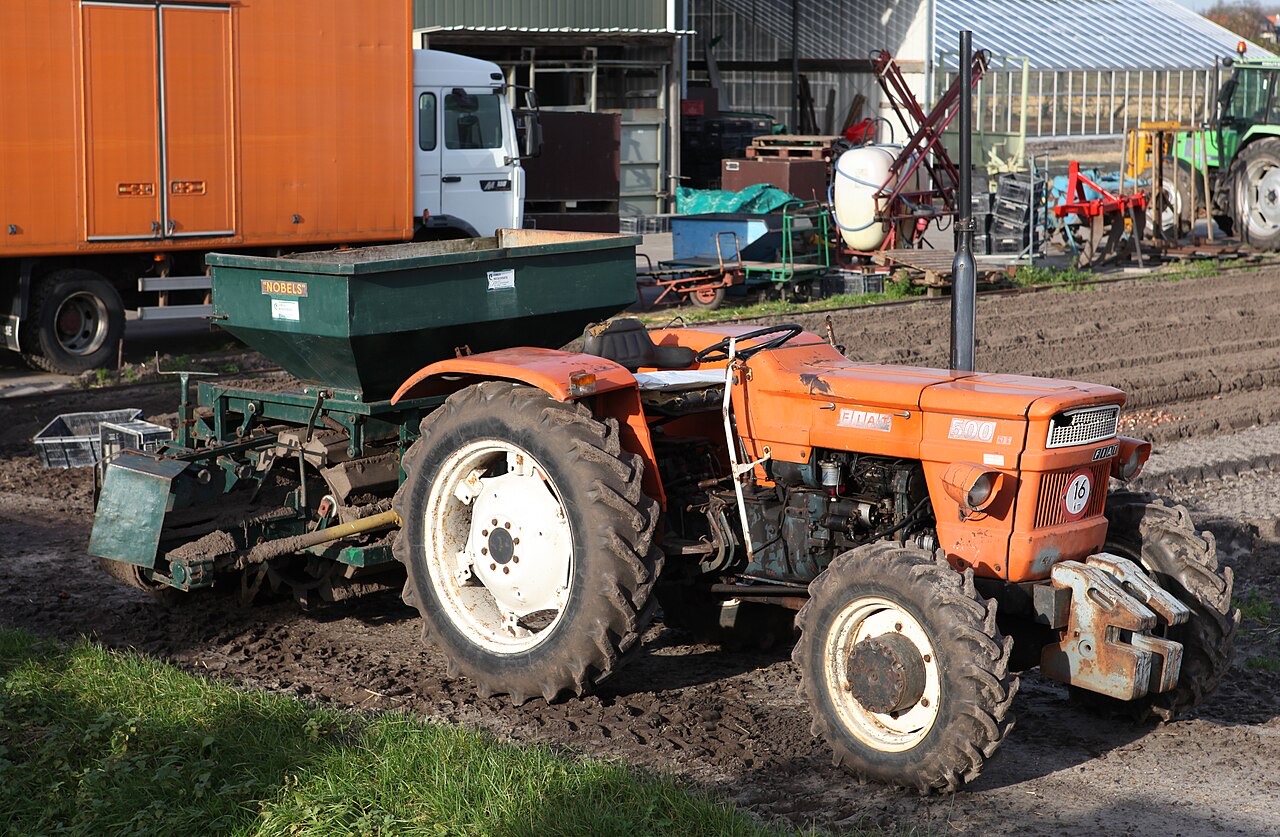
A seed drill is a towed or mounted implement that sows seed in evenly spaced rows at a set depth, rather than scattering it across the surface. It couples a seed-metering system with furrow openers and covering devices, so seed is placed into soil contact at a consistent depth in a single field pass.
Because germination and early crop establishment are strongly influenced by seed depth, seed-to-soil contact, and spacing, drilling is the standard planting method for cereals and many other close-drilled crops in mechanised systems, in contrast to broadcasting or precision row-crop planting used for wider-spaced crops.
What a seed drill is
A seed drill is designed to sow seed in rows rather than scatter it, giving more uniform plant spacing, depth, and emergence than broadcast sowing. Row spacing and configuration vary by crop and region, but the underlying function — metering seed into an opened furrow and covering it — is shared across drill designs.
How it works
- Seed is loaded into a hopper and fed to a metering mechanism
- The metering system distributes seed at a set rate to individual delivery tubes
- Furrow openers (discs or tines) cut a shallow slot in the soil ahead of each tube
- Seed drops into the furrow at a controlled depth
- Press wheels or covering devices close the furrow and firm the soil around the seed
Role in the production cycle
Drilling is the establishment step that follows seedbed preparation and precedes crop emergence, and it strongly influences final plant population and uniformity. Even emergence supports more consistent competition against weeds, more uniform crop development, and generally more predictable harvest timing.
In conservation and no-till systems, specialised drills are used to sow directly into undisturbed soil or crop residue, reducing the number of separate tillage passes and helping to protect soil structure and organic matter between crops.
Types and variations
- Conventional (tine or disc) drill
- Sows into a prepared, tilled seedbed
- No-till/direct drill
- Cuts through residue and undisturbed soil to place seed without prior tillage
- Air seeder/pneumatic drill
- Uses an air stream to distribute seed to a wide working width from a central metering unit
- Precision row-crop planter
- A related but distinct implement that singulates and spaces individual seeds, typically for wider-row crops
Operating considerations
Seed rate, sowing depth, and row spacing are set according to the crop, seed size, seedbed moisture, and target plant population, and are typically adjusted between fields and seasons. Soil structure and residue level at the time of drilling also affect how well openers achieve consistent seed placement.
Relationships
Evidence-backed connections in the knowledge graph.
Farming systems
Related topics
Scope & limitations
Geographic scope: General overview of seed drills as used across mechanised cereal and row-crop planting worldwide. Row spacing, seed rates, and drill types vary by crop and region.
- This entry describes drill function and types in general terms; it does not specify seed rates or depths, which are crop- and region-specific.
- The suitability of no-till drilling depends on soil, residue, and climate conditions not detailed here.
Sources
This article draws on the following authoritative sources. See our sources & methodology for how they are selected.
- [1]Iowa State University Extension and Outreach (opens in a new tab)High
Iowa State University Extension and Outreach
Cited for: Seed drill operation and no-till drilling
- Type:
- University extension service
- Jurisdiction:
- United States (Iowa)
- Accessed:
- 2026-07-12
- [2]USDA NRCS — Natural Resources Conservation Service (opens in a new tab)Authoritative
USDA Natural Resources Conservation Service (NRCS)
Cited for: Conservation tillage and drilling context
- Type:
- Government agency
- Jurisdiction:
- United States
- Accessed:
- 2026-07-12
- [3]AHDB — Agriculture and Horticulture Development Board (opens in a new tab)High
Agriculture and Horticulture Development Board (AHDB)
Cited for: Cereal establishment guidance context
- Type:
- Government agency
- Jurisdiction:
- United Kingdom
- Accessed:
- 2026-07-12
- [4]FAO — Food and Agriculture Organization (opens in a new tab)Authoritative
Food and Agriculture Organization of the United Nations (FAO)
Cited for: Role of seeding equipment in crop establishment
- Type:
- Intergovernmental organization
- Jurisdiction:
- Global
- Accessed:
- 2026-07-12