Plant Disease · Plant disease
Coffee Leaf Rust
Hemileia vastatrix
Also known as: Coffee rust, Roya
Coffee leaf rust is caused by the fungus Hemileia vastatrix, producing orange-yellow powdery pustules on the underside of coffee leaves that lead to premature leaf drop, reduced photosynthetic capacity, and yield loss, particularly in susceptible arabica coffee.
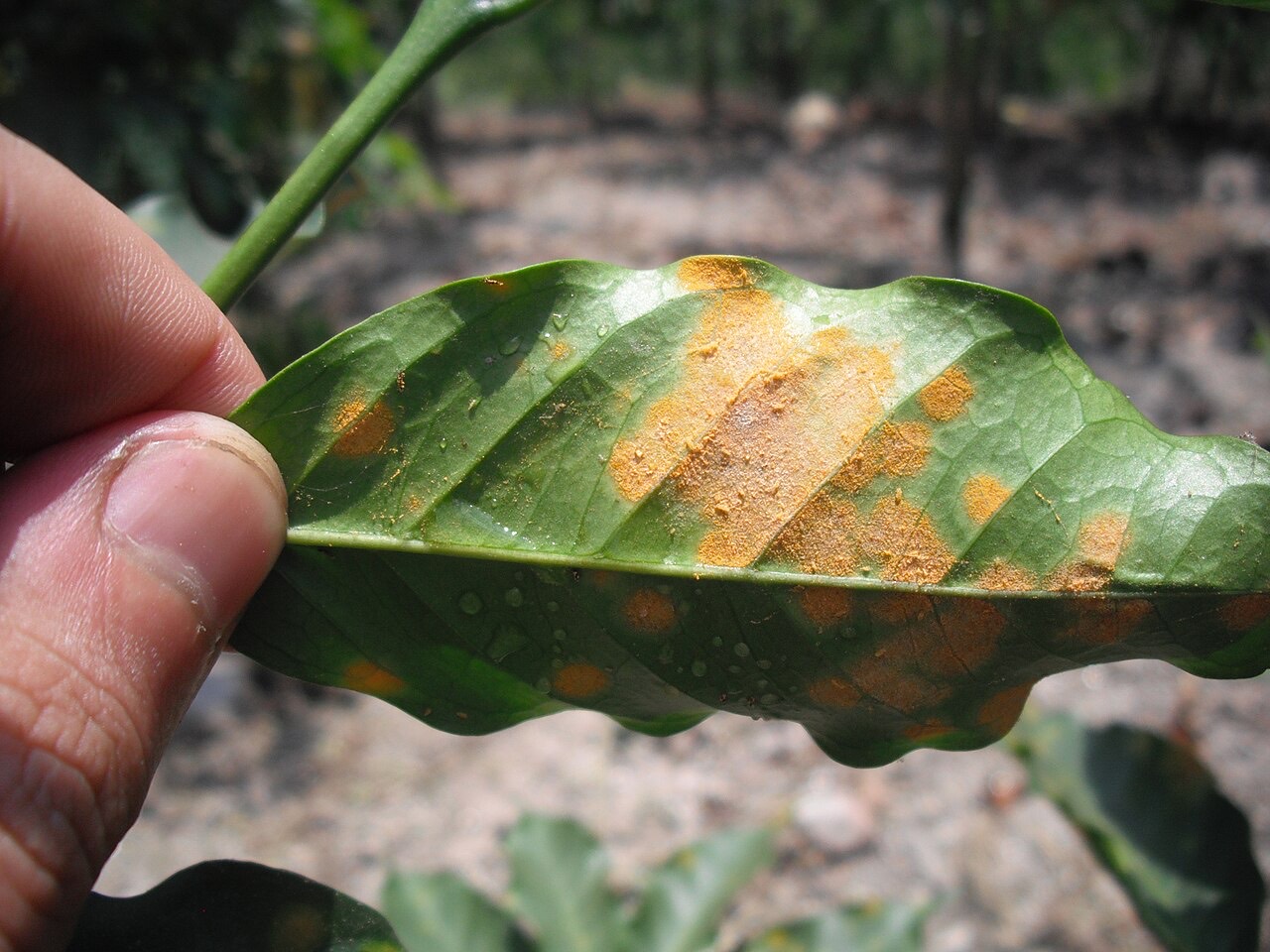
Coffee leaf rust, caused by Hemileia vastatrix, is one of the most significant diseases of coffee worldwide. It produces characteristic powdery, orange-yellow pustules on the underside of leaves, and heavy infection causes premature leaf drop that weakens trees and reduces yield.
Arabica coffee is generally more susceptible than robusta coffee, though susceptibility also varies by cultivar and by the numerous known races of the pathogen. Shade management, plant nutrition, and prevailing weather all influence how severely an outbreak develops in a given season.
Identification
Yellow-orange, powdery pustules develop mainly on the underside of leaves, with corresponding pale yellow spots visible on the upper surface. Heavily infected leaves drop prematurely, progressively thinning the canopy and reducing the tree's capacity to fill developing cherries.
Biology and disease cycle
Spores are dispersed mainly by wind and rain splash and germinate in the presence of free moisture on the leaf surface. Hemileia vastatrix is an obligate parasite requiring living coffee tissue, and repeated infection cycles can build up over a growing season under warm, humid conditions.
- Free moisture on leaves, from rain or dew, is needed for spore germination and infection
- Wind carries spores between plants and can move inoculum across a plantation and beyond
- Numerous distinct races of the pathogen exist, affecting which cultivars remain resistant over time
Affected hosts
Coffee is the host of Hemileia vastatrix. Arabica coffee is generally more susceptible than robusta coffee, and susceptibility varies further among individual cultivars and with the pathogen races present locally.
Risk factors
- Warm temperatures combined with humidity and leaf wetness from rain or dew
- Dense, heavily shaded, or poorly ventilated plantings that retain leaf moisture
- Susceptible cultivars
- Plant stress from heavy bearing loads or inadequate nutrition, which can reduce resilience
Prevention and monitoring
Because coffee leaf rust depends on leaf wetness and can build up over a season, prevention combines cultivar choice, canopy and shade management, and maintaining tree vigour through balanced nutrition.
- Plant rust-resistant cultivars where suited to the region and market
- Manage shade levels and plant density to improve airflow and reduce leaf wetness duration
- Maintain balanced plant nutrition to support tree vigour and resilience
- Monitor and prune to remove severely affected leaves and improve canopy conditions
Relationships
Evidence-backed connections in the knowledge graph.
Affects
Risk increases under
Related topics
Scope & limitations
Geographic scope: Widespread in coffee-growing regions worldwide, with severity varying by climate, cultivar, shade management, and the pathogen races present locally.
Climate context: Favoured by warm temperatures combined with humidity and leaf wetness from rain or dew; shade and canopy management influence how much leaf wetness accumulates on a given planting.
- This is a general overview and does not replace field diagnosis or region-specific extension guidance.
- Pathogen races and cultivar resistance shift over time and by region; consult local authorities and breeding programmes for current status.
- Control-product recommendations are jurisdiction-specific and are deliberately not provided here.
Sources
This article draws on the following authoritative sources. See our sources & methodology for how they are selected.
- [1]CABI Digital Library — Crop Protection Compendium (opens in a new tab)High
CABI (Centre for Agriculture and Bioscience International)
Cited for: Pathogen biology, disease cycle, and host range
- Type:
- Reference database
- Jurisdiction:
- Global
- Accessed:
- 2026-07-12
- [2]EPPO Global Database (opens in a new tab)Authoritative
European and Mediterranean Plant Protection Organization (EPPO)
Cited for: Pathogen nomenclature and distribution
- Type:
- Reference database
- Jurisdiction:
- Global
- Accessed:
- 2026-07-12
Cited for: Coffee disease research and management context
- Type:
- Research institute
- Jurisdiction:
- Global
- Accessed:
- 2026-07-12
- [4]FAO — Food and Agriculture Organization (opens in a new tab)Authoritative
Food and Agriculture Organization of the United Nations (FAO)
Cited for: Global coffee production and disease context
- Type:
- Intergovernmental organization
- Jurisdiction:
- Global
- Accessed:
- 2026-07-12