Plant Disease · Plant disease
Black Sigatoka
Pseudocercospora fijiensis (syn. Mycosphaerella fijiensis)
Also known as: Black leaf streak disease
Black Sigatoka, also known as black leaf streak disease, is a major fungal foliar disease of banana caused by Pseudocercospora fijiensis. It progressively destroys leaf tissue, reducing photosynthetic capacity, plant vigour, and bunch yield and quality, and is favoured by warm, humid, rainy conditions.
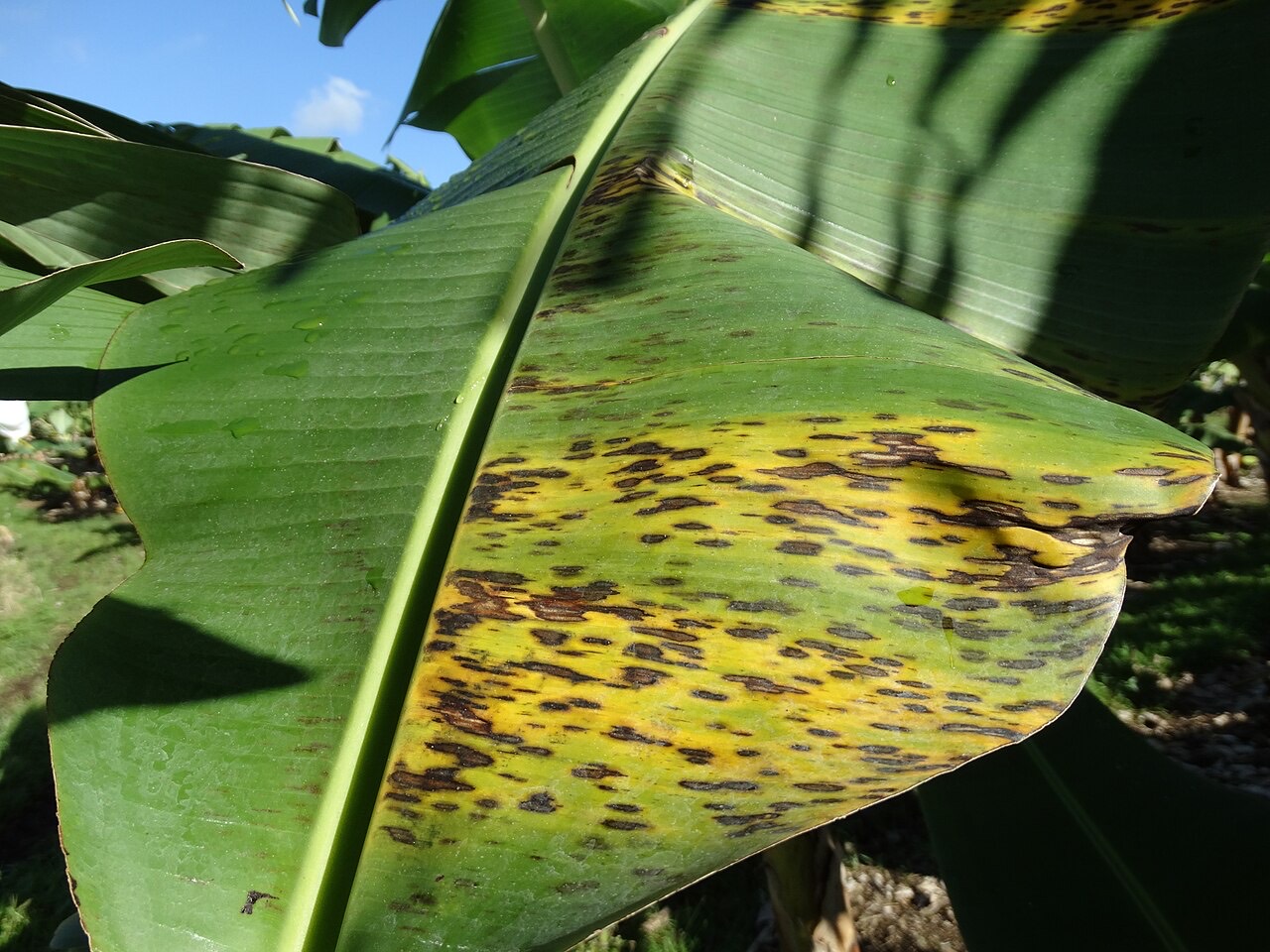
Black Sigatoka, caused by the fungus Pseudocercospora fijiensis, is one of the most economically significant diseases of banana worldwide. It progressively damages leaf tissue, reducing the plant's ability to photosynthesise and fill developing bunches.
Because banana plants continuously produce new leaves in warm, humid climates, the disease can cycle repeatedly through the growing period, and susceptibility varies considerably between banana genotypes, with some dessert cultivars particularly vulnerable.
Identification
Initial symptoms appear as light streaks on leaves that develop into dark brown to black elongated lesions, often surrounded by yellow halos. Under heavy disease pressure, lesions coalesce into large necrotic areas that can destroy most of the leaf surface.
Biology and disease cycle
The fungus produces both airborne ascospores and rain-splashed conidia, both contributing to spread within and between plantations. Infection requires a period of leaf wetness after spores land, and the disease cycles repeatedly through the season on the continuously produced new leaves typical of banana.
- Airborne ascospores can travel between plants and plantations
- Rain-splashed conidia spread the fungus over shorter distances within a plantation
- Continuous new leaf production in favourable climates allows year-round disease cycling
Affected hosts
Banana is the primary host of black Sigatoka. Susceptibility varies considerably between genotypes, with some dessert banana cultivars highly susceptible and some other types showing greater tolerance.
Risk factors
- Warm temperatures combined with high humidity and frequent rainfall
- Dense plantings and closed canopies that retain leaf wetness
- Susceptible cultivars
- Poor field drainage contributing to prolonged canopy humidity
Prevention and monitoring
Because black Sigatoka cycles continuously in favourable climates, management combines cultivar choice, sanitation, and canopy conditions that reduce leaf wetness duration.
- Use less-susceptible cultivars where suited to the local market
- Remove and destroy heavily infected leaves to reduce inoculum
- Manage plant density and field drainage to improve airflow and reduce leaf wetness duration
- Follow regional forecasting or warning systems where available
Relationships
Evidence-backed connections in the knowledge graph.
Affects
Risk increases under
Related topics
Scope & limitations
Geographic scope: Widespread in tropical and subtropical banana-growing regions worldwide, with severity varying by climate, cultivar, and plantation management.
Climate context: Favoured by warm temperatures combined with high humidity and frequent rainfall, which supports both spore production and the leaf wetness needed for infection.
- This is a general overview and does not replace field diagnosis or region-specific extension guidance.
- Cultivar susceptibility and appropriate management vary by banana type and production system and are not detailed here.
- Control-product recommendations are jurisdiction-specific and are deliberately not provided here.
Sources
This article draws on the following authoritative sources. See our sources & methodology for how they are selected.
- [1]CABI Digital Library — Crop Protection Compendium (opens in a new tab)High
CABI (Centre for Agriculture and Bioscience International)
Cited for: Pathogen biology, disease cycle, and host range
- Type:
- Reference database
- Jurisdiction:
- Global
- Accessed:
- 2026-07-12
- [2]EPPO Global Database (opens in a new tab)Authoritative
European and Mediterranean Plant Protection Organization (EPPO)
Cited for: Pathogen nomenclature and distribution
- Type:
- Reference database
- Jurisdiction:
- Global
- Accessed:
- 2026-07-12
Cited for: Banana disease research and management context
- Type:
- Research institute
- Jurisdiction:
- Global
- Accessed:
- 2026-07-12
- [4]FAO — Food and Agriculture Organization (opens in a new tab)Authoritative
Food and Agriculture Organization of the United Nations (FAO)
Cited for: Global banana production and disease context
- Type:
- Intergovernmental organization
- Jurisdiction:
- Global
- Accessed:
- 2026-07-12