Crop · Beverage crop
Coffee
Coffea arabica and Coffea canephora (robusta)
Coffee is a perennial tropical shrub grown for its seeds (beans), cultivated mainly as Coffea arabica in cooler highland areas and Coffea canephora (robusta) in warmer lowland areas, often under shade in smallholder systems.
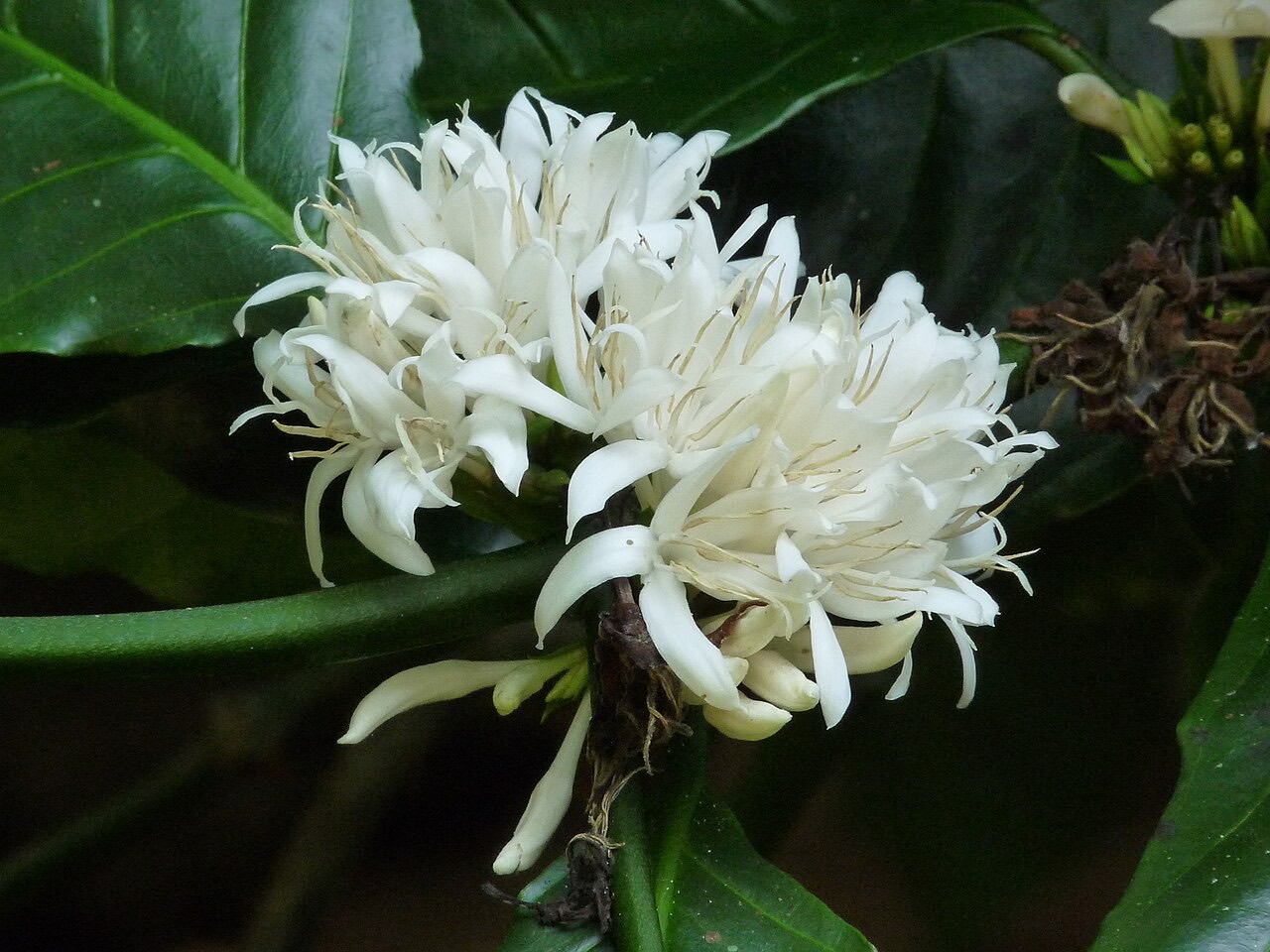
Coffee is grown as a long-lived perennial shrub, typically pruned and trained to a manageable height for hand-picking of the fruit (cherries), each of which usually contains two seeds that are processed, dried, and roasted to produce the familiar beans.
The two commercially dominant species differ in growing requirements and cup character: Coffea arabica is generally grown at higher elevations with cooler temperatures, while Coffea canephora (robusta) tolerates warmer, lower-elevation conditions and is generally more disease-tolerant but considered lower in cup quality by some markets.
Overview
Coffee is grown across the tropical belt by a mix of smallholder farmers, who produce a large share of the global crop, and larger commercial estates, often on hillside or highland terrain where cooler temperatures suit arabica in particular.
Production systems range from shade-grown coffee under a canopy of taller trees to more open, sun-grown plantations, with shade systems often associated with additional on-farm tree products and biodiversity benefits.
Botanical classification
- Family
- Rubiaceae (madder family)
- Genus
- Coffea
- Principal species
- Coffea arabica (arabica) and Coffea canephora (robusta)
- Growth habit
- Evergreen perennial shrub or small tree, commonly pruned to a manageable picking height in cultivation
Origin and distribution
Coffea arabica originates from the highlands of Ethiopia, while Coffea canephora originates from lowland forests of Central and West Africa; both species were subsequently spread through trade and colonial-era plantations to tropical regions across Asia and the Americas.
Today coffee is grown across the tropical belt, with major production in Latin America, Sub-Saharan Africa, and Asia.
Climate requirements
Arabica coffee generally performs best at higher elevations within the tropics, where cooler temperatures slow cherry ripening and are associated with higher cup quality, while robusta tolerates warmer, lower-elevation conditions and is generally hardier under heat and some diseases.
Both species require well-distributed rainfall through most of the year, and prolonged drought or unusually high temperatures during flowering and fruit development can reduce yield and quality.
Soil requirements
Coffee is often associated with fertile volcanic soils, valued for their depth, drainage, and mineral content, though it is also grown successfully on well-drained loam soils elsewhere. Coffee generally prefers acidic soil conditions.
Plantation establishment and management
New plantings are established from selected cultivars raised in nurseries, with spacing and shade-tree arrangement set according to species, elevation, and whether a shade-grown or sun-grown system is used.
- Species and cultivar selection matched to elevation, disease pressure, and market requirements
- Shade-tree management in agroforestry-style shade-grown systems
- Pruning to maintain picking height and renew productive wood
- Long-term orchard floor and soil-conservation management on sloping terrain
Nutrient considerations
Nitrogen supports vegetative growth and yield, and coffee is generally grown on acidic soils that support nutrient availability suited to the crop. Soil pH is closely monitored, since it affects the availability of both macronutrients and micronutrients.
Water and irrigation
Coffee is grown both rain-fed, in regions with well-distributed rainfall, and under supplemental irrigation elsewhere, with water stress during flowering and cherry development having the greatest effect on yield and bean quality.
Drip irrigation is used in some intensive plantations to apply water precisely to the root zone while limiting excess canopy humidity that can favor foliar disease.
Common diseases and pests
Coffee leaf rust is one of the most economically important diseases of coffee, capable of causing severe defoliation and yield loss, particularly in susceptible arabica plantings, while anthracnose-type diseases can affect leaves, stems, and cherries. Mealybugs and scale insects are common sap-feeding pests that can weaken plants and promote sooty mold.
Management combines resistant or tolerant cultivars where available, shade and canopy management, monitoring, and — where justified — locally authorized control products applied according to their labels.
Harvest
Coffee cherries are typically hand-picked, often selectively over multiple passes to harvest only ripe fruit, though mechanical and strip harvesting are used in some larger, more level plantations. Harvested cherries are processed promptly by wet or dry methods to produce dried green beans.
Uses
- Roasted whole and ground beans for brewed coffee beverages
- Instant and soluble coffee products
- By-products such as cherry pulp and parchment used in composting or, in some regions, novel food and beverage products
- Shade trees in agroforestry coffee systems providing additional timber, fruit, or fuelwood
What this page covers
genus conceptThis page covers coffee as a crop. Commercial coffee is two species with different biology — arabica and robusta — and both have their own pages; a third, liberica, is grown in small quantities and is held as a taxon.
The page covers several cultivated species of one genus. Each is a real, separately verifiable taxon; the page exists because the trade name covers all of them.
| Taxon | In this corpus | Role |
|---|---|---|
| Coffea arabicaArabica coffee | held as a verified taxon | Most of the specialty and filter trade. Tetraploid and self-fertile, grown at altitude. |
| Coffea canephoraRobusta coffee | held as a verified taxon | Most of the soluble trade. Diploid and self-incompatible, grown in the lowlands. |
| Coffea libericaLiberica coffee | held as a verified taxon — listed in the taxa register, no page of its own | A small third species, grown mainly in parts of Southeast Asia and West Africa. |
When a taxon here earns its own page: A species earns its own page when the agronomy, disease profile and trade of that species cannot be stated at genus level without being wrong about the others. Arabica and robusta met that in Wave 32; liberica did not, because the published record on it is thin.
Botanical identity
Genus-level crop concept- Accepted name
- CoffeaL.
- Family
- Rubiaceae
- Genus
- Coffea
- Harvested part
- seed
- Agricultural use
- beverage
- Crop group
- Beverage crops
What the authorities say
Commercial coffee is two species, not one. Coffea arabica accounts for most of the specialty trade and Coffea canephora (robusta) for most of the soluble trade; they differ in ploidy, caffeine content, disease resistance and the altitude they are grown at. Both are held separately with verified identities, as is Coffea liberica. Naming one as "coffee" would be wrong about roughly forty per cent of world production.
- Arabica and robusta differ agronomically in almost every respect that matters: arabica is tetraploid, self-fertile, grown at altitude and susceptible to coffee leaf rust; robusta is diploid, self-incompatible, lowland and more resistant.
Botanical identity here is what the consulted taxonomic authorities publish, on the date they were read. Where authorities disagree, both readings are shown rather than one being chosen silently.
Traded as
This crop is traded as 2 distinct commodities, which are graded and priced separately.
What AgricultureID holds for this crop
- 17 crop calendar records
- 3 pests and diseases naming this crop as a host
- 2 soil references
- 2 climate references
- 228 market price series
- 2 related crops
Not held
- No published cultivars — not researched
- No official variety registrations — source exists not mapped
- No verified extension resources — source exists not ingested
- No farm economics observations — source exists not mapped
An absence here means this corpus holds no such record, not that none exists.
How to read figures on this page
Production, area and trade figures for any crop change from season to season and are compiled by FAO and by national agricultural statistics agencies. Take current numbers from those primary sources, dated to the period you mean, rather than from a secondary summary — including this one.
Crop water requirements are estimated from reference evapotranspiration and local climate data, following methods published by FAO and national agricultural agencies. A requirement quoted without the reference method and the local climate behind it is not a number that can be applied to a field.
Related crops
- Same crop concept
- Arabica Coffee, Robusta Coffee
Planting and harvest calendar
Usual sowing and harvest windows across 17 jurisdictions, covering coffee and coffee — season 1 and coffee — season 2.
Tools for this
Each tool shows its formula, constants and sources, and starts empty — nothing is filled in from this page.
- Seed-rate calculator
Convert a target plant stand into a seed rate, allowing for germination and establishment.
- Row spacing calculator
Work out in-row spacing and plants per metre of row for a target density.
- Production, area and yield calculator
Relate a harvested area and a yield to a production total, in either direction.
- Growing degree-days calculator
Accumulate heat units against a base temperature.
Relationships
Evidence-backed connections in the knowledge graph.
Susceptible to
Nutrients required
Suitable soils
Irrigation methods
Farming systems
Related topics
Harvested commodities
The traded commodities harvested from this crop. A commodity is the harvested lot, described by its own quality, grading, and storage evidence — not by the agronomy of the plant.
- Coffee CherriesCoffee cherries are the fresh fruit picked from the coffee tree — a perishable commodity with a life measured in hours. They must reach processing the same day, because the sugary pulp begins fermenting immediately and defects formed here follow the coffee to the cup.
- Green CoffeeGreen coffee is the dried, hulled coffee seed: the form in which coffee crosses borders, sits in warehouses, and is priced on world markets. It is a storable commodity graded by origin, screen size, defect count, and cup quality.
Scope & limitations
Geographic scope: Global overview of tropical production, spanning highland arabica and lowland robusta growing regions.
Climate context: Tropical perennial shrub; arabica favors cooler highland elevations, robusta warmer lowland conditions.
- Elevation, shade system, and species/cultivar choice are highly site-specific and are not detailed here.
- Production and trade statistics change annually and should be taken from primary datasets such as FAOSTAT.
Sources
This article draws on the following authoritative sources. See our sources & methodology for how they are selected.
- [1]FAO — Food and Agriculture Organization (opens in a new tab)Authoritative
Food and Agriculture Organization of the United Nations (FAO)
Cited for: Global coffee production and trade context
- Type:
- Intergovernmental organization
- Jurisdiction:
- Global
- Accessed:
- 2026-07-12
- [2]FAOSTAT — FAO statistical database (opens in a new tab)Authoritative
Food and Agriculture Organization of the United Nations (FAO)
Cited for: Production and area statistics
- Type:
- Intergovernmental organization
- Jurisdiction:
- Global
- Accessed:
- 2026-07-12
- [3]CABI Digital Library — Crop Protection Compendium (opens in a new tab)High
CABI (Centre for Agriculture and Bioscience International)
Cited for: Coffee disease and pest compendium data
- Type:
- Reference database
- Jurisdiction:
- Global
- Accessed:
- 2026-07-12
- Authoritative
Cited for: Classification and nomenclature
- Type:
- Reference database
- Jurisdiction:
- United States
- Accessed:
- 2026-07-12
Cited for: Coffee genetic resources and agronomy research
- Type:
- Research institute
- Jurisdiction:
- Global
- Accessed:
- 2026-07-12