Farming System · Farming system
Aquaponics
Also known as: Aquaponic farming
Aquaponics combines recirculating aquaculture (raising fish) with hydroponic plant production in a single integrated system, where fish waste supplies nutrients to plants and the plants help filter water returned to the fish tank.
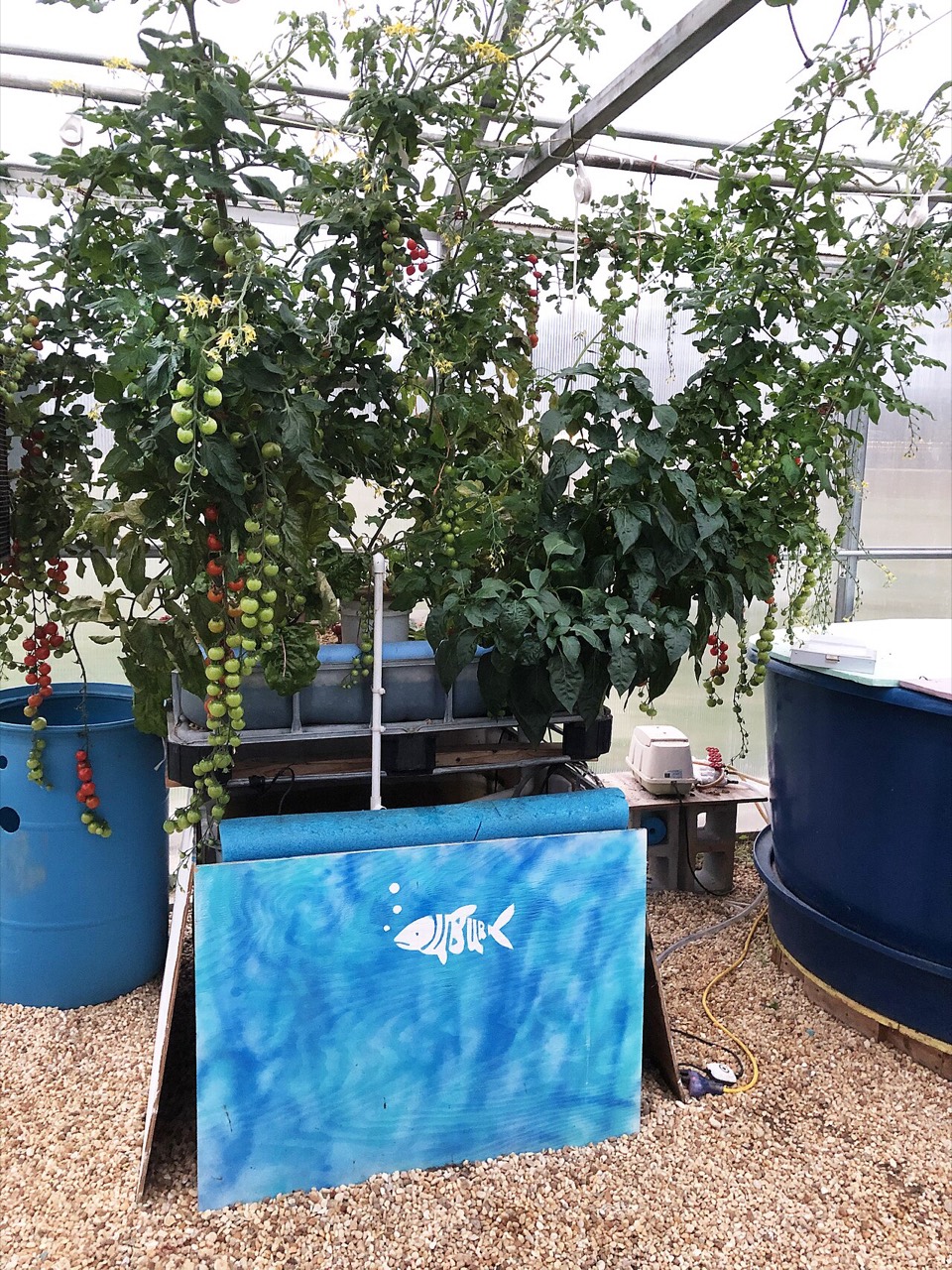
In an aquaponic system, fish are raised in a tank; waste ammonia they excrete is converted by nitrifying bacteria in a biofilter into nitrate and other forms plants can use; nutrient-rich water then flows to plant grow beds, where plants take up nutrients while helping to filter the water; the filtered water is returned to the fish tank to complete the loop.
Running the system well requires balancing fish stocking density and feed rate against the biofilter's nitrifying capacity and the plants' nutrient demand. Aquaponics is distinct from standalone hydroponics, which has no fish component, and from standalone recirculating aquaculture, which has no plant component.
How aquaponics works
- Fish are fed and excrete ammonia-rich waste into the tank water
- Water flows through a biofilter where nitrifying bacteria convert ammonia to nitrite and then nitrate
- Nutrient-rich water is delivered to plant grow beds (media beds or floating rafts)
- Plant roots take up nutrients and help filter the water further
- Filtered water is returned to the fish tank, completing the recirculating loop
This nitrification process is the biological core of the system: without an established, healthy bacterial colony, ammonia can build up to levels harmful to fish.
System components
- Fish tank
- Holds fish and receives their waste as the nutrient source for the system.
- Biofilter
- Provides surface area for nitrifying bacteria that convert fish waste into plant-available nutrients.
- Grow bed
- The plant-growing area, using media, floating rafts, or other soilless techniques.
- Sump and pump
- Circulate water between the fish tank, biofilter, and grow beds to maintain the loop.
Crop and fish choices
Crop and fish choices depend on matching nutrient supply and demand and on water-temperature tolerance. Leafy greens are common because their nutrient needs are often well matched to what fish waste supplies; heavier-feeding crops may need supplemental nutrients such as potassium or iron, since fish waste alone does not always meet every crop's full requirement.
Benefits and trade-offs
- Recirculating design can use water more efficiently than separate soil-based production and pond aquaculture
- Combines two outputs (fish and plants) from a single nutrient and water cycle
- Can be operated in controlled indoor or greenhouse environments year-round
- Requires continuous power for aeration and circulation; equipment failure can quickly harm both fish and plants
- Balancing fish stocking, feed rate, and plant nutrient demand requires ongoing monitoring and skill
- Not all crops or nutrient needs are well matched to fish-waste-derived nutrients without supplementation
Where aquaponics is used
Aquaponics is used in controlled-environment and urban agriculture, research settings, education, and a number of small commercial operations. It generally remains a niche approach relative to conventional soil-based and standalone hydroponic production.
Relationships
Evidence-backed connections in the knowledge graph.
Includes crops
Includes livestock
Scope & limitations
Geographic scope: Used worldwide in controlled environments; system operation is largely independent of outdoor climate, though indoor climate control adds cost.
- Requires continuous power and aeration; system failure risks losses to both fish and plants simultaneously.
- Nutrient balance can be difficult to fully match to crop needs without supplementation, and scaling to commercial volumes is more complex than single-system production.
Sources
This article draws on the following authoritative sources. See our sources & methodology for how they are selected.
- [1]FAO — Food and Agriculture Organization (opens in a new tab)Authoritative
Food and Agriculture Organization of the United Nations (FAO)
Cited for: Aquaponics as an integrated aquaculture-hydroponic system
- Type:
- Intergovernmental organization
- Jurisdiction:
- Global
- Accessed:
- 2026-07-12
- [2]Cornell CALS — Plant pathology and crop resources (opens in a new tab)High
Cornell University College of Agriculture and Life Sciences
Cited for: Controlled-environment and soilless production research
- Type:
- University extension service
- Jurisdiction:
- United States (New York)
- Accessed:
- 2026-07-12
- [3]University of Minnesota Extension — Crop and pest resources (opens in a new tab)High
University of Minnesota Extension
Cited for: Aquaponic system design and management guidance
- Type:
- University extension service
- Jurisdiction:
- United States (Minnesota)
- Accessed:
- 2026-07-12
Cited for: Research context on integrated aquaculture systems
- Type:
- Research institute
- Jurisdiction:
- Global
- Accessed:
- 2026-07-12