Crop · Vegetable crop
Tomato
Solanum lycopersicum (syn. Lycopersicon esculentum)
Also known as: Love apple
Tomato is a fruiting vegetable crop grown worldwide for fresh consumption and processing, cultivated in open-field, high-tunnel, and greenhouse systems across a wide range of climates.
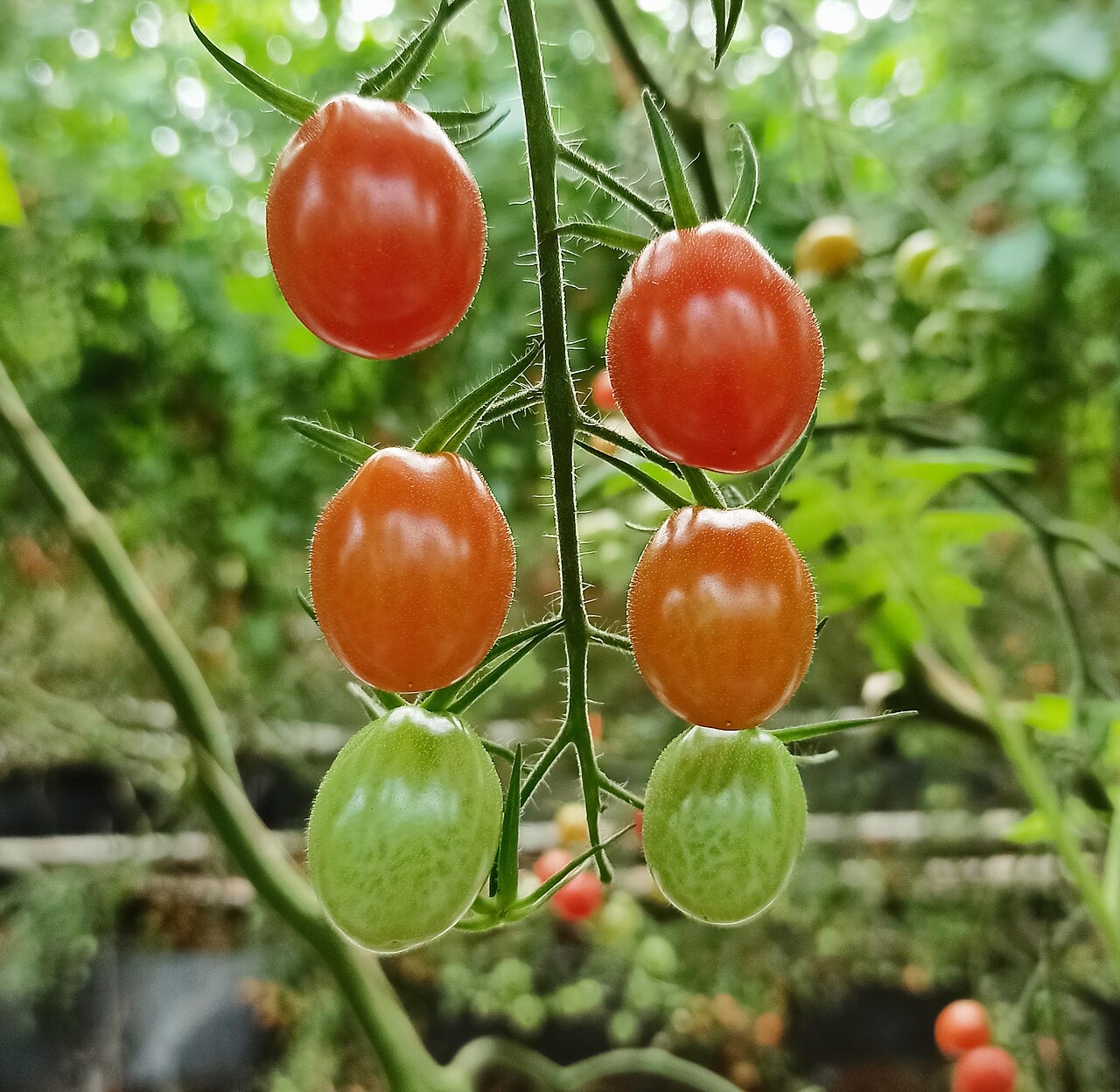
Tomato is one of the most widely grown vegetable crops in the world, produced both for fresh consumption and for processing into sauces, paste, and canned products. Botanically, the fruit is a berry, though it is grown, marketed, and used culinarily as a vegetable.
Tomato plants are classified by growth habit as determinate or indeterminate, a distinction that strongly influences how the crop is staked, pruned, and harvested. Production ranges from open-field systems to intensively managed greenhouse and high-tunnel operations.
Overview
Tomato is grown in an unusually wide range of production systems, from low-input open fields to highly controlled greenhouses, reflecting both its economic importance and its sensitivity to weather during fruit set and ripening.
Cultivars are broadly divided by growth habit and by intended use, such as fresh-market slicing tomatoes, processing tomatoes bred for mechanical harvest, and smaller-fruited types grown for salads and snacking.
Botanical classification
- Family
- Solanaceae (nightshade family)
- Genus and species
- Solanum lycopersicum
- Fruit type
- Botanically a berry, though grown and used as a vegetable
| Growth habit | Plant form | Typical management |
|---|---|---|
| Determinate | Compact plants that stop vegetative growth once flower clusters form at the shoot tip | Often grown with minimal staking; fruit tends to ripen over a shorter period |
| Indeterminate | Continuously growing vine that keeps producing new leaves and flower clusters | Typically staked or trellised; fruit is produced and harvested over an extended period |
Origin and distribution
The wild relatives of cultivated tomato are native to the Andean region of western South America, while domestication is generally attributed to Mesoamerica. Following European contact, tomato spread to Europe and, over subsequent centuries, became established as a major food crop worldwide.
Tomato is now grown across a very wide range of countries and climates, both in open fields and under protected culture.
Climate requirements
Tomato is a warm-season crop sensitive to frost and to chilling injury at low temperatures. Fruit set can also be impaired by temperature extremes at flowering, whether from excessive heat or from cool conditions, which affects pollen viability.
Protected-culture systems such as greenhouses and high tunnels are used in many regions to extend the growing season and buffer against unfavorable outdoor temperatures.
Soil requirements
Tomato performs best on well-drained loams with good structure and steady moisture supply. It is sensitive to waterlogging, which increases the risk of root diseases, and to irregular soil moisture, which is associated with certain fruit-quality disorders.
Establishment and crop management
Tomato is typically established from transplants raised in a nursery, though direct seeding is used in some processing tomato systems. Indeterminate types are commonly staked or trellised and pruned to manage the canopy, while determinate types are often grown more freely.
- Variety selection matched to growth habit, intended use, and local disease pressure
- Crop rotation away from other solanaceous crops to manage soilborne diseases
- Staking, trellising, or pruning systems suited to the growth habit and production scale
- Timely irrigation and mulching to maintain even soil moisture
Nutrient considerations
Tomato requires a balanced supply of nitrogen, phosphorus, and potassium to support vegetative growth and fruit development, with calcium availability also relevant to fruit quality. Requirements depend on soil supply, variety, and production system.
Water and irrigation
Consistent water supply is important throughout the tomato growing cycle, and irregular watering is associated with certain fruit disorders. Both open-field and protected-culture systems commonly use drip irrigation to manage moisture precisely.
Common diseases and pests
Tomato is affected by diseases including late blight, powdery mildew, and Fusarium wilt, whose severity depends on region, variety, and production system. Whiteflies, aphids, and thrips are among the common insect pests, several of which also transmit economically important viruses.
Management typically combines resistant varieties, crop rotation, sanitation, field or greenhouse monitoring, and, where warranted, locally authorized control measures used according to their labels.
Harvest
Harvest maturity depends on the intended market: fresh-market fruit may be picked at a partially ripe stage for later ripening and transport, while fruit for local sale or home use is often left to ripen more fully on the vine. Processing tomatoes are typically harvested at full ripeness, often mechanically, in a single pass.
Uses
- Fresh consumption in salads and cooked dishes
- Processing into sauces, paste, ketchup, and canned products
- Juice and other processed beverages in some markets
- Dried and sun-dried tomato products
Botanical identity
Species- Accepted name
- Solanum lycopersicum
- Family
- Solanaceae
- Genus
- Solanum
- Harvested part
- fruit
- Agricultural use
- human food
- Crop group
- Vegetables
What the authorities say
- World Flora Online — Taxonomic Backbone
- Solanum lycopersicum
- Plants of the World Online
- Solanum lycopersicum
Botanical identity here is what the consulted taxonomic authorities publish, on the date they were read. Where authorities disagree, both readings are shown rather than one being chosen silently.
Traded as
This crop is traded as one commodity in this corpus.
What AgricultureID holds for this crop
- 239 crop calendar records
- 8 published cultivars
- 9 official variety registrations
- 3 verified extension resources
- 26 pests and diseases naming this crop as a host
- 1 soil references
- 367 market price series
- 9 related crops
Not held
- No climate references — not researched
- No farm economics observations — source exists not mapped
An absence here means this corpus holds no such record, not that none exists.
How to read figures on this page
Production, area and trade figures for any crop change from season to season and are compiled by FAO and by national agricultural statistics agencies. Take current numbers from those primary sources, dated to the period you mean, rather than from a secondary summary — including this one.
Crop water requirements are estimated from reference evapotranspiration and local climate data, following methods published by FAO and national agricultural agencies. A requirement quoted without the reference method and the local climate behind it is not a number that can be applied to a field.
Part of
Related crops
- Shared pest and disease pressure
- Common Bean, Maize, Soybean, Sweet Pepper, Wheat
- Same genus
- Eggplant, Gboma Eggplant, Potato, Scarlet Eggplant
Planting and harvest calendar
Usual sowing and harvest windows across 239 jurisdictions, covering tomato and tomato — season 1 and tomato — season 2 and tomato — season 3.
Official extension guidance
3 resources indexed from public extension publishers. Each was written for a particular place; read it at the source.
Factsheet published by University of Maryland Extension for Maryland. It addresses tomato. The source is organised around “Bacterial Spot”, “Bacterial Speck” and “For both diseases”.
University of Maryland Extension · Disease management · publisher states 2023-02-20
Growing Tomatoes in the Home Garden
Factsheet published by Ohio State University Extension for Ohio. It addresses tomato. The source is organised around “Climatic Requirements”, “Site Requirements” and “Suggested Tomato Cultivars to Grow”.
Ohio State University Extension · Crop establishment, Cultivar selection, Disease management · publisher states no date; reachable 2026-08-27
Viral Diseases of Tomato in the Greenhouse
Factsheet published by NC State Extension for North Carolina. It addresses tomato. The source is organised around “General Information”, “Disease Cycle and Epidemiology” and “Disease Management for Commercial Growers”.
NC State Extension · Disease management · publisher states 2021-06-11
These are pointers to guidance published by others. Each was written for a particular place and season and is revised by its publisher; read it at the source, and check it applies where you farm.
Tools for this
Each tool shows its formula, constants and sources, and starts empty — nothing is filled in from this page.
- Seed-rate calculator
Convert a target plant stand into a seed rate, allowing for germination and establishment.
- Row spacing calculator
Work out in-row spacing and plants per metre of row for a target density.
- Production, area and yield calculator
Relate a harvested area and a yield to a production total, in either direction.
- Growing degree-days calculator
Accumulate heat units against a base temperature.
Relationships
Evidence-backed connections in the knowledge graph.
Suitable soils
Notable cultivars
Documented varieties tied to this species, with registry status and sources on each page. Not an exhaustive list.
- BrandywineBrandywine is a late-maturing heirloom beefsteak tomato, best known in a large pink, potato-leaved form, grown on indeterminate plants primarily for fresh use.
- Cherokee PurpleCherokee Purple is an heirloom beefsteak tomato with dusky pink-purple fruit, popularized in the United States in the early 1990s and now a widely grown "black" heirloom.
- Heinz 1706Heinz 1706 is a determinate processing tomato developed within the H. J. Heinz breeding program, best known as the cultivar sequenced for the first high-quality tomato reference genome.
- Micro-TomMicro-Tom is a miniature dwarf tomato released by the University of Florida in 1989 as an ornamental type, later adopted worldwide as a compact model system for tomato research.
- MoneymakerMoneymaker is a heritage English tomato, long popular for glasshouse and garden production, known for uniform, smooth, medium-sized round red fruit on indeterminate plants.
- RomaRoma is a determinate plum (paste) tomato that originated as a mid-twentieth-century United States introduction and has since become a broad, widely grown type name for sauce tomatoes.
- RutgersRutgers is a historic American tomato released in 1934 by the New Jersey Agricultural Experiment Station, bred for both canning and fresh market and long a standard in the eastern United States.
- San MarzanoSan Marzano is a traditional Italian plum (paste) tomato type from the Agro Sarnese-Nocerino area of Campania, prized for canning and sauce and associated with an EU Protected Designation of Origin.
Harvested commodities
The traded commodities harvested from this crop. A commodity is the harvested lot, described by its own quality, grading, and storage evidence — not by the agronomy of the plant.
Scope & limitations
Geographic scope: Global overview. Production system (open field, high tunnel, or greenhouse), variety choice, and pest pressure vary widely by region and are not reduced to universal guidance here.
Climate context: Warm-season crop sensitive to frost and to temperature extremes at flowering; grown in open-field and protected-culture systems across many climates.
- Production system, variety, and staking or trellising method are region- and operation-specific choices not covered by universal values here.
- Disease and pest pressure, including late blight and virus-transmitting insects, varies considerably by region and season.
- Fertilizer and irrigation programs should follow local soil and water testing rather than generic rates.
Sources
This article draws on the following authoritative sources. See our sources & methodology for how they are selected.
- [1]FAO — Food and Agriculture Organization (opens in a new tab)Authoritative
Food and Agriculture Organization of the United Nations (FAO)
Cited for: Role of tomato in global vegetable production
- Type:
- Intergovernmental organization
- Jurisdiction:
- Global
- Accessed:
- 2026-07-12
- [2]FAOSTAT — FAO statistical database (opens in a new tab)Authoritative
Food and Agriculture Organization of the United Nations (FAO)
Cited for: Production, area, and trade statistics
- Type:
- Intergovernmental organization
- Jurisdiction:
- Global
- Accessed:
- 2026-07-12
- Authoritative
Cited for: Classification and nomenclature
- Type:
- Reference database
- Jurisdiction:
- United States
- Accessed:
- 2026-07-12
- [4]UC Statewide Integrated Pest Management Program (UC IPM) (opens in a new tab)High
University of California Agriculture and Natural Resources (UC ANR)
Cited for: Integrated pest management for tomato
- Type:
- University extension service
- Jurisdiction:
- United States (California)
- Accessed:
- 2026-07-12
- [5]Cornell CALS — Plant pathology and crop resources (opens in a new tab)High
Cornell University College of Agriculture and Life Sciences
Cited for: Tomato disease diagnosis and management
- Type:
- University extension service
- Jurisdiction:
- United States (New York)
- Accessed:
- 2026-07-12
- [6]USDA ARS — Agricultural Research Service (opens in a new tab)Authoritative
USDA Agricultural Research Service (ARS)
Cited for: Tomato disease and pest research
- Type:
- Government agency
- Jurisdiction:
- United States
- Accessed:
- 2026-07-12