Crop · Vegetable crop
Lettuce
Lactuca sativa
Also known as: Garden lettuce
Lettuce is a fast-growing annual leafy vegetable grown mainly for fresh salad use, cultivated in open fields, high tunnels, and hydroponic systems across many climates.
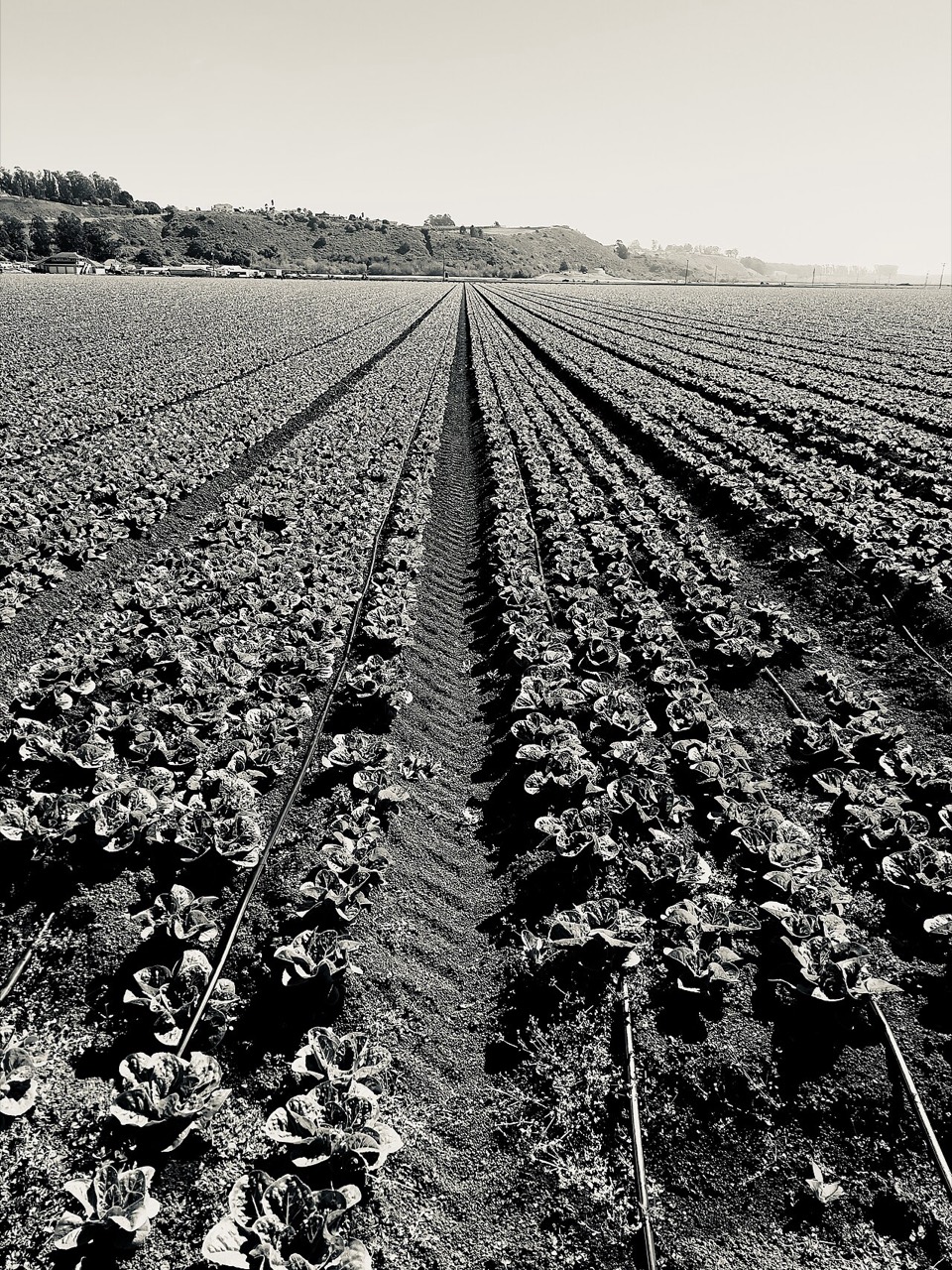
Lettuce is grown for its leaves or compact leafy head, harvested well before the plant would naturally bolt and flower. Types range from crisphead (iceberg) and romaine to loose-leaf and butterhead, each with different growth habits, textures, and production requirements.
The crop has a short growth cycle and a shallow, relatively limited root system, which makes it responsive to management but also sensitive to short-term stress. Lettuce is grown both in open-field systems and increasingly in protected and soilless (hydroponic) production.
Overview
Lettuce is grown across a range of types and systems, from field-grown crisphead lettuce harvested by machine to hydroponically grown leaf and butterhead types marketed as living lettuce or pre-packaged greens.
Because the crop matures quickly and is often grown in successive plantings to maintain continuous supply, timing, spacing, and post-harvest handling are closely managed to align with market demand.
Botanical classification
- Family
- Asteraceae (daisy family)
- Genus and species
- Lactuca sativa
- Growth habit
- Annual forming a rosette or compact head of leaves; bolts to a flowering stalk under long days and heat
- Common types
- Crisphead, romaine, butterhead, loose-leaf, and stem (celtuce) types
Origin and distribution
Cultivated lettuce is derived from wild Lactuca species native to the Mediterranean and Near East, with cultivation recorded in antiquity in Egypt and later spreading through the Mediterranean, Europe, and eventually worldwide.
Lettuce is now grown across a very wide range of countries and production systems.
Climate requirements
Lettuce is a cool-season crop that grows best within a moderate temperature range; heat and long day length together trigger bolting, in which the plant elongates and flowers, ending marketable leaf or head production.
Because bolting sensitivity varies by cultivar, cultivar selection and planting timing are matched to local season length, and protected culture is used in many regions to extend production into warmer or cooler periods.
Soil requirements
Lettuce performs best on fertile, well-drained loams and sandy loams with high organic matter content and reliable moisture-holding capacity, reflecting its shallow root system and rapid growth rate.
Establishment and crop management
Lettuce is established from direct seeding or transplants, often in successive plantings spaced over time to provide continuous harvest. Because the crop competes poorly with weeds during its short cycle, early weed control is important.
- Cultivar selection matched to bolting tolerance and intended production season
- Successive plantings to spread harvest over an extended period
- Close spacing management appropriate to head or leaf type
- Prompt weed control given the crop’s short growing cycle and shallow rooting
Nutrient considerations
Nitrogen availability strongly influences leaf growth rate and quality, while calcium availability in the growing tissue is linked to tipburn, a physiological leaf-margin disorder. Requirements depend on soil or nutrient-solution supply, cultivar, and production system.
Water and irrigation
Because of its shallow root system and high water content, lettuce requires frequent, consistent irrigation; moisture stress can reduce quality and increase the risk of tipburn and bitterness. Drip and sprinkler irrigation are both used in field production.
Common diseases and pests
Downy mildew is a major foliar disease of lettuce in cool, humid conditions, and gray mold (Botrytis) can affect leaves and heads, particularly under damp conditions or in storage. Aphids, cutworms, and slugs are among the common pests affecting establishment and leaf quality.
Management combines resistant cultivars, sanitation, field or greenhouse monitoring, and, where warranted, locally authorized control measures applied according to their labels.
Harvest
Lettuce is harvested at the target leaf or head size before bolting begins, either by cutting the whole head or plant or by repeated leaf picking in cut-and-come-again systems. Rapid post-harvest cooling is important to maintain quality given the crop’s high water content and perishability.
Uses
- Fresh use in salads, sandwiches, and as a garnish
- Pre-cut and packaged salad and salad-mix products
- Cooked or grilled use in some cuisines
- Living lettuce sold with roots intact from hydroponic systems in some markets
Botanical identity
Species- Accepted name
- Lactuca sativa
- Family
- Asteraceae
- Genus
- Lactuca
- Harvested part
- leaf
- Agricultural use
- human food
- Crop group
- Vegetables
What the authorities say
- World Flora Online — Taxonomic Backbone
- Lactuca sativa
- Plants of the World Online
- Lactuca sativa
Botanical identity here is what the consulted taxonomic authorities publish, on the date they were read. Where authorities disagree, both readings are shown rather than one being chosen silently.
Traded as
This crop is traded as one commodity in this corpus.
No ingested price series for these commodities yet.
What AgricultureID holds for this crop
- 142 crop calendar records
- 1 verified extension resources
- 7 pests and diseases naming this crop as a host
- 2 soil references
- 1 climate references
- 1 related crops
Not held
- No published cultivars — not researched
- No official variety registrations — source exists not mapped
- No farm economics observations — source exists not mapped
- No market price series — source exists not mapped
An absence here means this corpus holds no such record, not that none exists.
How to read figures on this page
Production, area and trade figures for any crop change from season to season and are compiled by FAO and by national agricultural statistics agencies. Take current numbers from those primary sources, dated to the period you mean, rather than from a secondary summary — including this one.
Crop water requirements are estimated from reference evapotranspiration and local climate data, following methods published by FAO and national agricultural agencies. A requirement quoted without the reference method and the local climate behind it is not a number that can be applied to a field.
Part of
Related crops
- Shared pest and disease pressure
- Cabbage
Planting and harvest calendar
Usual sowing and harvest windows across 142 jurisdictions, covering lettuce and lettuce — season 1 and lettuce — season 2.
Official extension guidance
1 resource indexed from public extension publishers. Each was written for a particular place; read it at the source.
Factsheet published by NC State Extension for North Carolina. It addresses lettuce. The source is organised around “Cultivation Options in Lettuce”, “Herbicide Options in Lettuce” and “Preplant and Preemergence”.
NC State Extension · Soil preparation, Weed management · publisher states no date; reachable 2026-08-27
These are pointers to guidance published by others. Each was written for a particular place and season and is revised by its publisher; read it at the source, and check it applies where you farm.
Authorised inputs (France)
The French register records 130 currently authorised products whose authorised use names this crop, held by 63 authorisation holders. This is a count of what exists on the register, not a recommendation and not a shortlist.
By function
- Fongicide 84
- Insecticide 28
- Herbicide 10
- Stimul. Déf. Plantes - Maladies 4
- Acaricide 2
- Stimulateur des défenses naturelles 1
Targets named on the register
- Mildiou(s) 39
- Pourriture grise et sclérotinioses 24
- Chenilles phytophages 18
- Bactériose(s) 12
- Champignons (autres que pythiacées) 11
- Stimul. Déf. Plantes - Maladies 9
Use scope is recorded as the register writes it. Collective terms cover several crops at once and are left unmapped rather than expanded, because expanding one entry into several would invent authorisations that were never granted.
Authorisation is specific to one jurisdiction, one legal object and one moment. It is not a recommendation, and it says nothing about how a product may be used: always read the current official label at the source before acting.
Tools for this
Each tool shows its formula, constants and sources, and starts empty — nothing is filled in from this page.
- Seed-rate calculator
Convert a target plant stand into a seed rate, allowing for germination and establishment.
- Row spacing calculator
Work out in-row spacing and plants per metre of row for a target density.
- Production, area and yield calculator
Relate a harvested area and a yield to a production total, in either direction.
- Growing degree-days calculator
Accumulate heat units against a base temperature.
Relationships
Evidence-backed connections in the knowledge graph.
Susceptible to
Suitable soils
Climate sensitivity
Irrigation methods
Managed with
Farming systems
Harvested commodities
The traded commodities harvested from this crop. A commodity is the harvested lot, described by its own quality, grading, and storage evidence — not by the agronomy of the plant.
Scope & limitations
Geographic scope: Global overview. Cultivar bolting tolerance, production system, and input levels are region- and system-specific.
Climate context: Cool-season leafy vegetable prone to bolting under heat and long days; grown in open fields, protected culture, and hydroponic systems.
- Bolting sensitivity and planting timing are cultivar- and region-specific and are not reduced to universal guidance here.
- Nutrient-solution and fertility programs in soilless systems differ substantially from soil-based recommendations.
- Disease and pest control should follow locally authorized guidance and product labels.
Sources
This article draws on the following authoritative sources. See our sources & methodology for how they are selected.
- [1]FAO — Food and Agriculture Organization (opens in a new tab)Authoritative
Food and Agriculture Organization of the United Nations (FAO)
Cited for: Role of lettuce in global vegetable production
- Type:
- Intergovernmental organization
- Jurisdiction:
- Global
- Accessed:
- 2026-07-12
- [2]FAOSTAT — FAO statistical database (opens in a new tab)Authoritative
Food and Agriculture Organization of the United Nations (FAO)
Cited for: Production, area, and trade statistics
- Type:
- Intergovernmental organization
- Jurisdiction:
- Global
- Accessed:
- 2026-07-12
- Authoritative
Cited for: Classification and nomenclature
- Type:
- Reference database
- Jurisdiction:
- United States
- Accessed:
- 2026-07-12
- [4]UC Statewide Integrated Pest Management Program (UC IPM) (opens in a new tab)High
University of California Agriculture and Natural Resources (UC ANR)
Cited for: Integrated pest management for lettuce
- Type:
- University extension service
- Jurisdiction:
- United States (California)
- Accessed:
- 2026-07-12
- [5]Cornell CALS — Plant pathology and crop resources (opens in a new tab)High
Cornell University College of Agriculture and Life Sciences
Cited for: Lettuce production and disease guidance
- Type:
- University extension service
- Jurisdiction:
- United States (New York)
- Accessed:
- 2026-07-12