Livestock · Livestock
Camels
Camelus dromedarius (dromedary); Camelus bactrianus (Bactrian)
Also known as: Dromedary, Bactrian camel
Camels are large, foregut-fermenting livestock adapted to arid and semi-arid environments, raised for milk, meat, transport, and fibre. The single-humped dromedary dominates hot desert regions, while the two-humped Bactrian camel is kept in colder Central Asian rangelands.
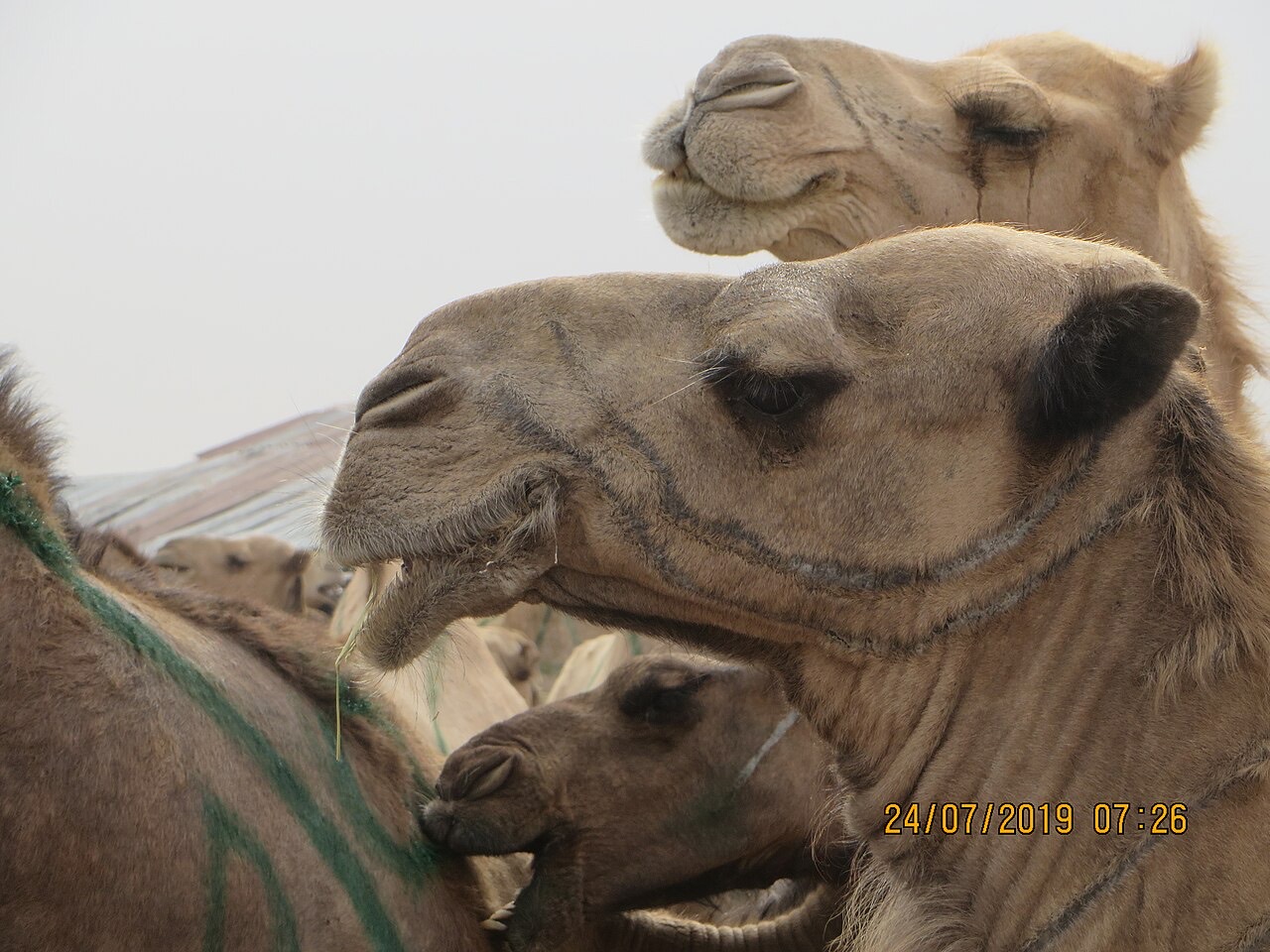
Camels are pseudo-ruminants: they ferment plant material in a three-chambered stomach, in contrast to the four compartments of true ruminants such as cattle and water buffalo. Two domesticated species are kept — the single-humped dromedary (Camelus dromedarius), found across hot desert and semi-arid regions of North Africa, the Middle East, and South Asia, and the two-humped Bactrian camel (Camelus bactrianus), adapted to the colder, drier rangelands of Central Asia.
Camels are prized above all for their capacity to produce milk and sustain work in hot, arid, and forage-scarce environments where other livestock struggle, drawing on efficient water use, tolerance of browse on thorny and saline plants, and an ability to withstand extended periods without water. Beyond pastoral herding, camels are increasingly kept in peri-urban dairies supplying fresh camel milk to urban markets.
Overview
Camel production is most developed in arid and semi-arid parts of Africa, the Middle East, and Asia, where the species supports pastoral livelihoods through milk, meat, and transport. Dromedaries dominate hot desert regions, while Bactrian camels and dromedary–Bactrian hybrids are kept in colder Central Asian environments.
Types and breeds
- Dairy-type dromedaries
- Regional breeds selected or managed for higher milk yield, increasingly supplying peri-urban dairies.
- Riding and pack dromedaries
- Types bred and trained for transport, racing, or pack work.
- Bactrian camel
- Two-humped species adapted to cold, dry Central Asian rangelands, used for milk, fibre, and transport.
Regional breed and genetic diversity is documented internationally, including through FAO’s Domestic Animal Diversity Information System (DAD-IS).
Nutrition and feeding
Camels are adapted to browse a wide range of shrubs, trees, and grasses, including thorny and salt-tolerant plants that many other livestock avoid, and can travel long distances between forage and water sources. In pastoral systems, feeding relies almost entirely on natural rangeland vegetation, while peri-urban and more intensive dairy operations increasingly supplement forage with concentrate feeds to support higher milk yields.
Health and welfare
Camel health and welfare depend on adequate access to forage and water even in arid environments, appropriate handling given the animal’s size and temperament, and management of diseases and parasites relevant to the species and region.
Production context
Camels allow productive use of arid and semi-arid land unsuitable for most other livestock or crops, underpinning pastoral livelihoods across large parts of Africa and Asia. Growing interest in camel milk for urban and export markets is expanding more intensive dairy operations alongside traditional pastoral herding.
Relationships
Evidence-backed connections in the knowledge graph.
Climate sensitivity
Commonly raised in
Scope & limitations
Geographic scope: Concentrated in arid and semi-arid Africa, the Middle East, South Asia, and Central Asia; breeds, systems, and regulations vary by country and region.
Climate context: Camels are adapted to hot, arid environments (dromedary) or cold, dry rangelands (Bactrian), tolerating drought and water scarcity better than most livestock.
- This is a general species overview, not breed-, system-, or region-specific husbandry guidance.
- Health, medicine, and welfare practices are governed by local regulation and veterinary advice and are not detailed here.
Sources
This article draws on the following authoritative sources. See our sources & methodology for how they are selected.
- [1]FAO — Food and Agriculture Organization (opens in a new tab)Authoritative
Food and Agriculture Organization of the United Nations (FAO)
Cited for: Camel production systems and global role
- Type:
- Intergovernmental organization
- Jurisdiction:
- Global
- Accessed:
- 2026-07-12
- [2]DAD-IS — Domestic Animal Diversity Information System (opens in a new tab)Authoritative
FAO Commission on Genetic Resources for Food and Agriculture
Cited for: Camel breeds and genetic diversity
- Type:
- Official registry
- Jurisdiction:
- Global
- Accessed:
- 2026-07-12
- [3]WOAH — World Organisation for Animal Health (opens in a new tab)Authoritative
World Organisation for Animal Health (WOAH)
Cited for: Animal health and welfare standards
- Type:
- Intergovernmental organization
- Jurisdiction:
- Global
- Accessed:
- 2026-07-12
- [4]National Academies Press — Nutrient Requirements series (opens in a new tab)High
National Research Council, U.S. National Academies
Cited for: Nutrient requirement references
- Type:
- Peer-reviewed literature
- Jurisdiction:
- Global
- Accessed:
- 2026-07-12