Crop · Cereal crop
Sorghum
Sorghum bicolor
Also known as: Milo, Great millet, Guinea corn
Sorghum is a warm-season cereal grass valued for its drought and heat tolerance, grown for grain, forage, and sweet-stalk products across semi-arid and tropical regions.
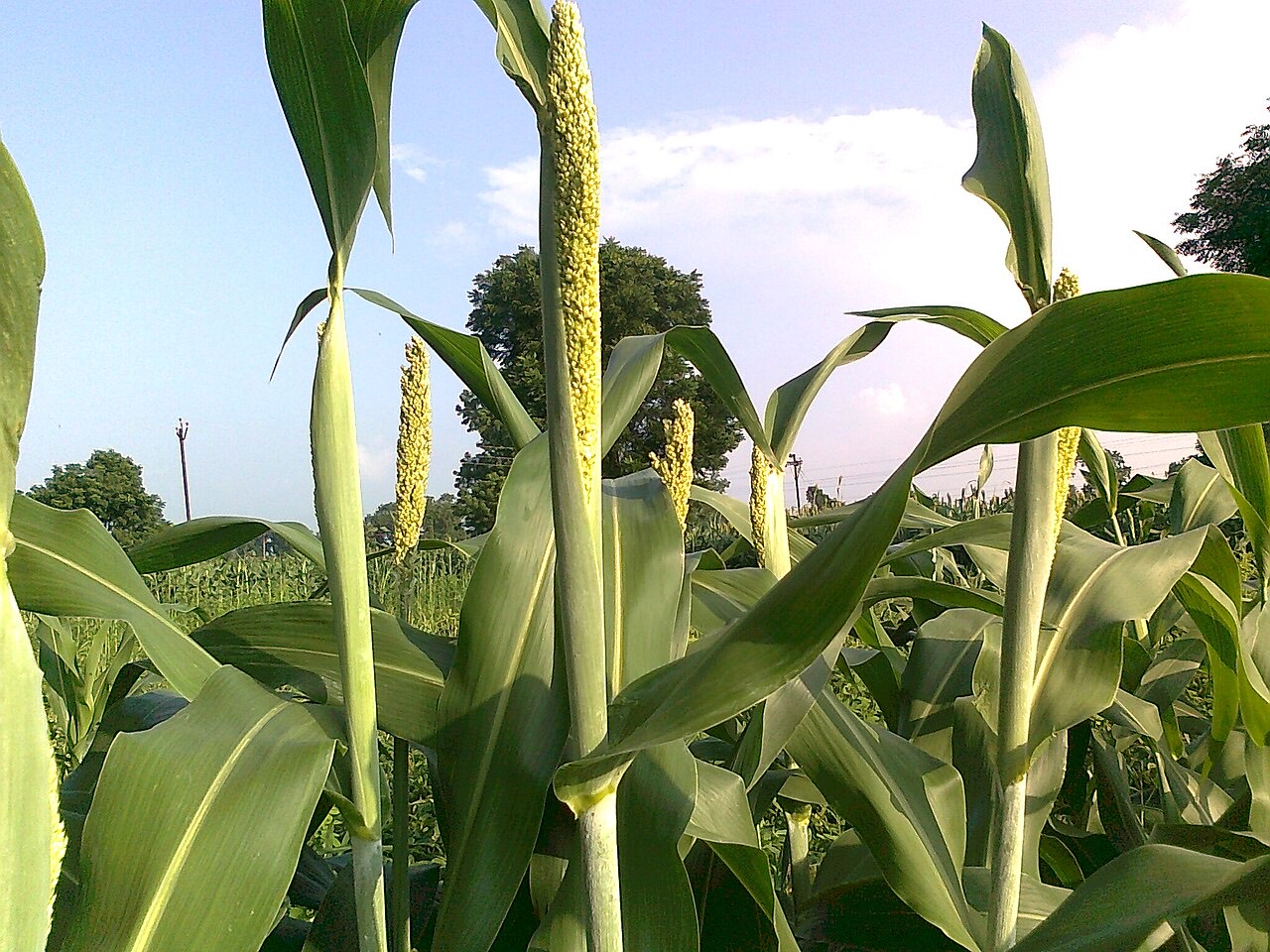
Sorghum is a warm-season cereal grass notable for its ability to produce a reliable crop under drier and hotter conditions than many other cereals, making it a staple food grain across parts of Africa and Asia and a major feed and industrial grain crop in the Americas.
As a C4 grass, sorghum uses water and nitrogen relatively efficiently, and its physiological drought-avoidance traits, including the ability to reduce water loss under stress and resume growth once moisture returns, underpin much of its reputation as a resilient crop in semi-arid environments.
Overview
Sorghum is grown across a wide range of production systems, from subsistence food-grain farming in semi-arid Africa and Asia to large-scale mechanized grain and forage production in the Americas and Australia.
Because input requirements are often lower than for crops such as maize, sorghum is frequently grown on more marginal or moisture-limited land, though it also responds well to more favorable growing conditions and inputs where they are available.
Botanical classification
- Family
- Poaceae (grass family)
- Genus
- Sorghum
- Principal species
- Sorghum bicolor
- Growth habit
- Warm-season annual grass producing a terminal panicle of grain, using C4 photosynthesis
Origin and distribution
Sorghum was domesticated in northeastern Africa, in the region spanning present-day Sudan and Ethiopia, several thousand years ago, and subsequently spread across Africa and into South Asia before later introduction to the Americas.
Sorghum remains a staple food grain in parts of Africa and Asia and is a major feed and industrial grain crop in the Americas.
Climate requirements
Sorghum is a warm-season crop, sensitive to frost and cool soil temperatures at planting, but notably tolerant of heat and drought once established, relative to many other cereal crops.
This drought tolerance reflects a deep root system and physiological mechanisms that reduce water loss under moisture stress, allowing the crop to resume growth once conditions improve rather than failing outright.
Soil requirements
Sorghum is adaptable to a wide range of soils, including loams and silt loams, and shows somewhat greater tolerance of marginal conditions, including transient waterlogging and moderate salinity, than many other cereals.
Establishment and crop management
Sorghum is sown once soils have warmed sufficiently in spring or early summer, into a firm, shallow seedbed suited to its relatively small seed size, with seeding rate and row spacing set locally according to moisture availability and end use.
- Variety selection matched to grain, forage, or sweet-sorghum end use
- Crop rotation to manage soil-borne pests and diseases
- Timely weed control during early crop establishment
- Seedbed preparation suited to local tillage and moisture conditions
Nutrient considerations
Nitrogen strongly influences grain yield and tillering, while phosphorus supports early root establishment. Overall input requirements are often lower than for maize, reflecting sorghum's comparatively efficient water and nutrient use.
Water and irrigation
Sorghum is predominantly grown under rain-fed conditions in semi-arid production regions, where its drought tolerance is a key advantage relative to more water-demanding cereals. It is also grown under irrigation, including sprinkler systems, in higher-input production systems.
Even with its drought tolerance, adequate moisture during flowering and grain fill remains important for maximizing yield potential.
Common diseases and pests
Anthracnose is a major foliar and stalk disease of sorghum in many production regions, and sorghum downy mildew is a classic disease particularly associated with humid or tropical growing conditions. Aphids, including species with a broad host range across grasses, and fall armyworm are among the key insect pests affecting sorghum.
Management combines resistant hybrids and varieties, rotation, monitoring, and — where justified — locally authorized control products applied according to their labels.
Harvest
Grain sorghum is harvested with a combine-harvester once the grain has matured and dried to a moisture content suitable for safe storage, while forage and silage types are cut at a growth stage matched to their intended feeding use.
Uses
- Food grain, especially in parts of Africa and Asia
- Livestock feed grain, particularly in the Americas
- Forage, silage, and hay production
- Sweet sorghum for syrup, and grain sorghum for industrial and brewing uses
Botanical identity
Species- Accepted name
- Sorghum bicolor
- Family
- Poaceae
- Genus
- Sorghum
- Harvested part
- grain, forage biomass
- Agricultural use
- human food, animal feed, forage, bioenergy
- Crop group
- Cereals
What the authorities say
- World Flora Online — Taxonomic Backbone
- Sorghum bicolor
- Plants of the World Online
- Sorghum bicolor
- The name Sorghum bicolor is a homonym: more than one published name matches it exactly, and they resolve to different taxa. The accepted one was selected; Sorghum bicolor Kuntze.
Botanical identity here is what the consulted taxonomic authorities publish, on the date they were read. Where authorities disagree, both readings are shown rather than one being chosen silently.
Traded as
This crop is traded as one commodity in this corpus.
What AgricultureID holds for this crop
- 203 crop calendar records
- 1 published cultivars
- 1 verified extension resources
- 15 pests and diseases naming this crop as a host
- 2 soil references
- 2 climate references
- 34 farm economics observations
- 387 market price series
- 6 related crops
Not held
- No official variety registrations — source exists not mapped
An absence here means this corpus holds no such record, not that none exists.
How to read figures on this page
Production, area and trade figures for any crop change from season to season and are compiled by FAO and by national agricultural statistics agencies. Take current numbers from those primary sources, dated to the period you mean, rather than from a secondary summary — including this one.
Crop water requirements are estimated from reference evapotranspiration and local climate data, following methods published by FAO and national agricultural agencies. A requirement quoted without the reference method and the local climate behind it is not a number that can be applied to a field.
Part of
Related crops
Planting and harvest calendar
Usual sowing and harvest windows across 203 jurisdictions, covering s.s. hybrid (sadabahar) and sorghum and sorghum — season 1 and sorghum — season 2.
Cost of production, as forecast
United States national estimates for 2027, published by USDA Economic Research Service.
- Total costs listed
- 476.66 USD
- Dollars per planted acre
- Operating costs
- 191.52 USD
- Dollars per planted acre
- Allocated overhead
- 285.14 USD
- Dollars per planted acre
A forecast of what a crop will cost to grow is not a record of what it cost. It is the source’s expectation for a year that has not finished.
These are costs only. The source publishes no revenue alongside them, so no margin, profit or break-even price is derived from them here.
Official extension guidance
1 resource indexed from public extension publishers. Each was written for a particular place; read it at the source.
Sweet Sorghum Production to Support Energy and Industrial Products
Factsheet published by NC State Extension for North Carolina. It addresses sorghum. The source is organised around “What is Sweet Sorghum?”, “Sweet Sorghum Characteristics” and “Preplanting Operations”.
NC State Extension · Crop establishment, Nutrient management, Irrigation, Weed management · publisher states 2024-05-22
These are pointers to guidance published by others. Each was written for a particular place and season and is revised by its publisher; read it at the source, and check it applies where you farm.
Authorised inputs (France)
The French register records 26 currently authorised products whose authorised use names this crop, held by 14 authorisation holders. This is a count of what exists on the register, not a recommendation and not a shortlist.
By function
- Herbicide 22
- Insecticide 3
- Fongicide 1
Targets named on the register
- Ravageurs du sol (1) 2
- Chenilles phytophages (1) 1
- Champignons (autres que pythiacées) (1) 1
Use scope is recorded as the register writes it. Collective terms cover several crops at once and are left unmapped rather than expanded, because expanding one entry into several would invent authorisations that were never granted.
Authorisation is specific to one jurisdiction, one legal object and one moment. It is not a recommendation, and it says nothing about how a product may be used: always read the current official label at the source before acting.
Tools for this
Each tool shows its formula, constants and sources, and starts empty — nothing is filled in from this page.
- Seed-rate calculator
Convert a target plant stand into a seed rate, allowing for germination and establishment.
- Row spacing calculator
Work out in-row spacing and plants per metre of row for a target density.
- Production, area and yield calculator
Relate a harvested area and a yield to a production total, in either direction.
- Growing degree-days calculator
Accumulate heat units against a base temperature.
Relationships
Evidence-backed connections in the knowledge graph.
Susceptible to
Nutrients required
Climate sensitivity
Irrigation methods
Machinery
Managed with
Farming systems
Notable cultivars
Documented varieties tied to this species, with registry status and sources on each page. Not an exhaustive list.
Harvested commodities
The traded commodities harvested from this crop. A commodity is the harvested lot, described by its own quality, grading, and storage evidence — not by the agronomy of the plant.
Scope & limitations
Geographic scope: Global overview. Variety choice and input levels vary widely between subsistence and commercial production systems.
Climate context: Warm-season C4 cereal notably tolerant of drought and heat relative to many other cereal crops.
- Sowing dates, seeding rates, and input levels are region-specific decisions not covered by universal values here.
- Production statistics change annually and should be taken from primary datasets such as FAOSTAT.
Sources
This article draws on the following authoritative sources. See our sources & methodology for how they are selected.
- [1]FAO — Food and Agriculture Organization (opens in a new tab)Authoritative
Food and Agriculture Organization of the United Nations (FAO)
Cited for: Global sorghum production and food-security role
- Type:
- Intergovernmental organization
- Jurisdiction:
- Global
- Accessed:
- 2026-07-12
- [2]FAOSTAT — FAO statistical database (opens in a new tab)Authoritative
Food and Agriculture Organization of the United Nations (FAO)
Cited for: Production and area statistics
- Type:
- Intergovernmental organization
- Jurisdiction:
- Global
- Accessed:
- 2026-07-12
- Authoritative
Cited for: Classification and nomenclature
- Type:
- Reference database
- Jurisdiction:
- United States
- Accessed:
- 2026-07-12
- [4]USDA ARS — Agricultural Research Service (opens in a new tab)Authoritative
USDA Agricultural Research Service (ARS)
Cited for: Sorghum breeding and disease research
- Type:
- Government agency
- Jurisdiction:
- United States
- Accessed:
- 2026-07-12
- [5]CABI Digital Library — Crop Protection Compendium (opens in a new tab)High
CABI (Centre for Agriculture and Bioscience International)
Cited for: Sorghum disease and pest compendium data
- Type:
- Reference database
- Jurisdiction:
- Global
- Accessed:
- 2026-07-12