Livestock · Livestock
Donkeys
Equus africanus asinus
Also known as: Domestic donkey, Ass, Burro
Donkeys are monogastric hindgut-fermenting equids kept worldwide as working animals for pack and draught power, transport, and, in some regions, milk. Descended from the African wild ass, they are especially well adapted to hot, dry, and marginal environments.
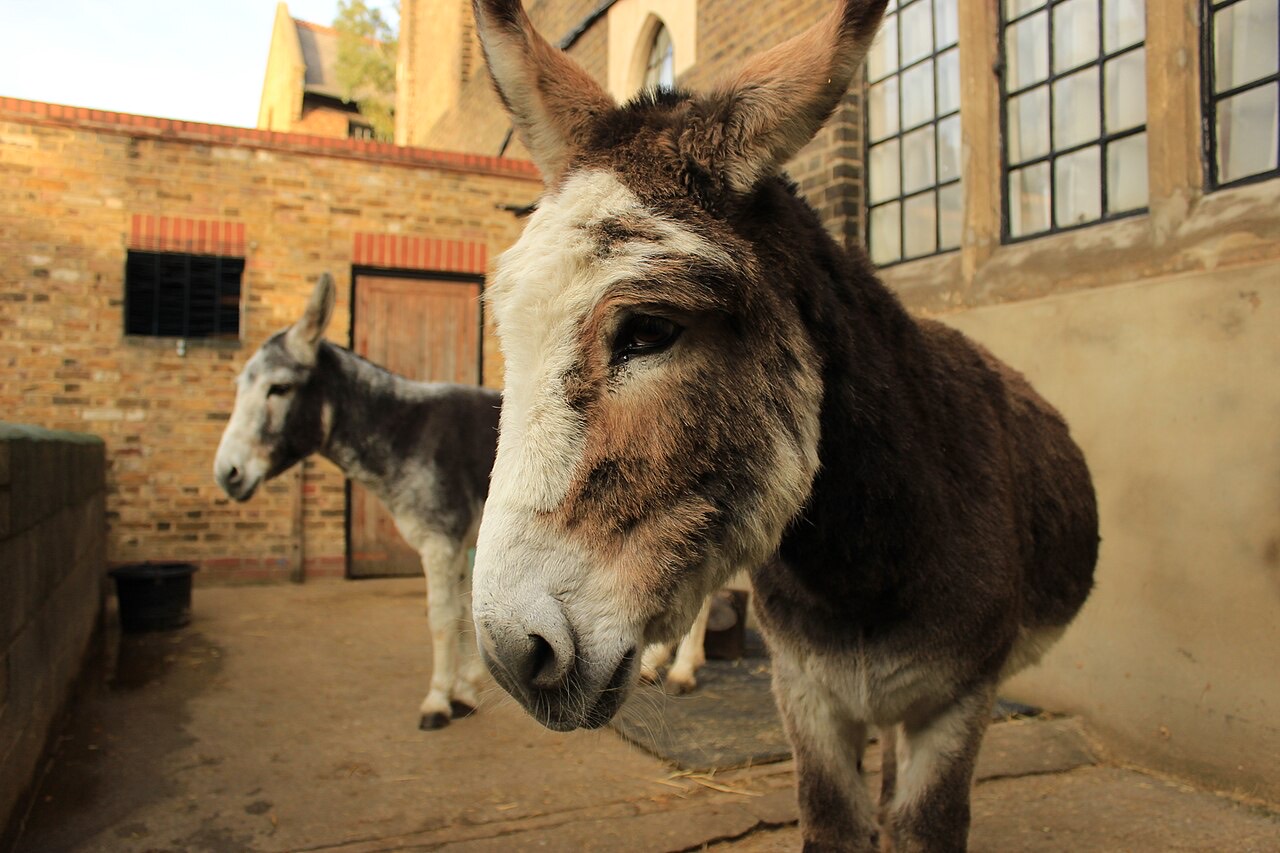
The domestic donkey (Equus africanus asinus) descends from the African wild ass and, like horses, is a monogastric hindgut fermenter: it has a single stomach but relies on an enlarged caecum and colon to ferment fibrous plant material after digestion in the stomach and small intestine. Donkeys are generally smaller and hardier than horses, with a long history of use as pack and draught animals in arid and mountainous regions where feed and water can be scarce.
Millions of donkeys remain essential working animals in smallholder and rural livelihoods worldwide, carrying goods, water, and produce, and providing draught power for cultivation and transport where mechanisation is limited or impractical. A smaller-scale dairy and meat sector also exists in some regions, alongside donkeys kept for companionship or conservation of local breeds.
Overview
Donkeys remain widely kept as working animals in rural and smallholder economies, particularly where terrain, cost, or infrastructure limit the use of motorised transport and machinery. Their role ranges from carrying water and goods to providing draught power for tillage and haulage in mixed farming systems.
Types and uses
- Pack and draught donkeys
- The most common working role worldwide, carrying loads or pulling carts and implements.
- Dairy donkeys
- Kept in some regions for milk, valued in niche markets and, historically, for infant feeding where other milk was unavailable.
- Local and landrace types
- Regionally adapted, often hardy types suited to local terrain, climate, and smallholder use.
Breed and type diversity is documented internationally, including through FAO’s Domestic Animal Diversity Information System (DAD-IS), which records equine breeds and their status by country.
Nutrition and feeding
Donkeys are efficient at extracting nutrition from coarse, fibrous, and lower-quality forage compared with horses, reflecting their origin in arid and semi-arid environments with sparse vegetation. This efficiency means donkeys in light work can be prone to excess weight gain on rich pasture, while working or lactating animals need forage supplemented with additional energy and protein.
Health and welfare
Donkey health and welfare depend on consistent access to forage and water, appropriate shelter, routine hoof care, and workloads and equipment suited to the animal’s size and condition. Donkeys can mask signs of pain or illness more readily than horses, which makes routine observation and handler awareness particularly important.
Production context
Donkeys support smallholder livelihoods by reducing labour burdens for transport and cultivation, particularly for households without access to tractors or fuel. Global demand for donkey hides in some markets has also raised welfare and population concerns in several donkey-keeping regions, an issue tracked by international animal health and welfare bodies.
Relationships
Evidence-backed connections in the knowledge graph.
Climate sensitivity
Commonly raised in
Scope & limitations
Geographic scope: Global overview; uses, systems, and regulations vary widely by country and region, with concentrations in Africa, Asia, and Latin America.
Climate context: Donkeys are well adapted to hot, dry, and marginal environments and are kept across a wide range of climates worldwide.
- This is a general species overview, not region- or use-specific working-animal management guidance.
- Health, medicine, and welfare practices are governed by local regulation and veterinary advice and are not detailed here.
Sources
This article draws on the following authoritative sources. See our sources & methodology for how they are selected.
- [1]FAO — Food and Agriculture Organization (opens in a new tab)Authoritative
Food and Agriculture Organization of the United Nations (FAO)
Cited for: Donkeys as working animals and role in agriculture
- Type:
- Intergovernmental organization
- Jurisdiction:
- Global
- Accessed:
- 2026-07-12
- [2]DAD-IS — Domestic Animal Diversity Information System (opens in a new tab)Authoritative
FAO Commission on Genetic Resources for Food and Agriculture
Cited for: Donkey breeds and genetic diversity
- Type:
- Official registry
- Jurisdiction:
- Global
- Accessed:
- 2026-07-12
- [3]WOAH — World Organisation for Animal Health (opens in a new tab)Authoritative
World Organisation for Animal Health (WOAH)
Cited for: Animal health and welfare standards
- Type:
- Intergovernmental organization
- Jurisdiction:
- Global
- Accessed:
- 2026-07-12
- [4]National Academies Press — Nutrient Requirements series (opens in a new tab)High
National Research Council, U.S. National Academies
Cited for: Nutrient requirement references
- Type:
- Peer-reviewed literature
- Jurisdiction:
- Global
- Accessed:
- 2026-07-12