Crop · Forage crop
Alfalfa
Medicago sativa
Also known as: Lucerne
Alfalfa is a deep-rooted, nitrogen-fixing perennial legume grown primarily as hay and forage for livestock. Stands can remain productive for several years, with multiple cuttings taken each season.
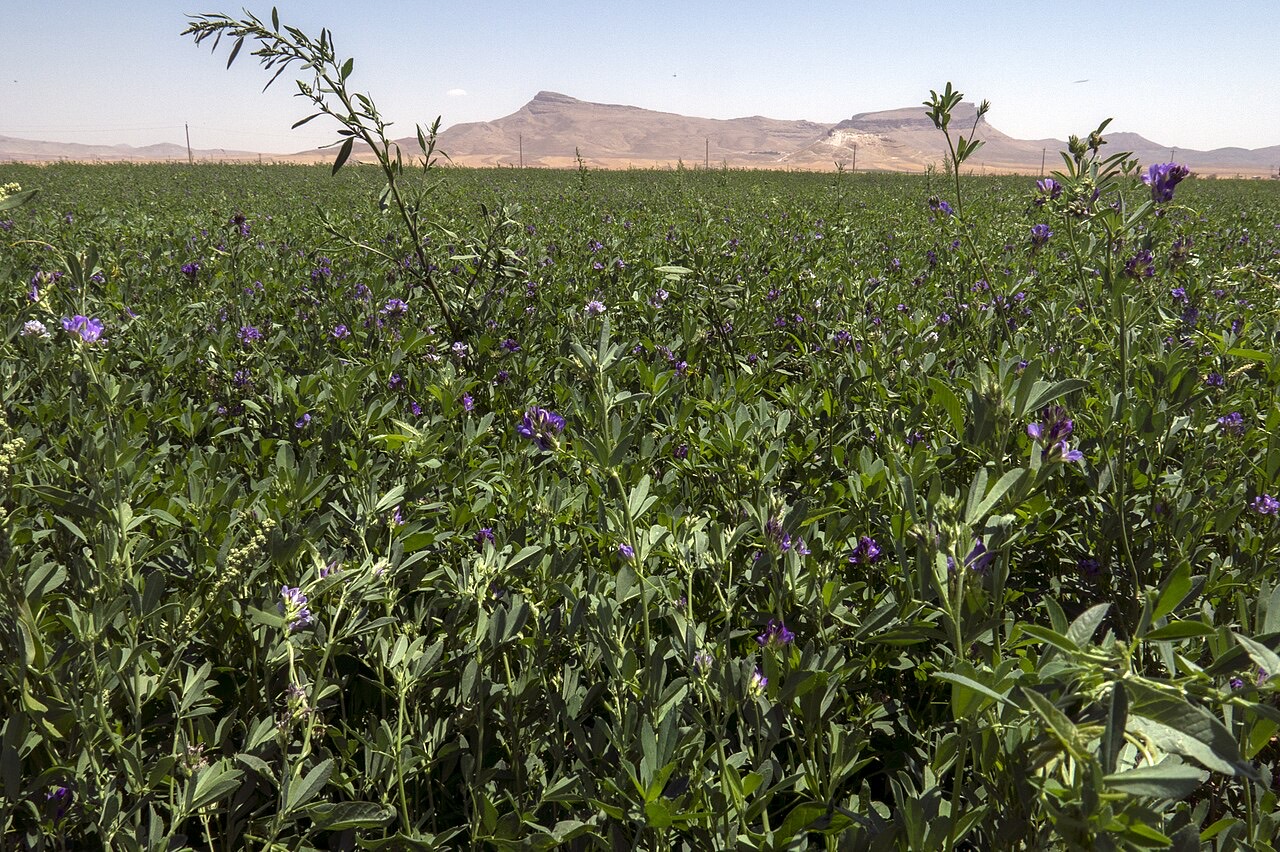
Alfalfa, also known as lucerne in many regions, is a perennial forage legume valued for its high protein content, palatability, and yield across repeated cuttings within a season. Its deep taproot allows it to access moisture and nutrients from lower in the soil profile than many shallower-rooted crops.
As a legume, alfalfa forms a symbiotic relationship with nitrogen-fixing rhizobia bacteria in root nodules, allowing the crop to meet much of its own nitrogen requirement rather than depending on applied nitrogen fertilizer.
Overview
Alfalfa is one of the most widely grown forage legumes, valued by livestock producers for its high yield and forage quality across multiple cuttings per growing season. It is also an important rotation crop, contributing organic matter and residual soil nitrogen to subsequent crops.
Because a well-managed stand can remain productive for several years, establishment decisions such as variety selection, inoculation, and seedbed preparation have a lasting influence on stand performance.
Botanical classification
- Family
- Fabaceae (legume family)
- Genus
- Medicago
- Principal species
- Medicago sativa
- Growth habit
- Deep-rooted perennial legume forming symbiotic nitrogen-fixing root nodules with rhizobia bacteria
Origin and distribution
Alfalfa is believed to have originated in the region encompassing present-day Iran and Central Asia, where it was domesticated in antiquity, and it spread along historical trade routes into the Mediterranean, Europe, and eventually worldwide.
Alfalfa is now grown across temperate and semi-arid regions on multiple continents as a major forage crop.
Climate requirements
Alfalfa is adapted to a wide range of climates, with dormant and semi-dormant varieties suited to colder regions with pronounced winters, and non-dormant types used in milder or subtropical climates where growth continues over more of the year.
Its deep taproot provides considerable drought tolerance once a stand is established, allowing continued growth under moisture conditions that would stress many shallower-rooted crops.
Soil requirements
Alfalfa performs best on deep, well-drained loam soils with near-neutral to slightly alkaline pH. It is notably intolerant of poor drainage and prolonged waterlogging, which favor root and crown diseases and reduce stand persistence.
Stand establishment and management
Alfalfa is seeded into a firm, well-prepared seedbed, and inoculation with the appropriate rhizobia is recommended where alfalfa has not been grown recently, to help ensure effective nitrogen fixation from the outset.
- Variety selection for winter-hardiness/dormancy class matched to the region
- Seed inoculation with compatible rhizobia where needed
- Cutting schedule balancing yield, forage quality, and stand persistence
- Multi-year stand management, since alfalfa is not replanted annually
Nutrient considerations
As a nitrogen-fixing legume, a well-nodulated alfalfa stand typically requires little or no applied nitrogen. However, repeated hay cuttings remove substantial phosphorus and potassium, which generally need to be replenished based on soil testing to sustain yield and stand health.
Water and irrigation
Alfalfa is grown both rain-fed, where its deep rooting supports reasonable drought tolerance, and under irrigation in arid and semi-arid production regions, where irrigated alfalfa is a major forage crop.
Center-pivot and other pressurized irrigation systems are widely used in irrigated alfalfa production to support consistent yield across multiple cuttings per season.
Common diseases and pests
Root rot, associated with soil-borne pathogens favored by wet, poorly drained conditions, is a major cause of stand decline in alfalfa, while powdery mildew can affect foliage, particularly late in the season. Aphids are significant pests capable of causing direct feeding damage and reducing forage yield, and spider mites can become problematic under hot, dry conditions.
Management combines resistant varieties, attention to drainage at establishment, monitoring, and — where justified — locally authorized control products applied according to their labels.
Harvest
Alfalfa is typically cut for hay at a bud-to-early-bloom growth stage that balances yield against forage quality, with multiple cuttings taken through the growing season depending on climate and management. Proper curing and drying after cutting are important for preserving forage quality before baling or ensiling.
Uses
- Hay and haylage for dairy cattle, beef cattle, and horses
- Pasture and grazing in some production systems
- Pelleted alfalfa products for feed and export markets
- Rotation benefits, including residual soil nitrogen for following crops
Botanical identity
Species- Accepted name
- Medicago sativa
- Family
- Fabaceae
- Genus
- Medicago
- Harvested part
- forage biomass
- Agricultural use
- forage, animal feed, cover crop
- Crop group
- Forage and pasture, Pulses and grain legumes
What the authorities say
- World Flora Online — Taxonomic Backbone
- Medicago sativa
- Plants of the World Online
- Medicago sativa
Botanical identity here is what the consulted taxonomic authorities publish, on the date they were read. Where authorities disagree, both readings are shown rather than one being chosen silently.
What AgricultureID holds for this crop
- 3 crop calendar records
- 1 verified extension resources
- 1 soil references
- 1 climate references
Not held
- No published cultivars — not researched
- No official variety registrations — source exists not mapped
- No pests and diseases naming this crop as a host — source exists not ingested
- No farm economics observations — source exists not mapped
- No market price series — source exists not mapped
- No related crops — not applicable
An absence here means this corpus holds no such record, not that none exists.
How to read figures on this page
Production, area and trade figures for any crop change from season to season and are compiled by FAO and by national agricultural statistics agencies. Take current numbers from those primary sources, dated to the period you mean, rather than from a secondary summary — including this one.
Crop water requirements are estimated from reference evapotranspiration and local climate data, following methods published by FAO and national agricultural agencies. A requirement quoted without the reference method and the local climate behind it is not a number that can be applied to a field.
Part of
Fabaceae — the legume family · Forage and pasture crops · Pulses and grain legumes
Planting and harvest calendar
Usual sowing and harvest windows across 3 jurisdictions, covering alfalfa.
Official extension guidance
1 resource indexed from public extension publishers. Each was written for a particular place; read it at the source.
Grazing Alfalfa in Pennsylvania
Factsheet published by Penn State Extension for Pennsylvania. It addresses alfalfa. The source is organised around “Establishing Alfalfa for Grazing”, “Grazing Management” and “Grazing Periods for Alfalfa”.
Penn State Extension · Crop establishment, Grazing · publisher states 2025-11-21
These are pointers to guidance published by others. Each was written for a particular place and season and is revised by its publisher; read it at the source, and check it applies where you farm.
Tools for this
Each tool shows its formula, constants and sources, and starts empty — nothing is filled in from this page.
- Seed-rate calculator
Convert a target plant stand into a seed rate, allowing for germination and establishment.
- Row spacing calculator
Work out in-row spacing and plants per metre of row for a target density.
- Production, area and yield calculator
Relate a harvested area and a yield to a production total, in either direction.
- Growing degree-days calculator
Accumulate heat units against a base temperature.
Relationships
Evidence-backed connections in the knowledge graph.
Susceptible to
Nutrients required
Suitable soils
Climate sensitivity
Irrigation methods
Machinery
Managed with
Farming systems
Related topics
Scope & limitations
Geographic scope: Global overview. Dormancy class, cutting schedule, and irrigation practice vary widely by region.
Climate context: Deep-rooted perennial legume widely adapted across temperate and semi-arid regions; grown rain-fed or irrigated.
- Variety dormancy class and cutting-schedule specifics are region-specific decisions not covered by universal values here.
- Production statistics change annually and should be taken from primary datasets such as FAOSTAT and USDA NASS.
Sources
This article draws on the following authoritative sources. See our sources & methodology for how they are selected.
- [1]FAO — Food and Agriculture Organization (opens in a new tab)Authoritative
Food and Agriculture Organization of the United Nations (FAO)
Cited for: Global forage legume production context
- Type:
- Intergovernmental organization
- Jurisdiction:
- Global
- Accessed:
- 2026-07-12
- [2]FAOSTAT — FAO statistical database (opens in a new tab)Authoritative
Food and Agriculture Organization of the United Nations (FAO)
Cited for: Production and area statistics
- Type:
- Intergovernmental organization
- Jurisdiction:
- Global
- Accessed:
- 2026-07-12
- Authoritative
Cited for: Classification and nomenclature
- Type:
- Reference database
- Jurisdiction:
- United States
- Accessed:
- 2026-07-12
- [4]USDA ARS — Agricultural Research Service (opens in a new tab)Authoritative
USDA Agricultural Research Service (ARS)
Cited for: Alfalfa breeding and forage research
- Type:
- Government agency
- Jurisdiction:
- United States
- Accessed:
- 2026-07-12
- [5]CABI Digital Library — Crop Protection Compendium (opens in a new tab)High
CABI (Centre for Agriculture and Bioscience International)
Cited for: Alfalfa disease and pest compendium data
- Type:
- Reference database
- Jurisdiction:
- Global
- Accessed:
- 2026-07-12