Livestock · Livestock
Pheasant
Phasianus colchicus
Also known as: Common pheasant, Ring-necked pheasant
Pheasants are farmed game birds raised for meat, for release into hunting estates, and on a smaller scale for eggs. Reared under commercial, small-scale, and release-oriented systems, they form a distinct branch of poultry husbandry linked to game management.
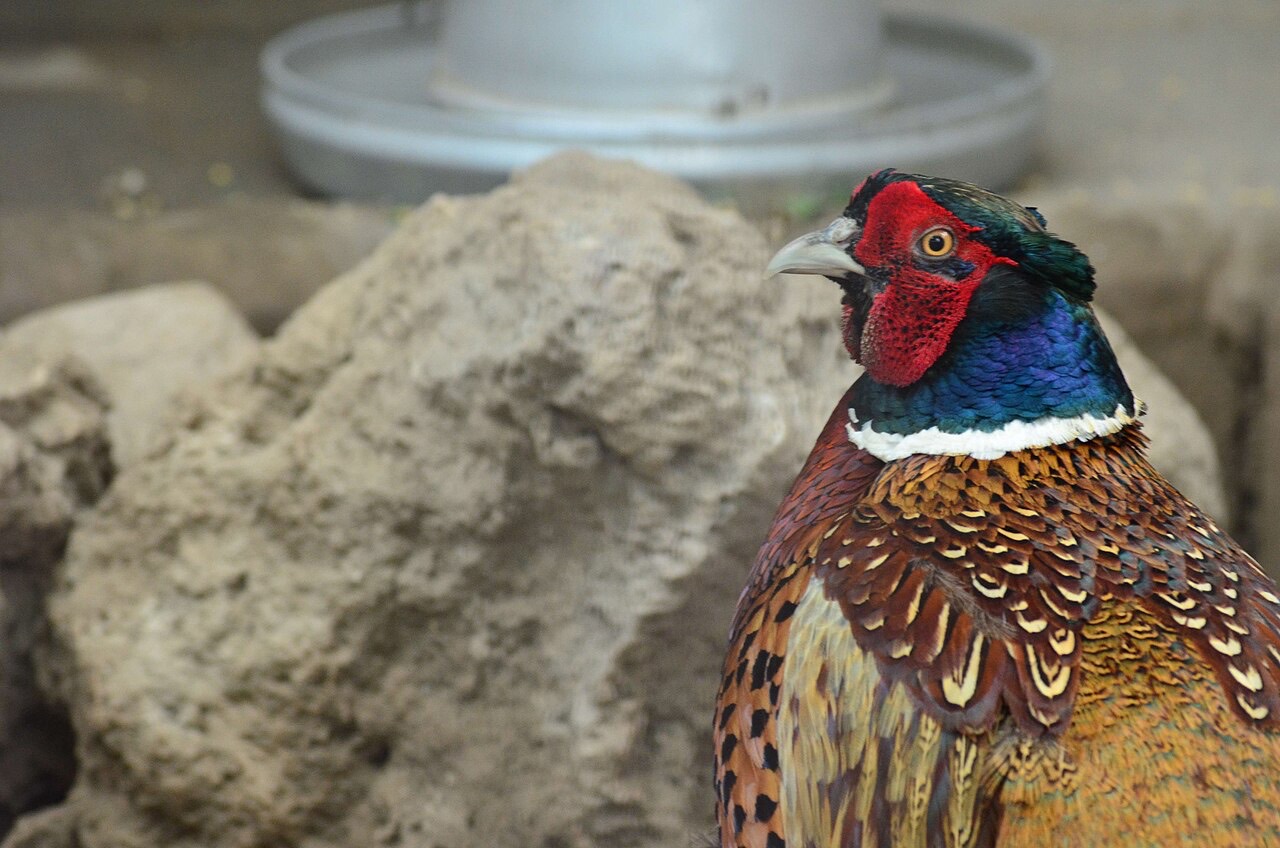
The common or ring-necked pheasant (Phasianus colchicus) is a game bird native to Asia that has been widely introduced and farmed elsewhere, particularly across Europe and North America. Pheasant farming developed largely to supply managed shooting estates with birds for release, alongside a smaller direct market for pheasant meat and, occasionally, eggs.
As monogastric poultry, pheasants are reared on formulated rations similar to other game birds, but husbandry differs from conventional broiler or layer poultry in its emphasis on rearing birds fit for eventual release into semi-wild conditions, including exercise pens and gradual acclimatisation to outdoor cover.
Overview
Pheasant production spans commercial meat farming and, more prominently in many countries, game-bird rearing for release onto managed shooting estates, with the two production goals shaping different rearing practices.
Types and production lines
- Meat production lines
- Birds reared to processing weight for the table market.
- Game-release rearing
- Birds reared in sheds and pens then released for managed shooting.
- Breeding and laying stock
- Maintained to supply eggs and poults for the following season’s rearing.
Nutrition and feeding
Young pheasants are fed formulated starter and grower rations with protein levels matched to rapid early growth; birds destined for release are gradually transitioned toward natural foraging in outdoor pens before being released.
Health and welfare
Rearing-shed biosecurity and disease prevention are important during early growth, while the transition to release pens requires attention to stress, predator exposure, and acclimatisation to outdoor conditions.
Production context
Pheasant rearing is closely linked to game management and woodland habitat, with production timed to align release with regional hunting seasons and with implications for land management on shooting estates.
Official extension guidance
1 resource indexed from public extension publishers. Each was written for a particular place; read it at the source.
Factsheet published by Penn State Extension for Pennsylvania. It addresses pheasant. The source is organised around “Getting Started”, “Hatching and Rearing Young Birds” and “Disease Management”.
Penn State Extension · Disease management, Farm management · publisher states 2005-02-11
These are pointers to guidance published by others. Each was written for a particular place and season and is revised by its publisher; read it at the source, and check it applies where you farm.
Relationships
Evidence-backed connections in the knowledge graph.
Climate sensitivity
Commonly raised in
Scope & limitations
Geographic scope: Farmed and released widely across Europe, North America, and parts of Asia; regulation of game-bird rearing and release varies significantly by country.
Climate context: Pheasants are adapted to temperate climates and are typically reared to align release timing with regional hunting seasons and forage availability.
- This is a general species overview, not a system- or region-specific production guide.
- Health, medicine, and welfare practices are governed by local regulation and veterinary advice and are not detailed here.
Sources
This article draws on the following authoritative sources. See our sources & methodology for how they are selected.
- [1]FAO — Food and Agriculture Organization (opens in a new tab)Authoritative
Food and Agriculture Organization of the United Nations (FAO)
Cited for: Pheasant farming and game-bird production context
- Type:
- Intergovernmental organization
- Jurisdiction:
- Global
- Accessed:
- 2026-07-12
- [2]USDA ARS — Agricultural Research Service (opens in a new tab)Authoritative
USDA Agricultural Research Service (ARS)
Cited for: Poultry and game-bird nutrition research
- Type:
- Government agency
- Jurisdiction:
- United States
- Accessed:
- 2026-07-12
- [3]WOAH — World Organisation for Animal Health (opens in a new tab)Authoritative
World Organisation for Animal Health (WOAH)
Cited for: Animal health and welfare standards
- Type:
- Intergovernmental organization
- Jurisdiction:
- Global
- Accessed:
- 2026-07-12
- [4]DAD-IS — Domestic Animal Diversity Information System (opens in a new tab)Authoritative
FAO Commission on Genetic Resources for Food and Agriculture
Cited for: Poultry genetic resources and diversity
- Type:
- Official registry
- Jurisdiction:
- Global
- Accessed:
- 2026-07-12