Crop · Cereal crop
Maize
Zea mays
Also known as: Corn, Indian corn
Maize (corn) is a warm-season cereal grown worldwide for grain used in food, feed, and industrial products. It is cultivated across a wide range of climates, from temperate to tropical, typically completing its life cycle within a single growing season.
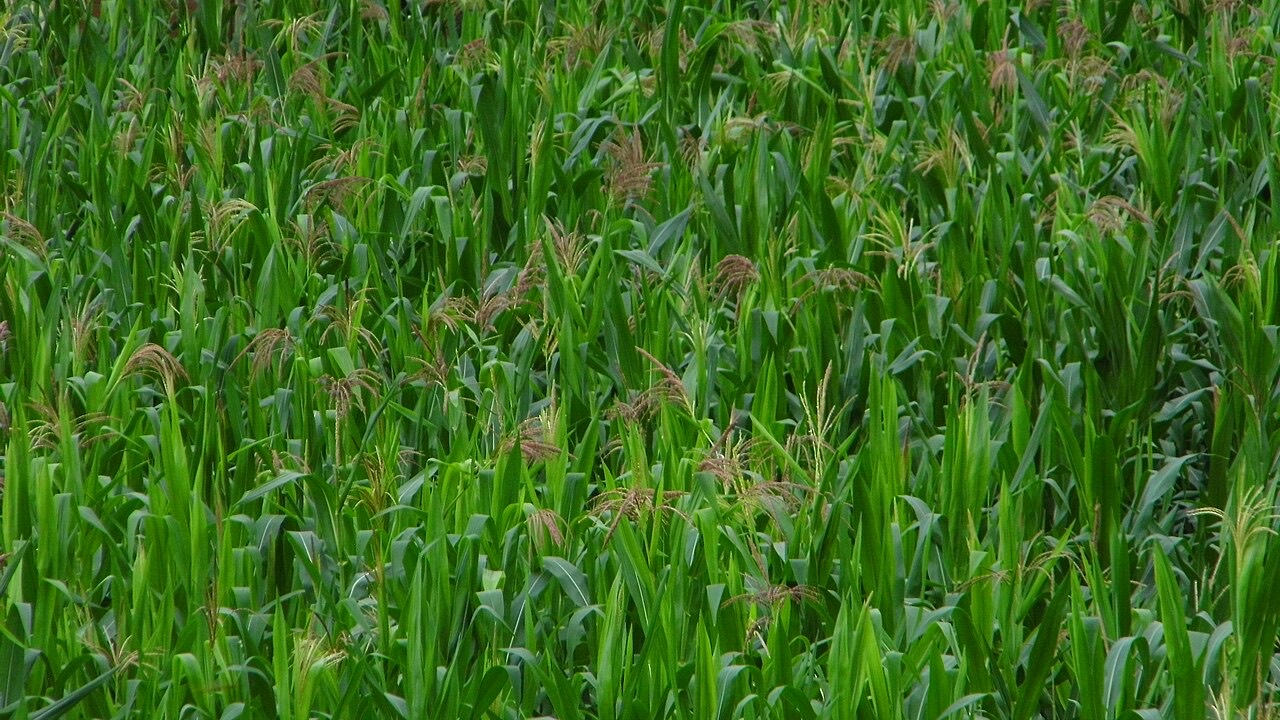
Maize is one of the most widely cultivated cereal crops in the world, grown for grain that serves as a staple food, a major livestock feed ingredient, and a raw material for starch, sweeteners, and industrial products. Its high yield potential and adaptability to diverse environments have made it a dominant crop across many agricultural systems.
Maize is a tall, single-stemmed annual grass. Unlike wheat and barley, it is monoecious with separate male and female flower structures on the same plant: the tassel produces pollen at the top of the plant, while ears develop lower on the stalk and are fertilized by wind-blown pollen landing on their silks.
Overview
Maize uses the C4 photosynthetic pathway, which allows it to use water and nitrogen efficiently and sustain high rates of growth under warm, sunny conditions. This physiology, combined with more than a century of breeding, underlies its high yield potential relative to many other cereals.
Maize is grown across an unusually wide range of production systems, from smallholder plots to large mechanized farms, and is used for grain, silage, and, in some regions, fresh consumption as sweet corn. Agronomic practices differ substantially between these systems and by region.
Botanical classification
- Family
- Poaceae (grass family)
- Genus and species
- Zea mays
- Flower structure
- Monoecious; male tassel at the plant apex and female ears borne on lower nodes, fertilized by wind-dispersed pollen
- Growth habit
- Tall, single-stemmed annual grass, typically 1.5–3 m at maturity
Origin and distribution
Maize was domesticated from wild teosinte in what is now Mexico and subsequently spread throughout the Americas before European contact. Following its introduction to other continents, it became established as a major crop in Africa, Asia, Europe, and beyond.
Maize is now grown on every inhabited continent under an enormous range of climates.
Climate requirements
Maize is a warm-season crop that requires a frost-free period long enough for the chosen hybrid to complete its growth cycle. It is sensitive to cold soil and air temperatures at planting and to frost at either end of the season.
Heat and drought stress around silking and the early grain-fill period can substantially affect kernel set and yield. Hybrid maturity class is selected to match the length of the local frost-free season and expected moisture conditions.
Soil requirements
Maize performs best on deep, well-drained, medium-textured soils such as loams that combine good moisture-holding capacity with adequate aeration. It is sensitive to compaction and waterlogging, both of which restrict root development.
Establishment and crop management
Establishing a uniform plant stand at the correct depth and spacing is a key determinant of maize yield potential. Hybrid selection, planting date, and target plant population are set according to local climate, soil, and market end use.
- Hybrid selection matched to maturity class, disease pressure, and end use (grain, silage, or sweet corn)
- Crop rotation, often with legumes such as soybean, to manage pests, diseases, and soil nitrogen supply
- Seedbed preparation and planting equipment suited to the tillage system in use
- Weed management during early growth, when maize competes poorly with weeds
Nutrient considerations
Maize has a high nitrogen requirement relative to many other cereals, reflecting its rapid biomass accumulation and yield potential. Phosphorus and potassium support early root development, stalk strength, and grain fill, while requirements for each nutrient depend on soil supply, target yield, and previous cropping history.
Water and irrigation
Maize is grown both rain-fed and under irrigation, depending on regional rainfall reliability. Water demand peaks around tasseling, silking, and early grain fill, and stress during this window has a disproportionate effect on yield.
Common diseases and pests
Maize is affected by a range of fungal diseases, including Fusarium stalk and ear rots, as well as leaf blights and smuts whose importance varies by region and season. Insect pests such as aphids can reduce vigor directly and transmit certain viruses; other regionally important pests include stalk borers and rootworms.
Management typically combines resistant or tolerant hybrids, crop rotation, field monitoring, and, where warranted, locally authorized control measures applied according to their labels.
Harvest
Grain maize is harvested once kernels have reached physiological maturity and dried to a moisture level suitable for combining and safe storage, with further drying often applied afterward. Silage maize is harvested earlier, at a whole-plant moisture content suited to fermentation and storage as feed.
Uses
- Human food, including cornmeal, masa-based products, and sweet corn for direct consumption
- Livestock feed, as grain, silage, or processing by-products
- Industrial starch, sweeteners, and oil extracted from the grain
- Feedstock for ethanol and other biofuel production in some regions
Botanical identity
Species- Accepted name
- Zea mays
- Family
- Poaceae
- Genus
- Zea
- Harvested part
- grain
- Agricultural use
- human food, animal feed, starch, bioenergy
- Crop group
- Cereals
What the authorities say
- Plants of the World Online
- Zea mays
Botanical identity here is what the consulted taxonomic authorities publish, on the date they were read. Where authorities disagree, both readings are shown rather than one being chosen silently.
Traded as
This crop is traded as one commodity in this corpus.
What AgricultureID holds for this crop
- 99 crop calendar records
- 5 published cultivars
- 10 verified extension resources
- 33 pests and diseases naming this crop as a host
- 1 soil references
- 34 farm economics observations
- 533 market price series
- 12 related crops
Not held
- No official variety registrations — source exists not mapped
- No climate references — not researched
An absence here means this corpus holds no such record, not that none exists.
How to read figures on this page
Production, area and trade figures for any crop change from season to season and are compiled by FAO and by national agricultural statistics agencies. Take current numbers from those primary sources, dated to the period you mean, rather than from a secondary summary — including this one.
Crop water requirements are estimated from reference evapotranspiration and local climate data, following methods published by FAO and national agricultural agencies. A requirement quoted without the reference method and the local climate behind it is not a number that can be applied to a field.
Part of
Related crops
Planting and harvest calendar
Usual sowing and harvest windows across 99 jurisdictions, covering corn and corn — season 1 and corn — season 2 and corn — season 3.
Cost of production, as forecast
United States national estimates for 2027, published by USDA Economic Research Service.
- Total costs listed
- 952.09 USD
- Dollars per planted acre
- Operating costs
- 473.34 USD
- Dollars per planted acre
- Allocated overhead
- 478.75 USD
- Dollars per planted acre
A forecast of what a crop will cost to grow is not a record of what it cost. It is the source’s expectation for a year that has not finished.
These are costs only. The source publishes no revenue alongside them, so no margin, profit or break-even price is derived from them here.
Official extension guidance
10 resources indexed from public extension publishers. Each was written for a particular place; read it at the source.
Factsheet published by Ohio State University Extension for Ohio. It addresses maize. The source is organised around “Disease Cycle and Epidemiology”, “Search form” and “PLPATH-CER-02”.
Ohio State University Extension · Disease management · publisher states no date; reachable 2026-08-27
Factsheet published by University of Maryland Extension for Maryland. It addresses maize. The source is organised around “Corn Fungicide ROI Calculator”, “Information on the Corn Fungicide ROI Calculator” and “How were fungicide products selected for inclusion in the calculator?”.
University of Maryland Extension · Disease management, Farm management · publisher states 2026-06-04
Factsheet published by Ohio State University Extension for Ohio. It addresses maize. The source is organised around “Key Findings”, “Points to Ponder and Looking Ahead” and “Search form”.
Ohio State University Extension · Soil preparation, Disease management, Crop rotation · publisher states no date; reachable 2026-08-27
Factsheet published by Ohio State University Extension for Ohio. It addresses maize. The source is organised around “Rootworm Injury to Corn”, “Rootworm Variants” and “Symptoms, Assessment, and Scouting”.
Ohio State University Extension · Pest management · publisher states no date; reachable 2026-08-27
Energy Conservation in Corn Production
Factsheet published by Ohio State University Extension for Ohio. It addresses maize. The source is organised around “Search form”, “AGF-102” and “Social Media”.
Ohio State University Extension · Conservation · publisher states no date; reachable 2026-08-27
Gibberella Ear Rot and Mycotoxins in Corn: Sampling, Testing, and Storage
Factsheet published by Ohio State University Extension for Ohio. It addresses maize. The source is organised around “Vomitoxin Variability in Infected Grain”, “Sampling for Mycotoxins” and “Mycotoxin Test Options”.
Ohio State University Extension · Disease management, Storage · publisher states no date; reachable 2026-08-27
Factsheet published by Ohio State University Extension for Ohio. It addresses maize. The source is organised around “Disease Cycle and Epidemiology”, “Search form” and “PLPATH-CER-05”.
Ohio State University Extension · Disease management · publisher states no date; reachable 2026-08-27
Factsheet published by University of Maryland Extension for Maryland. It addresses maize. The source is organised around “Grazing Corn Residue” and “Agronomy News-October 2024”.
University of Maryland Extension · Grazing · publisher states 2024-10-11
Managing “Pollen Drift” to Minimize Contamination of Non-GMO Corn
Factsheet published by Ohio State University Extension for Ohio. It addresses maize. The source is organised around “Characteristics of Corn Pollen Affecting “Drift””, “How Far can Corn Pollen Travel?” and “Planting Practices to Minimize GMO Pollen Contamination”.
Ohio State University Extension · Crop establishment · publisher states no date; reachable 2026-08-27
Using Corn for Livestock Grazing
Factsheet published by Ohio State University Extension for Ohio. It addresses maize. The source is organised around “What Corn Can I Graze?”, “How Should I Grow Corn That Will Be Grazed?” and “Where Does Corn Fit in a Grazing System?”.
Ohio State University Extension · Livestock management, Grazing · publisher states no date; reachable 2026-08-27
These are pointers to guidance published by others. Each was written for a particular place and season and is revised by its publisher; read it at the source, and check it applies where you farm.
Authorised inputs (France)
The French register records 168 currently authorised products whose authorised use names this crop, held by 48 authorisation holders. This is a count of what exists on the register, not a recommendation and not a shortlist.
By function
- Herbicide 112
- Insecticide 32
- Fongicide 22
- Répulsif 1
- Régulateur de croissance 1
Targets named on the register
- Ravageurs du sol 15
- Maladies des taches foliaires 14
- Champignons (autres que pythiacées) 13
- Chenilles phytophages 11
- Pyrale(s) (1) 10
- Rouille(s) 7
Use scope is recorded as the register writes it. Collective terms cover several crops at once and are left unmapped rather than expanded, because expanding one entry into several would invent authorisations that were never granted.
Authorisation is specific to one jurisdiction, one legal object and one moment. It is not a recommendation, and it says nothing about how a product may be used: always read the current official label at the source before acting.
Tools for this
Each tool shows its formula, constants and sources, and starts empty — nothing is filled in from this page.
- Seed-rate calculator
Convert a target plant stand into a seed rate, allowing for germination and establishment.
- Row spacing calculator
Work out in-row spacing and plants per metre of row for a target density.
- Production, area and yield calculator
Relate a harvested area and a yield to a production total, in either direction.
- Growing degree-days calculator
Accumulate heat units against a base temperature.
Relationships
Evidence-backed connections in the knowledge graph.
Notable cultivars
Documented varieties tied to this species, with registry status and sources on each page. Not an exhaustive list.
- B73B73 is a public maize inbred line developed at Iowa State University and released in 1972 from the Iowa Stiff Stalk Synthetic population. It is one of the most influential lines in temperate maize breeding and was the source of the first maize reference genome.
- Lancaster Sure CropLancaster Sure Crop is a historic open-pollinated maize variety selected by the Hershey family in Lancaster County, Pennsylvania. It is the namesake and germplasm source of the Lancaster (non-Stiff-Stalk) heterotic pool used in temperate hybrid maize.
- Mo17Mo17 is a public maize inbred line released by the University of Missouri in 1964 and belonging to the Lancaster Sure Crop heterotic group. Its cross with the Stiff Stalk line B73 is a classic model of hybrid vigour in temperate maize.
- Reid's Yellow DentReid's Yellow Dent is a historic open-pollinated maize variety developed by the Reid family in Illinois in the mid-19th century. It became the dominant dent corn of the U.S. Corn Belt and a foundational source of germplasm for later hybrid maize.
- W22W22 is a public maize inbred line associated with the Wisconsin Agricultural Experiment Station and widely used as a genetics model. Its anthocyanin-expressing background and its role in transposon research make it a standard reference line, and it now has its own assembled genome.
Harvested commodities
The traded commodities harvested from this crop. A commodity is the harvested lot, described by its own quality, grading, and storage evidence — not by the agronomy of the plant.
Scope & limitations
Geographic scope: Global overview. Hybrid choice, planting dates, and input levels are region-specific and vary widely by climate and market.
Climate context: Warm-season crop requiring a frost-free growing period; grown from temperate to tropical zones, rain-fed or irrigated.
- Hybrid selection, planting density, and fertilizer programs are region-specific decisions not covered by universal values here.
- Production and trade statistics change annually and should be taken from primary datasets such as FAOSTAT and USDA NASS.
- Disease and pest pressure varies considerably by region and season; local extension guidance should inform management decisions.
Sources
This article draws on the following authoritative sources. See our sources & methodology for how they are selected.
- [1]FAO — Food and Agriculture Organization (opens in a new tab)Authoritative
Food and Agriculture Organization of the United Nations (FAO)
Cited for: Role of maize in global food and feed systems
- Type:
- Intergovernmental organization
- Jurisdiction:
- Global
- Accessed:
- 2026-07-12
- [2]FAOSTAT — FAO statistical database (opens in a new tab)Authoritative
Food and Agriculture Organization of the United Nations (FAO)
Cited for: Production, area, and trade statistics
- Type:
- Intergovernmental organization
- Jurisdiction:
- Global
- Accessed:
- 2026-07-12
- [3]CIMMYT — International Maize and Wheat Improvement Center (opens in a new tab)High
International Maize and Wheat Improvement Center (CIMMYT)
Cited for: Maize improvement and agronomy research
- Type:
- Research institute
- Jurisdiction:
- Global
- Accessed:
- 2026-07-12
- [4]USDA ARS — Agricultural Research Service (opens in a new tab)Authoritative
USDA Agricultural Research Service (ARS)
Cited for: Maize disease and pest research
- Type:
- Government agency
- Jurisdiction:
- United States
- Accessed:
- 2026-07-12
- Authoritative
Cited for: Classification and nomenclature
- Type:
- Reference database
- Jurisdiction:
- United States
- Accessed:
- 2026-07-12
- [6]Iowa State University Extension and Outreach (opens in a new tab)High
Iowa State University Extension and Outreach
Cited for: Regional maize agronomy guidance
- Type:
- University extension service
- Jurisdiction:
- United States (Iowa)
- Accessed:
- 2026-07-12
Related topics
Plant Diseases
Pests
- Aphids
- Armyworms
- Brown Marmorated Stink Bug
- Cotton Bollworm
- Cutworms
- Desert Locust
- European Corn Borer
- Fall Armyworm
- Granary Weevil
- Grasshoppers
- Indianmeal Moth
- Japanese Beetle
- Khapra Beetle
- Leafhoppers
- Lesser Grain Borer
- Maize Weevil
- Mole Crickets
- Red Flour Beetle
- Rice Weevil
- Root Aphids
- Sawtoothed Grain Beetle
- Stem Borers
- Western Corn Rootworm
- White Grubs
- Wireworms
Plant Nutrients
Fertilizers
Soil Health
Machinery
Climate
Farming Systems
Post-Harvest
- Aerated Storage
- Bag Stack Storage
- Batch Drying
- Chilled Grain Storage
- Commercial Grain Silo
- Continuous-Flow Drying
- Farm Grain Bin
- Flat Storage Warehouse
- Grain Cleaning
- Grain Drying
- Grain Storage
- Hermetic Storage
- Moisture Content and Equilibrium
- Natural-Air and Low-Temperature Drying
- Post-Harvest Food Loss
- Silo Bag
- Storage Moulds and Mycotoxins
- Stored-Grain Insects
- Sun Drying
- Threshing and Shelling
- Woven Polypropylene Sack