Livestock · Livestock
Rabbits
Oryctolagus cuniculus
Also known as: Domestic rabbit, Cuniculture (rabbit farming)
Rabbits are small monogastric hindgut fermenters raised for meat, fibre, and pelts, kept in systems ranging from backyard hutches to intensive commercial cage operations. Their digestion relies on caecal fermentation and re-ingestion of soft droppings (cecotrophy).
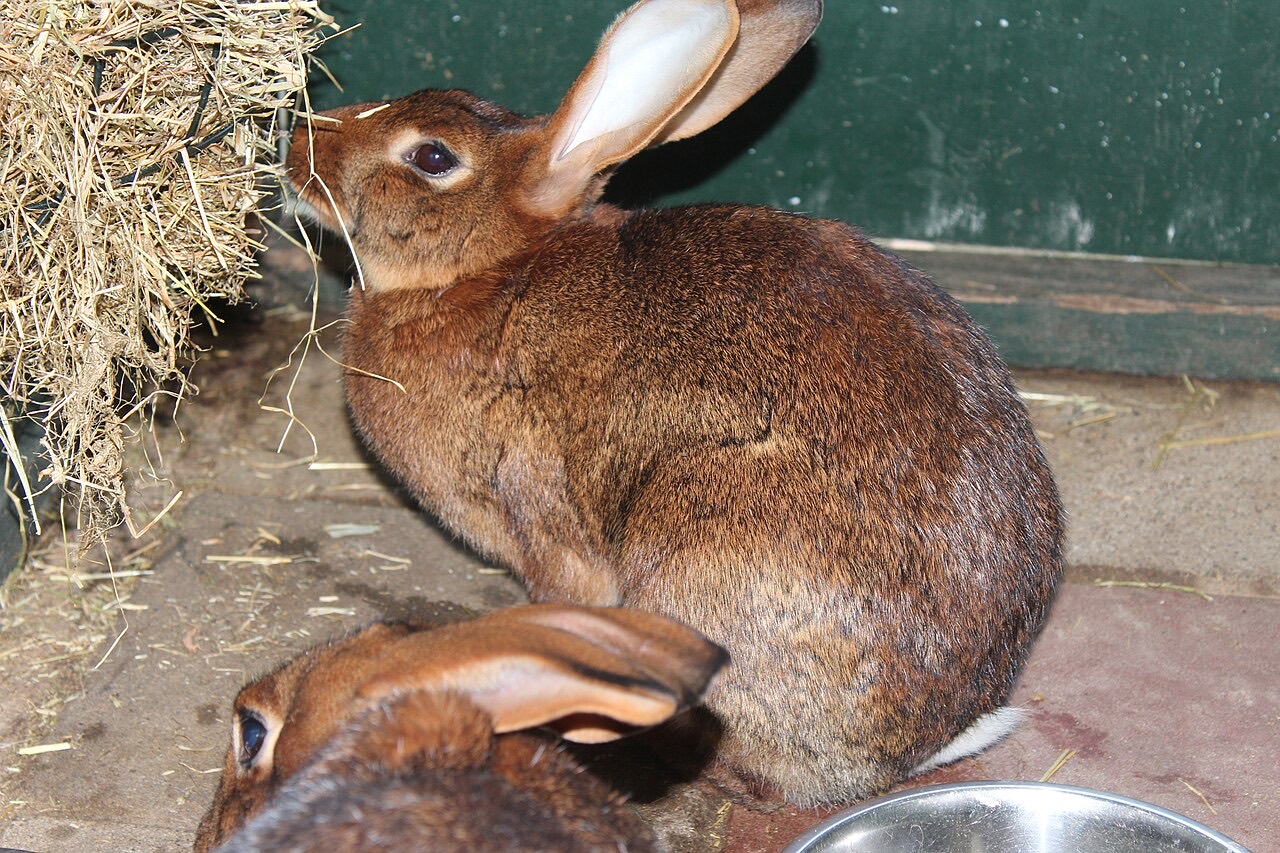
The domestic rabbit (Oryctolagus cuniculus) is a monogastric animal — it has a single-chambered stomach rather than a ruminant’s multi-chambered one — but, like horses, it is a hindgut fermenter, using an enlarged caecum to ferment fibrous plant material after it leaves the stomach and small intestine. Rabbits are distinctive even among hindgut fermenters for cecotrophy: they produce soft, nutrient-rich caecal droppings that they re-ingest directly from the anus, extracting additional nutrients and microbial protein that would otherwise be lost.
Rabbit farming (cuniculture) ranges from smallholder and backyard operations producing meat and manure for household or local use, to intensive commercial systems built around cage housing, controlled breeding cycles, and formulated feed. Fibre breeds, kept mainly for Angora wool, follow a distinct production model built around fleece harvesting rather than meat.
Overview
Rabbit production is organised mainly around meat, with breeding does managed on a repeated kindling cycle to supply young stock for growing out, alongside smaller fibre and pelt sectors. Scale ranges from a few backyard hutches to commercial operations with hundreds or thousands of breeding does managed on standardised cages and feeding programmes.
Breeds and types
- Meat breeds
- Selected for growth rate and carcass yield (for example, New Zealand White and Californian types).
- Fibre breeds
- Angora rabbits, kept for their long wool fleece, which is periodically shorn or plucked.
- Dual-purpose and local breeds
- Balanced for meat, pelts, or hardiness in smallholder and backyard settings.
Nutrition and feeding
Rabbit diets centre on fibrous forage — commonly alfalfa or grass hay — because adequate long fibre supports normal gut motility and caecal fermentation; diets too low in fibre are linked to digestive upset. Commercial production typically relies on formulated pelleted feed balancing fibre, protein, and energy, while backyard systems often combine hay with vegetables, greens, and root crops as supplementary feed.
Health and welfare
Rabbit health and welfare depend on adequate space, appropriate flooring or bedding, protection from heat stress and predators, and management practices that reduce stress, since rabbits are prey animals sensitive to handling and environment. Digestive upsets, often linked to diet or stress, are a significant health concern in commercial rabbitries.
Production context
Rabbit production makes efficient use of forage crops and by-products relative to its space requirements, and manure is commonly recycled as a garden or field soil amendment in smallholder systems. Commercial rabbit meat production remains a comparatively small livestock sector globally but is well established in several regions with strong local demand.
Relationships
Evidence-backed connections in the knowledge graph.
Commonly raised in
Scope & limitations
Geographic scope: Global overview; breeds, systems, and regulations vary widely by country and region.
Climate context: Rabbits are sensitive to heat stress; housing and management adapt to local temperature extremes.
- This is a general species overview, not breed-, system-, or region-specific husbandry guidance.
- Health, medicine, and welfare practices are governed by local regulation and veterinary advice and are not detailed here.
Sources
This article draws on the following authoritative sources. See our sources & methodology for how they are selected.
- [1]FAO — Food and Agriculture Organization (opens in a new tab)Authoritative
Food and Agriculture Organization of the United Nations (FAO)
Cited for: Rabbit production systems and global role
- Type:
- Intergovernmental organization
- Jurisdiction:
- Global
- Accessed:
- 2026-07-12
- [2]DAD-IS — Domestic Animal Diversity Information System (opens in a new tab)Authoritative
FAO Commission on Genetic Resources for Food and Agriculture
Cited for: Rabbit breeds and genetic diversity
- Type:
- Official registry
- Jurisdiction:
- Global
- Accessed:
- 2026-07-12
- [3]WOAH — World Organisation for Animal Health (opens in a new tab)Authoritative
World Organisation for Animal Health (WOAH)
Cited for: Animal health and welfare standards
- Type:
- Intergovernmental organization
- Jurisdiction:
- Global
- Accessed:
- 2026-07-12
- [4]National Academies Press — Nutrient Requirements series (opens in a new tab)High
National Research Council, U.S. National Academies
Cited for: Nutrient requirement references
- Type:
- Peer-reviewed literature
- Jurisdiction:
- Global
- Accessed:
- 2026-07-12