Crop · Vegetable crop
Cabbage
Brassica oleracea var. capitata
Also known as: Head cabbage
Cabbage is a biennial brassica vegetable grown worldwide for its dense leafy head, used fresh, cooked, fermented, and processed, and cultivated across a wide range of temperate and subtropical climates.
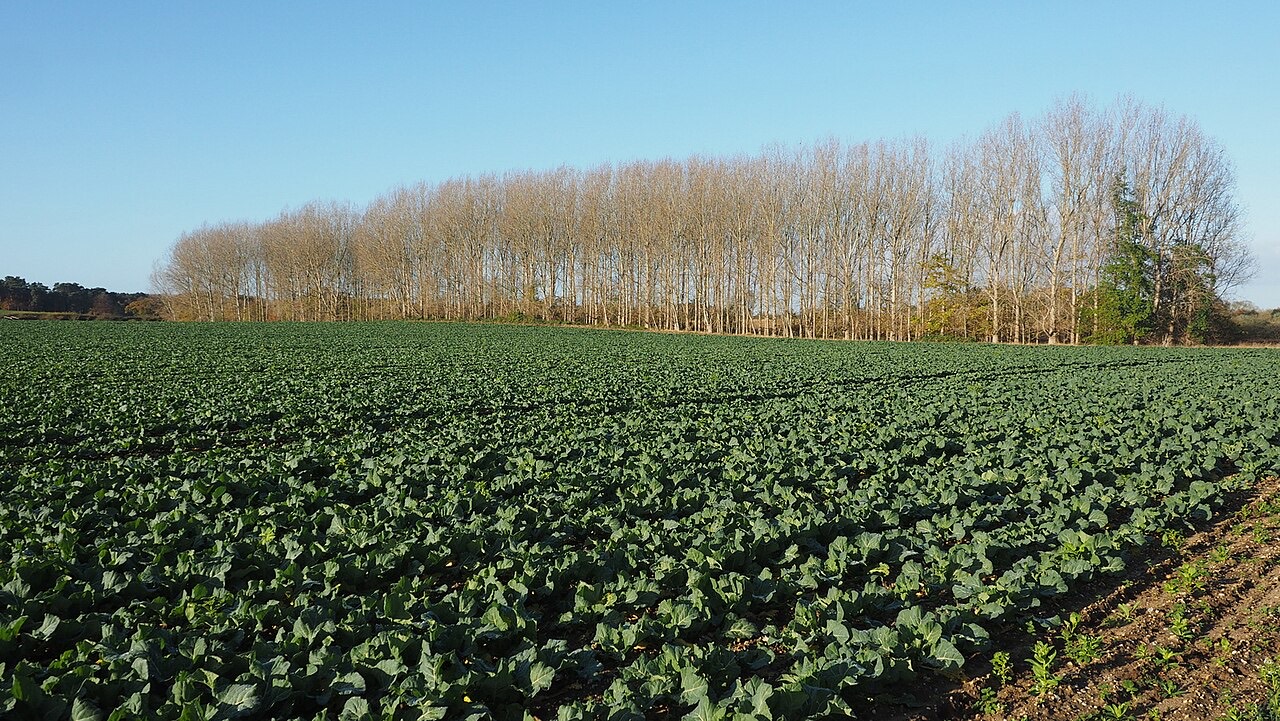
Cabbage is a cultivar group of Brassica oleracea, the same species that includes broccoli, kale, and Brussels sprouts, distinguished by the formation of a tight, overlapping-leaf head at the growing point. It is grown for this head, which is harvested before the plant would naturally overwinter and flower.
Head types range from smooth, round green cabbages to crinkled savoy types and dense red or purple cultivars, and maturity ranges from early, fast-maturing types to later, larger, longer-storing types suited to different markets and production windows.
Overview
Cabbage belongs to a group of cultivars within Brassica oleracea selected for tight head formation rather than for flower buds, stems, or leaves as in its close relatives. As a cole crop, it shares many pest, disease, and soil-fertility management considerations with other Brassica vegetables.
Production ranges from small-scale market gardens to large mechanized operations, and cultivar choice — early, mid-season, or storage type — is matched to local season length and intended market.
Botanical classification
- Family
- Brassicaceae (mustard family)
- Genus and species
- Brassica oleracea var. capitata
- Growth habit
- Biennial forming a compact terminal head of tightly overlapping leaves in its first year
- Related cultivar groups
- Same species as broccoli, kale, cauliflower, Brussels sprouts, and kohlrabi, distinguished by cultivar group
Origin and distribution
Cabbage descends from wild Brassica oleracea populations native to coastal areas of the Mediterranean and Atlantic Europe. Head-forming types were selected over centuries in Europe before cabbage spread globally through trade and colonization to become a staple vegetable on most continents.
Climate requirements
Cabbage is a cool-season crop that tolerates light frost well and, in many cultivars, develops best head quality under moderate temperatures. Sustained heat during head formation is associated with looser heads, splitting, and reduced quality.
Cultivars vary considerably in cold tolerance and heat sensitivity, and cultivar choice is matched to local season length and the timing of head maturity relative to expected weather.
Soil requirements
Cabbage grows well on fertile, well-drained loams and clay loams with good moisture-holding capacity. A near-neutral to slightly alkaline soil pH is often favored in brassica production, partly because more acidic soils are associated with greater pressure from certain soilborne brassica diseases.
Establishment and crop management
Cabbage is commonly established from transplants raised in a nursery, though direct seeding is also used in some systems. Spacing is set according to cultivar head size and intended market, and rotation away from other brassicas is a standard practice to manage soilborne disease buildup.
- Cultivar selection matched to season length, intended maturity window, and market type
- Rotation away from other cole crops to reduce soilborne disease carryover
- Consistent moisture management to reduce the risk of head splitting
- Field monitoring for caterpillar pests and aphids from early establishment onward
Nutrient considerations
Nitrogen and potassium are both important for vigorous leaf and head development, and sulfur is notable in brassica crops as a component of the sulfur-containing compounds characteristic of the group. Requirements depend on soil supply, target yield, and cultivar.
Water and irrigation
Consistent soil moisture supports even head development, while irregular watering — particularly a dry period followed by heavy rain or irrigation — is associated with head splitting in mature crops. Drip and sprinkler irrigation are both used depending on region and scale.
Common diseases and pests
Downy mildew and Fusarium wilt (cabbage yellows) are notable diseases of cabbage, with severity varying by region, cultivar resistance, and weather. Aphids, cutworms, and slugs are among the common pests, with aphids also capable of transmitting certain viruses.
Management typically combines resistant cultivars, crop rotation, field sanitation, monitoring, and, where warranted, locally authorized control measures applied according to their labels.
Harvest
Cabbage is harvested once heads reach the desired firmness and size for the intended market, typically cut by hand or machine at the base of the head. Timing balances maximum size against the risk of splitting or over-maturity.
Uses
- Fresh use in salads such as coleslaw and in cooked dishes worldwide
- Fermentation into products such as sauerkraut and kimchi
- Processing into packaged coleslaw mixes and other prepared products
- Culinary use across many cuisines, raw, cooked, pickled, or fermented
Botanical identity
Cultivar group- Accepted name
- Brassica oleracea Capitata Group
- Family
- Brassicaceae
- Genus
- Brassica
- Harvested part
- leaf
- Agricultural use
- human food
- Crop group
- Vegetables
What the authorities say
- World Flora Online — Taxonomic Backbone
- Brassica oleracea
- Plants of the World Online
- Brassica oleracea
Broccoli, cabbage, cauliflower, kale, kohlrabi and Brussels sprouts are all Brassica oleracea. Plants of the World Online sinks the cultivated forms into the species; World Flora Online keeps infraspecific epithets for them. AgricultureID publishes them as CULTIVAR GROUPS under the cultivated-plant code, which is what they are: selections of one species that differ in which organ was bred for size. Both authorities agree on the species, and neither is asked to carry a rank it does not recognise.
Botanical identity here is what the consulted taxonomic authorities publish, on the date they were read. Where authorities disagree, both readings are shown rather than one being chosen silently.
Traded as
This crop is traded as one commodity in this corpus.
What AgricultureID holds for this crop
- 251 crop calendar records
- 3 verified extension resources
- 8 pests and diseases naming this crop as a host
- 2 soil references
- 1 climate references
- 357 market price series
- 12 related crops
Not held
- No published cultivars — not researched
- No official variety registrations — source exists not mapped
- No farm economics observations — source exists not mapped
An absence here means this corpus holds no such record, not that none exists.
How to read figures on this page
Production, area and trade figures for any crop change from season to season and are compiled by FAO and by national agricultural statistics agencies. Take current numbers from those primary sources, dated to the period you mean, rather than from a secondary summary — including this one.
Crop water requirements are estimated from reference evapotranspiration and local climate data, following methods published by FAO and national agricultural agencies. A requirement quoted without the reference method and the local climate behind it is not a number that can be applied to a field.
Part of
Brassica — one genus, many crops · Brassicaceae — the cabbage family · Vegetables
Related crops
- Same genus
- Broccoli, Brussels Sprouts, Cauliflower, Chinese Cabbage, Kale, Kohlrabi, Mustard, Oilseed rape, Pak Choi, Swede, Turnip
- Shared pest and disease pressure
- Lettuce
Planting and harvest calendar
Usual sowing and harvest windows across 251 jurisdictions, covering cabbage and cabbage — season 1 and cabbage — season 2 and cabbage, common and cabbage, common — season 1 and cabbage, common — season 2 and cabbage, common — season 3.
Official extension guidance
3 resources indexed from public extension publishers. Each was written for a particular place; read it at the source.
Cabbage stem flea beetle (CSFB) and its management in oilseed rape
Guide published by AHDB for Great Britain. It addresses cabbage. The source is organised around “Why cabbage stem flea beetle is an issue”, “Cabbage stem flea beetle IPM” and “Cabbage stem flea beetle treatment thresholds”.
Agriculture and Horticulture Development Board · Crop establishment, Pest management · publisher states no date; reachable 2026-08-27
Selecting, Storing, and Serving Ohio Cabbage
Factsheet published by Ohio State University Extension for Ohio. It addresses cabbage. The source is organised around “Types of Cabbage:”, “Search form” and “HYG-5513”.
Ohio State University Extension · Storage · publisher states no date; reachable 2026-08-27
Weed Management in Broccoli, Cabbage, and Cauliflower
Factsheet published by NC State Extension for North Carolina. It addresses broccoli. The source is organised around “Cultivation Options in Cole Crops”, “Herbicide Options in Cole Crops” and “Preplant and Preemergence”.
NC State Extension · Crop establishment, Soil preparation, Weed management · publisher states no date; reachable 2026-08-27
These are pointers to guidance published by others. Each was written for a particular place and season and is revised by its publisher; read it at the source, and check it applies where you farm.
Authorised inputs (France)
The French register records 30 currently authorised products whose authorised use names this crop, held by 15 authorisation holders. This is a count of what exists on the register, not a recommendation and not a shortlist.
By function
- Fongicide 16
- Insecticide 8
- Herbicide 6
Targets named on the register
- Maladies des taches brunes 12
- Chenilles phytophages 7
- Mildiou(s) 4
- Pucerons 3
- Coléoptères phytophages 2
- Aleurodes 1
Use scope is recorded as the register writes it. Collective terms cover several crops at once and are left unmapped rather than expanded, because expanding one entry into several would invent authorisations that were never granted.
Authorisation is specific to one jurisdiction, one legal object and one moment. It is not a recommendation, and it says nothing about how a product may be used: always read the current official label at the source before acting.
Tools for this
Each tool shows its formula, constants and sources, and starts empty — nothing is filled in from this page.
- Seed-rate calculator
Convert a target plant stand into a seed rate, allowing for germination and establishment.
- Row spacing calculator
Work out in-row spacing and plants per metre of row for a target density.
- Production, area and yield calculator
Relate a harvested area and a yield to a production total, in either direction.
- Growing degree-days calculator
Accumulate heat units against a base temperature.
Relationships
Evidence-backed connections in the knowledge graph.
Susceptible to
Climate sensitivity
Irrigation methods
Managed with
Related topics
Harvested commodities
The traded commodities harvested from this crop. A commodity is the harvested lot, described by its own quality, grading, and storage evidence — not by the agronomy of the plant.
Scope & limitations
Geographic scope: Global overview. Cultivar maturity type, transplant timing, and input levels are region-specific and depend on local season length and climate.
Climate context: Cool-season brassica vegetable tolerant of light frost, grown across temperate and subtropical regions.
- Cultivar maturity class and transplant timing are region-specific decisions not reduced to universal guidance here.
- Production and trade statistics change annually and should be taken from primary datasets such as FAOSTAT.
- Disease and pest control should follow locally authorized guidance and product labels.
Sources
This article draws on the following authoritative sources. See our sources & methodology for how they are selected.
- [1]FAO — Food and Agriculture Organization (opens in a new tab)Authoritative
Food and Agriculture Organization of the United Nations (FAO)
Cited for: Role of cabbage in global vegetable production
- Type:
- Intergovernmental organization
- Jurisdiction:
- Global
- Accessed:
- 2026-07-12
- [2]FAOSTAT — FAO statistical database (opens in a new tab)Authoritative
Food and Agriculture Organization of the United Nations (FAO)
Cited for: Production, area, and trade statistics
- Type:
- Intergovernmental organization
- Jurisdiction:
- Global
- Accessed:
- 2026-07-12
- Authoritative
Cited for: Classification and nomenclature
- Type:
- Reference database
- Jurisdiction:
- United States
- Accessed:
- 2026-07-12
- [4]UC Statewide Integrated Pest Management Program (UC IPM) (opens in a new tab)High
University of California Agriculture and Natural Resources (UC ANR)
Cited for: Integrated pest management for cole crops
- Type:
- University extension service
- Jurisdiction:
- United States (California)
- Accessed:
- 2026-07-12
- [5]Cornell CALS — Plant pathology and crop resources (opens in a new tab)High
Cornell University College of Agriculture and Life Sciences
Cited for: Cabbage production and disease guidance
- Type:
- University extension service
- Jurisdiction:
- United States (New York)
- Accessed:
- 2026-07-12