Livestock · Livestock
Sheep
Ovis aries
Also known as: Ewes, Rams, Lambs
Sheep are small domesticated ruminants raised worldwide for wool, meat, milk, and hides. They are well suited to grazing a wide range of terrain, including land too steep or marginal for other livestock or crops.
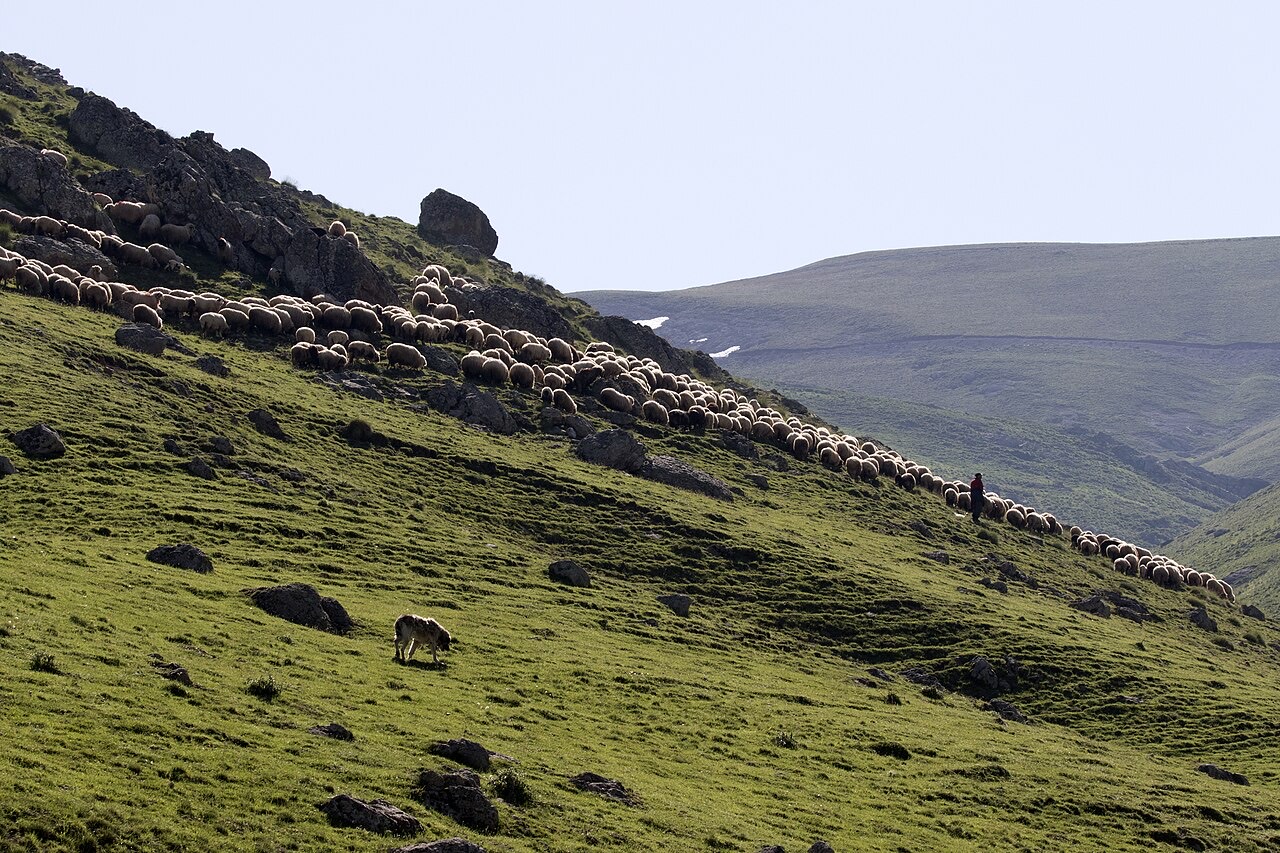
Sheep are among the earliest domesticated livestock and remain widespread across grassland, hill, and rangeland systems on every inhabited continent. Breeds have diversified for wool, meat, milk, or a combination of these purposes, and for adaptation to local climates ranging from arid rangeland to cold uplands.
As ruminants, sheep ferment fibrous forage in a specialised stomach, allowing them to convert grass and browse that humans cannot digest into wool, meat, and milk. Their relatively small size, hardiness, and flocking behaviour make them well suited to grazing marginal or steep land and to management in mobile or seasonal systems.
Overview
Sheep production spans wool-focused systems, meat (lamb and mutton) systems, dairy sheep systems producing milk for cheese and other products, and dual- or triple-purpose flocks combining these outputs. The relative emphasis depends on breed, region, market demand, and terrain.
- Wool production — fleece quality, staple length, and micron count are selection priorities.
- Meat production — growth rate, muscling, and carcass characteristics are prioritised for lamb and mutton.
- Dairy sheep — milk yield and composition support cheese and other dairy products in some regions.
Types and breeds
- Wool breeds
- Selected primarily for fleece characteristics such as fineness, staple length, and yield.
- Meat breeds
- Selected for growth rate, carcass conformation, and lamb production efficiency.
- Dairy breeds
- Selected for milk yield and composition, used in regional cheese and dairy traditions.
- Hair sheep and hardy local breeds
- Adapted to specific climates or terrain, often shedding wool naturally and requiring less fleece management; valued for hardiness and parasite tolerance in some environments.
Breed diversity is documented internationally, including through FAO’s Domestic Animal Diversity Information System (DAD-IS), which records breeds and their conservation status by country.
Nutrition and feeding
Sheep are grazing ruminants whose diets are built around pasture, browse, hay, and silage, reflecting a rumen adapted to ferment fibrous plant material. Depending on the system, life stage, and production goal, forage may be supplemented with concentrates, minerals, and vitamins.
Health and welfare
Flock health and welfare depend on adequate nutrition and water, appropriate shelter from weather extremes, routine flock health management, parasite monitoring, and calm, low-stress handling given sheep’s strong flocking and flight instincts.
Production context
Sheep can make productive use of grassland, hill country, and marginal or steep terrain unsuitable for cropping or larger livestock, and are integrated into mixed farming and land-management systems in many regions, including targeted grazing for vegetation management. Environmental and land-use considerations vary widely by system and region.
Official extension guidance
2 resources indexed from public extension publishers. Each was written for a particular place; read it at the source.
Factsheet published by University of Maryland Extension for Maryland. It addresses sheep. The source is organised around “General description”, “Growth habit” and “Conditions that favor growth”.
University of Maryland Extension · Livestock management · publisher states 2023-03-03
Sheep Exhibitor's Project Guide (5-6 Years of Age)
Guide published by NC State Extension for North Carolina. It addresses sheep. The source is organised around “General Knowledge Information”, “Items to Learn and Know” and “Sheep Showmanship Danish Standards for 5 and 6 Year Old Exhibitors”.
NC State Extension · Crop establishment, Livestock management · publisher states no date; reachable 2026-08-27
These are pointers to guidance published by others. Each was written for a particular place and season and is revised by its publisher; read it at the source, and check it applies where you farm.
Relationships
Evidence-backed connections in the knowledge graph.
Notable breeds
Documented breeds tied to this species, with registry status and sources on each page. Not an exhaustive list.
- Border LeicesterThe Border Leicester is an English longwool breed with distinctive upright ears and a Roman nose, used widely as a crossing sire to produce prolific crossbred (mule) ewes in stratified sheep systems.
- CorriedaleThe Corriedale is a dual-purpose sheep breed developed in New Zealand and Australia by crossing longwool rams with Merino ewes, producing both medium wool and meat; it is very numerous in South America.
- DorperThe Dorper is a South African meat sheep breed developed for arid conditions, carrying a short coat of mixed hair and wool that sheds, so shearing is generally not required.
- Hampshire DownThe Hampshire Down is an English Down meat breed with a dark face and legs, used chiefly as a terminal sire to produce fast-growing, well-conformed market lambs.
- KarakulThe Karakul is an ancient fat-tailed sheep breed of Central Asia, historically prized for the tightly curled coats of newborn lambs and also kept for coarse wool, milk, meat, and fat, and noted for hardiness in harsh, arid environments.
- KatahdinThe Katahdin is a North American hair sheep breed developed in Maine for low-maintenance meat production, carrying a hair coat that sheds so that shearing is not required.
- Lincoln LongwoolThe Lincoln Longwool is a large English longwool sheep breed from Lincolnshire, producing a very long, heavy, lustrous fleece; historically influential in developing other breeds and now regarded as a rare breed in several national registries.
- MerinoThe Merino is a fine-wool sheep breed of Spanish origin, renowned for producing some of the finest and highest-value apparel wool among sheep. It exists as many strains developed across the world, especially in Australia.
- Poll DorsetThe Poll Dorset is a polled (hornless) meat sheep breed developed in Australia from the Dorset Horn, valued for prime-lamb production and an extended breeding season.
- RambouilletThe Rambouillet is a large fine-wool sheep breed developed in France from Spanish Merinos, sometimes called the French Merino; it became a foundation of range sheep production in the western United States.
- RomneyThe Romney is a dual-purpose longwool sheep breed from the Romney Marsh of Kent, England, valued for long-stapled wool and meat and noted for hardiness on wet, low-lying pasture.
- SuffolkThe Suffolk is an English meat sheep breed with a distinctive black, wool-free head and legs, widely used as a terminal sire to produce fast-growing market lambs.
- TexelThe Texel is a heavily muscled meat sheep breed from the Dutch island of Texel, widely used across Europe and beyond as a terminal sire for lean, well-conformed carcasses.
Harvested commodities
The traded commodities obtained from this species, described by their own quality, grading, and handling evidence.
- Raw WoolRaw wool is the greasy fleece as shorn from sheep, baled and traded before any washing. It is bought on measured fibre attributes — diameter above all, then staple length and strength, yield after scouring, and vegetable matter — rather than on weight alone.
- Sheep MilkSheep milk is the untreated milk of dairy ewes, collected chilled and destined almost entirely for cheesemaking. It is a specialist commodity: volumes per animal are small, supply is markedly seasonal, and its high solids content is the reason processors want it.
Scope & limitations
Geographic scope: Global overview; breeds, systems, regulations, and guidance vary widely by country and region.
Climate context: Sheep are kept from arid rangeland to cold uplands; breed adaptation and management practices differ with climate and terrain.
- This is a general species overview, not breed-, system-, or region-specific husbandry guidance.
- Health, medicine, and welfare practices are governed by local regulation and veterinary advice and are not detailed here.
- Wool and dairy sheep practices vary considerably by region and are described here only in general terms.
Sources
This article draws on the following authoritative sources. See our sources & methodology for how they are selected.
- [1]FAO — Food and Agriculture Organization (opens in a new tab)Authoritative
Food and Agriculture Organization of the United Nations (FAO)
Cited for: Sheep production systems and global role
- Type:
- Intergovernmental organization
- Jurisdiction:
- Global
- Accessed:
- 2026-07-12
- [2]DAD-IS — Domestic Animal Diversity Information System (opens in a new tab)Authoritative
FAO Commission on Genetic Resources for Food and Agriculture
Cited for: Sheep breeds and diversity
- Type:
- Official registry
- Jurisdiction:
- Global
- Accessed:
- 2026-07-12
- [3]WOAH — World Organisation for Animal Health (opens in a new tab)Authoritative
World Organisation for Animal Health (WOAH)
Cited for: Animal health and welfare standards
- Type:
- Intergovernmental organization
- Jurisdiction:
- Global
- Accessed:
- 2026-07-12
- [4]National Academies Press — Nutrient Requirements series (opens in a new tab)High
National Research Council, U.S. National Academies
Cited for: Nutrient requirement references
- Type:
- Peer-reviewed literature
- Jurisdiction:
- Global
- Accessed:
- 2026-07-12
- [5]AHDB — Agriculture and Horticulture Development Board (opens in a new tab)High
Agriculture and Horticulture Development Board (AHDB)
Cited for: Sheep production guidance context
- Type:
- Government agency
- Jurisdiction:
- United Kingdom
- Accessed:
- 2026-07-12