Machinery · Agricultural machinery
Baler
A baler gathers cut, dried forage or crop residue from the ground and compresses it into round or rectangular bales bound with twine, net wrap, or wire, producing a compact, storable, and transportable form for feeding or bedding.
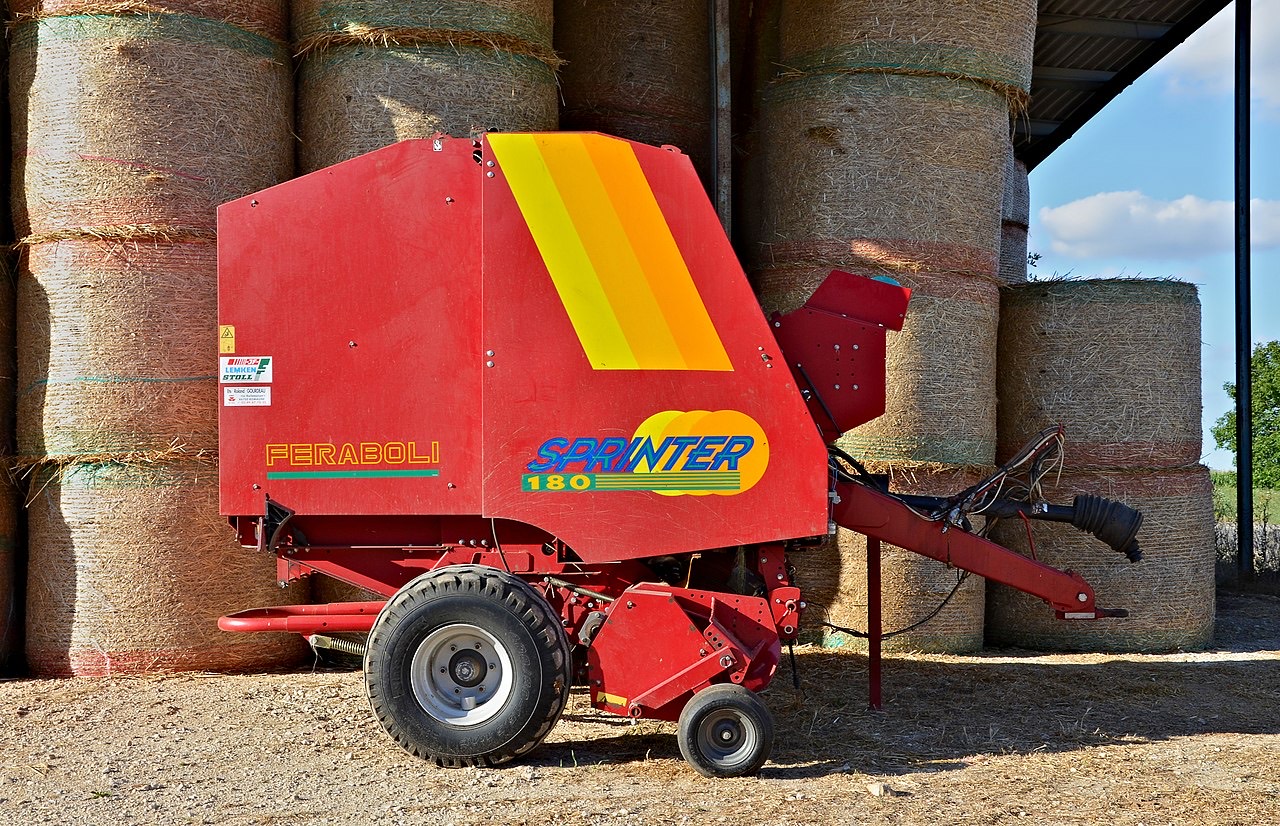
A baler is towed behind a windrow of cut material — typically hay, straw, or other forage that has been mown and dried in the field — and picks it up, compresses it, and forms it into bales that hold their shape for handling, storage, and transport.
Baling is the step that converts a loose, bulky windrow into a dense, uniform unit, dramatically reducing the volume and handling effort compared with loose forage, which is central to why it became standard practice for hay and straw.
What a baler is
A baler’s role is to collect windrowed material and form it into a compact, bound unit. It follows mowing and field curing in the forage-harvest sequence, and the resulting bales are the standard unit for storing and transporting hay, straw, and similar material.
How it works
- A pickup reel lifts windrowed material from the ground into the machine
- The material is fed into a compression chamber
- A plunger (rectangular balers) or rotating belts/rollers (round balers) compress the material into shape
- Twine, net wrap, or wire is applied to bind the bale and hold its form
- The finished bale is ejected onto the field for collection
Role in the production cycle
Baling completes the forage harvest sequence that begins with mowing and field-drying, and its timing relative to moisture content affects storage quality: material baled too wet is prone to heating and mould, while material baled too dry can shatter and lose leaf material.
Baled hay, straw, and silage-wrapped forage are central inputs to livestock feeding programs, and straw bales are also used for bedding, mulch, and erosion control.
Types and variations
- Round baler
- Forms cylindrical bales, commonly handled with front-end loaders or bale spears
- Small rectangular (square) baler
- Produces smaller bales traditionally handled manually
- Large rectangular baler
- Produces large, dense rectangular bales suited to bulk handling and transport
Considerations
Moisture content at baling, bale density, and storage conditions (such as shelter from rain) all affect forage quality retention and the risk of spoilage or, in extreme cases, spontaneous combustion in improperly cured hay.
Relationships
Evidence-backed connections in the knowledge graph.
Farming systems
Related topics
Scope & limitations
Geographic scope: General overview of balers as used in forage and straw handling worldwide. Bale types and typical practice vary by region and farming system.
- This entry describes baler function and types in general terms; it does not specify target moisture levels, which vary by crop, bale type, and storage method.
- Storage risks such as mould or heating depend on moisture, bale density, and storage conditions not detailed here.
Sources
This article draws on the following authoritative sources. See our sources & methodology for how they are selected.
- [1]Iowa State University Extension and Outreach (opens in a new tab)High
Iowa State University Extension and Outreach
Cited for: Baler operation and forage handling
- Type:
- University extension service
- Jurisdiction:
- United States (Iowa)
- Accessed:
- 2026-07-12
- [2]USDA ARS — Agricultural Research Service (opens in a new tab)Authoritative
USDA Agricultural Research Service (ARS)
Cited for: Forage quality and storage research context
- Type:
- Government agency
- Jurisdiction:
- United States
- Accessed:
- 2026-07-12
- [3]AHDB — Agriculture and Horticulture Development Board (opens in a new tab)High
Agriculture and Horticulture Development Board (AHDB)
Cited for: Forage and hay management context
- Type:
- Government agency
- Jurisdiction:
- United Kingdom
- Accessed:
- 2026-07-12
- [4]FAO — Food and Agriculture Organization (opens in a new tab)Authoritative
Food and Agriculture Organization of the United Nations (FAO)
Cited for: Role of forage conservation in livestock systems
- Type:
- Intergovernmental organization
- Jurisdiction:
- Global
- Accessed:
- 2026-07-12