Pest · Insect pest
Grasshoppers
Suborder Caelifera, family Acrididae (order Orthoptera)
Also known as: Short-horned grasshoppers
Grasshoppers are chewing insects that feed on foliage and can build to damaging densities on wheat, maize, and sorghum during warm, dry periods, occasionally reaching outbreak levels distinct from, but related to, locust behaviour.
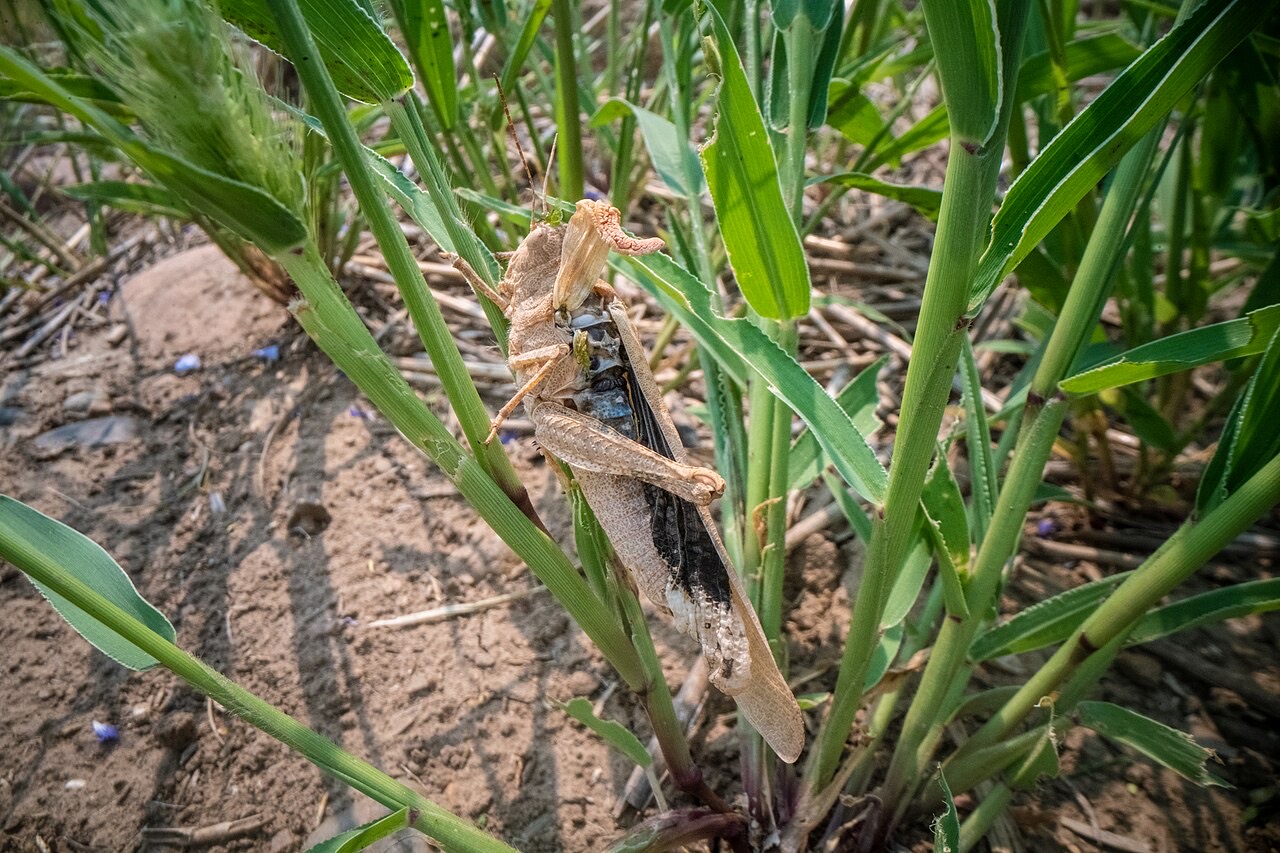
Grasshoppers (suborder Caelifera, mainly family Acrididae) are chewing insects found in grasslands, rangelands, and field margins worldwide. Most species live at low, background densities, but populations of some can increase sharply under favourable conditions and move into adjacent crops in search of food.
Grasshoppers are closely related to locusts, and in a few species the same insects can shift between a solitary form and a swarming, migratory phase, though most grassland grasshopper species of concern to crops remain solitary and cause localized rather than swarm-scale damage.
Identification
Grasshoppers have large hind legs adapted for jumping, short antennae relative to their body (distinguishing them from crickets and katydids), and chewing mouthparts. Colour and size vary widely among species, from a couple of centimetres to several centimetres long.
Damage appears as ragged, irregular feeding along leaf margins and, at higher densities, complete stripping of foliage and feeding on seed heads and stems.
Biology and life cycle
Most pest grasshopper species overwinter as eggs laid in soil, particularly in undisturbed field margins, rangeland, and roadsides. Nymphs hatch in spring and develop through several instars before becoming winged adults, with warm, dry conditions generally favouring egg survival and faster development.
Damage and hosts
Feeding reduces photosynthetic leaf area and can damage seed heads directly, with the greatest impact typically occurring when large numbers move from drying field margins or rangeland into adjacent crops as vegetation there declines.
Host crops include wheat, maize, and sorghum, along with many rangeland grasses and other field crops, particularly at field edges.
Monitoring
Counting nymphs and adults in field margins and rangeland during spring, and monitoring conditions known to favour outbreaks, such as warm, dry weather following egg-laying seasons, help anticipate movement into crops and inform timely field-edge scouting.
Management principles
Grasshopper management typically targets field margins and early nymphal stages before large populations move into the crop itself.
- Monitor field margins and rangeland for nymphs early in the season
- Conserve birds, predatory insects, and entomopathogenic natural enemies
- Manage vegetation at field edges to reduce egg-laying and early nymphal habitat where appropriate
- Coordinate monitoring and any response at a landscape scale, since populations move between rangeland and cropland
Relationships
Evidence-backed connections in the knowledge graph.
Risk increases under
Scope & limitations
Geographic scope: Found worldwide wherever grassland, rangeland, or field crops occur; outbreak-prone species and typical triggers vary by region.
Climate context: Warm, dry conditions during and after egg-laying generally favour higher survival and faster nymphal development, and drought can accelerate movement from drying rangeland into irrigated or greener crops.
- This is a general overview of a large family of grassland and field insects, not species-level guidance for a specific crop or region.
- Thresholds and control-product recommendations are jurisdiction-specific and are not provided here.
Sources
This article draws on the following authoritative sources. See our sources & methodology for how they are selected.
- [1]CABI Digital Library — Crop Protection Compendium (opens in a new tab)High
CABI (Centre for Agriculture and Bioscience International)
Cited for: Biology, hosts, and distribution
- Type:
- Reference database
- Jurisdiction:
- Global
- Accessed:
- 2026-07-12
- [2]USDA APHIS — Animal and Plant Health Inspection Service (opens in a new tab)Authoritative
USDA Animal and Plant Health Inspection Service (APHIS)
Cited for: Monitoring and regulatory context
- Type:
- Government agency
- Jurisdiction:
- United States
- Accessed:
- 2026-07-12
- [3]Iowa State University Extension and Outreach (opens in a new tab)High
Iowa State University Extension and Outreach
Cited for: Field scouting and cultural management context
- Type:
- University extension service
- Jurisdiction:
- United States (Iowa)
- Accessed:
- 2026-07-12
- [4]FAO — Food and Agriculture Organization (opens in a new tab)Authoritative
Food and Agriculture Organization of the United Nations (FAO)
Cited for: Outbreak context and management principles
- Type:
- Intergovernmental organization
- Jurisdiction:
- Global
- Accessed:
- 2026-07-12