Plant Disease · Plant disease
Gray Mold
Botrytis cinerea
Also known as: Botrytis blight, Botrytis bunch rot, Grey mould
Gray mold is a widespread fungal disease caused by Botrytis cinerea, one of the broadest host-range plant pathogens known. It causes fuzzy grey fungal growth and rapid decay on flowers, fruit, and foliage, and is a major cause of losses both in the field and after harvest.
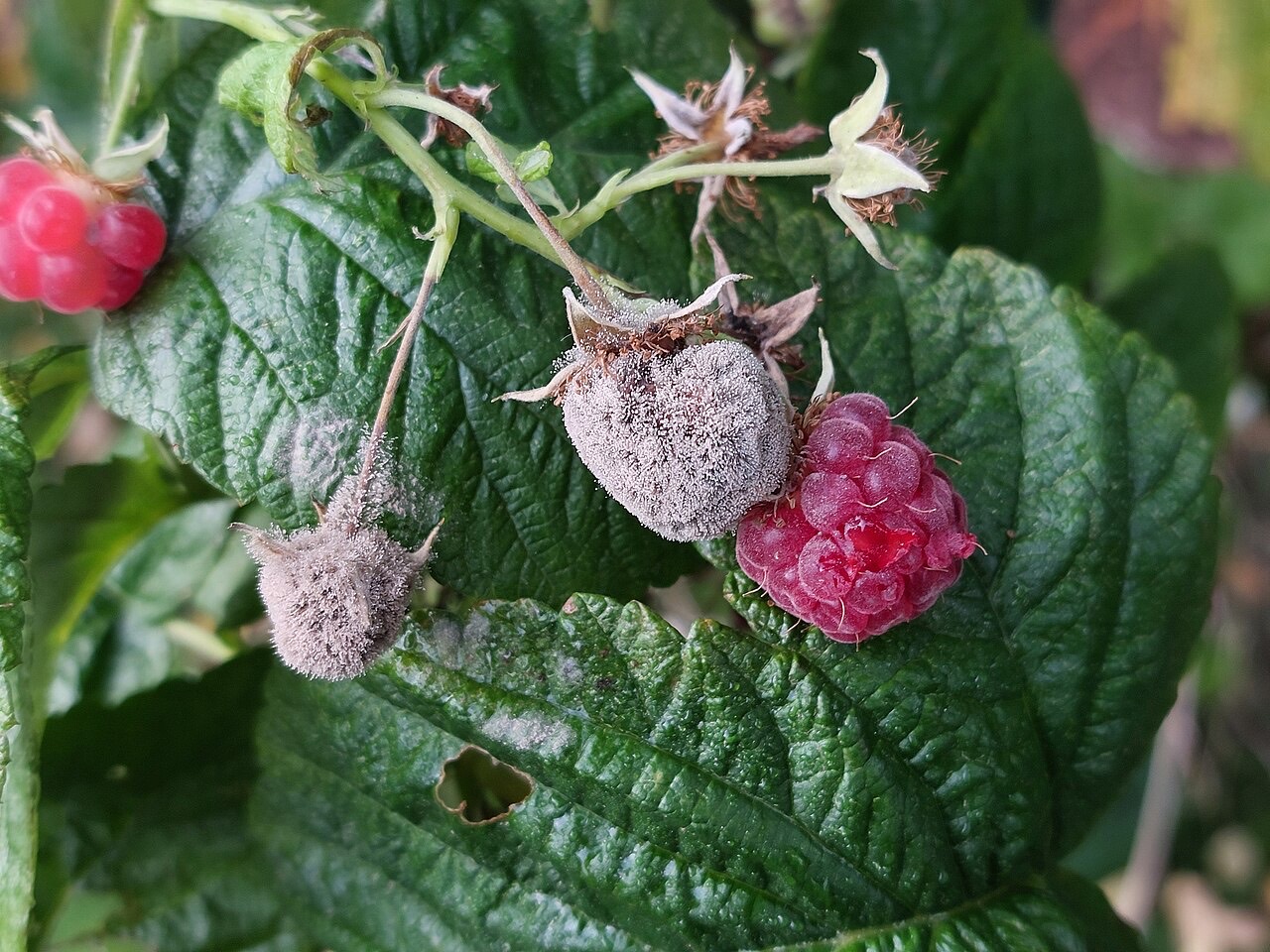
Gray mold is caused by Botrytis cinerea, a necrotrophic fungus that kills plant tissue and then feeds on the dead cells. It is unusual among plant pathogens for its extremely broad host range, attacking more than a hundred crop species, and for its ability to attack wounded, senescent, or otherwise stressed tissue especially readily.
The disease is economically important on grapevine, where it causes bunch rot, and on strawberry and tomato, where it damages flowers, fruit, and stems. Because it also develops in storage and transit, gray mold is a significant post-harvest as well as field problem.
Identification
Gray mold is identified by a fuzzy, grey to brown fungal growth that develops on decaying or infected flowers, fruit, stems, and leaves, often starting at wounds, faded flower parts, or where plant surfaces touch. Infected tissue typically becomes soft, water-soaked, and brown before the characteristic grey spore layer appears.
Biology and disease cycle
Botrytis cinerea produces huge numbers of airborne conidia (asexual spores) on infected tissue, which are dispersed by wind and water splash to new hosts. The fungus is an efficient necrotroph, often entering through wounds, dead or senescing tissue such as spent flower petals, or areas of high humidity where plant parts touch, before spreading into adjacent healthy tissue.
- Survives between seasons as resting structures (sclerotia) or as mycelium in plant debris
- Infection is strongly favoured by free moisture and moderate, cool temperatures
- Can continue to develop after harvest, making storage and transit conditions important
Affected hosts
Grapevine, strawberry, and tomato are among the crops most affected by gray mold, but its host range extends to a very wide range of vegetables, fruits, and ornamentals. On grape it causes bunch rot of ripening clusters; on strawberry it rots flowers and fruit; and on tomato it can blight flowers, stems, and fruit, particularly in humid greenhouse production.
| Host | Commonly affected tissue | Typical symptom |
|---|---|---|
| Grape | Ripening berry clusters | Soft rot with grey fungal growth (bunch rot) |
| Strawberry | Flowers and fruit | Brown, soft rot with grey spore layer |
| Tomato | Flowers, stems, fruit | Blighted flowers; stem and fruit lesions |
Risk factors
- Cool, humid conditions with prolonged leaf, flower, or fruit wetness
- Dense canopies and poor air circulation, especially in greenhouses and tunnels
- Wounds from handling, insects, or weather, and senescent tissue such as spent flowers
- Excessive nitrogen supply producing soft, lush growth
- Fruit clusters or plants in close contact, allowing the fungus to spread between touching tissue
Prevention and monitoring
Because Botrytis cinerea readily colonises wounded or senescent tissue and spreads rapidly in humid conditions, management focuses on reducing humidity and injury, removing infection sources, and inspecting produce regularly.
- Improve air movement through spacing, pruning, and canopy management
- Remove spent flowers, damaged fruit, and infected debris promptly
- Avoid excessive nitrogen and overly dense plantings
- Handle fruit carefully to minimise wounds, and manage storage humidity and temperature
- Scout regularly, especially during cool, humid weather or in enclosed production systems
Official extension guidance
1 resource indexed from public extension publishers. Each was written for a particular place; read it at the source.
Strawberry Disease - Gray Mold
Factsheet published by Penn State Extension for Pennsylvania. It addresses strawberry. The source is organised around “Disease Cycle” and “Disease Management”.
Penn State Extension · Disease management · publisher states 2026-04-02
These are pointers to guidance published by others. Each was written for a particular place and season and is revised by its publisher; read it at the source, and check it applies where you farm.
Relationships
Evidence-backed connections in the knowledge graph.
Affects
Risk increases under
Related topics
Scope & limitations
Geographic scope: Global; gray mold occurs wherever susceptible crops are grown, with the greatest impact in cool, humid regions and in enclosed production such as greenhouses.
Climate context: Favoured by cool temperatures and high humidity with prolonged surface wetness; humid, poorly ventilated production environments carry particular risk.
- This is a general overview covering a very broad-host-range pathogen; specific risk and severity vary substantially by crop, cultivar, and region.
- Control-product recommendations are jurisdiction-specific and are deliberately not provided here.
Sources
This article draws on the following authoritative sources. See our sources & methodology for how they are selected.
- [1]CABI Digital Library — Crop Protection Compendium (opens in a new tab)High
CABI (Centre for Agriculture and Bioscience International)
Cited for: Pathogen biology, host range, and disease cycle
- Type:
- Reference database
- Jurisdiction:
- Global
- Accessed:
- 2026-07-12
- [2]EPPO Global Database (opens in a new tab)Authoritative
European and Mediterranean Plant Protection Organization (EPPO)
Cited for: Pathogen nomenclature and distribution
- Type:
- Reference database
- Jurisdiction:
- Global
- Accessed:
- 2026-07-12
- [3]UC Statewide Integrated Pest Management Program (UC IPM) (opens in a new tab)High
University of California Agriculture and Natural Resources (UC ANR)
Cited for: Identification and management principles
- Type:
- University extension service
- Jurisdiction:
- United States (California)
- Accessed:
- 2026-07-12
- Moderate
Cited for: General symptoms and horticultural context
- Type:
- Reference database
- Jurisdiction:
- United Kingdom
- Accessed:
- 2026-07-12
- [5]Cornell CALS — Plant pathology and crop resources (opens in a new tab)High
Cornell University College of Agriculture and Life Sciences
Cited for: Greenhouse and fruit crop risk factors
- Type:
- University extension service
- Jurisdiction:
- United States (New York)
- Accessed:
- 2026-07-12