Plant Disease · Plant disease
Downy Mildew
Multiple genera (e.g. Plasmopara, Peronospora, Pseudoperonospora, Bremia spp.)
Also known as: Downy mildews
Downy mildew is a group of oomycete diseases, not a single pathogen, that produce yellow leaf patches and a characteristic fuzzy sporulation on the underside of leaves. Different host-specialised species affect grapevine, cucurbits, lettuce, sunflower, and many other crops.
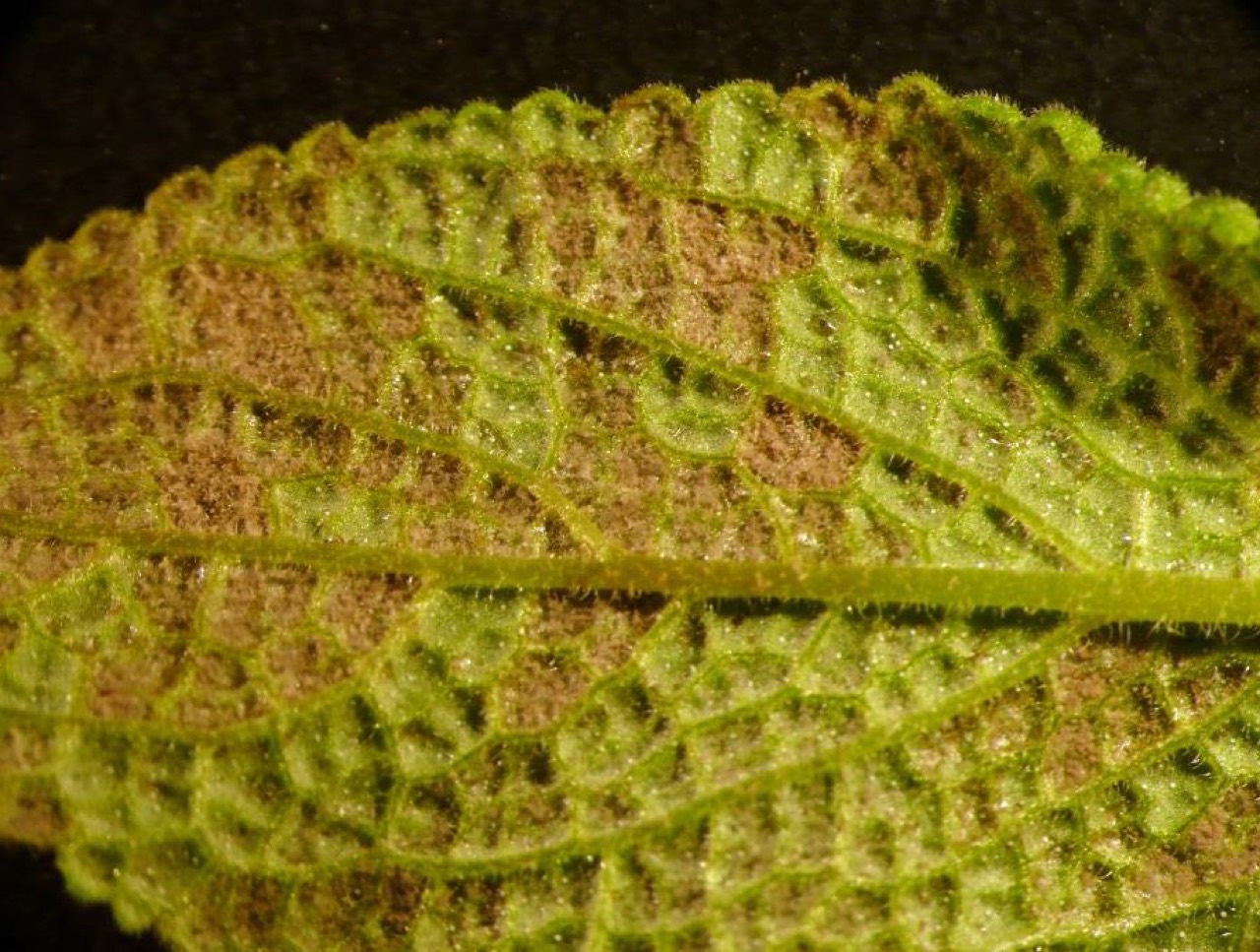
"Downy mildew" describes a group of related but distinct diseases caused by obligate, host-specialised oomycetes in the family Peronosporaceae. Well-known examples include Plasmopara viticola on grapevine, Pseudoperonospora cubensis on cucurbits such as cucumber, Bremia lactucae on lettuce, and Plasmopara halstedii on sunflower.
Although the causal organisms differ by host, downy mildews share a broadly similar biology: they thrive in humid, wet conditions, spread rapidly by wind- and rain-dispersed sporangia, and are managed mainly through prevention, resistant varieties, and canopy conditions that limit leaf wetness.
Identification
Downy mildew typically produces pale green to yellow patches on the upper leaf surface, often bounded by the leaf veins so that they appear angular rather than rounded. On the corresponding underside, especially in humid or damp conditions, a fuzzy grey, purplish, or white sporulating growth develops, most visible early in the morning while dew is still present.
Biology and disease cycle
Downy mildew oomycetes produce sporangia on infected leaf undersides that are carried by wind and rain splash to new leaves and plants, where they can release swimming zoospores under wet conditions that actively move toward and infect fresh tissue. This cycle can repeat every few days when humidity stays high and leaves remain wet for extended periods.
- Foliage-infecting species (e.g. on grape and cucurbits) survive between seasons mainly in infected plant debris
- Some species, such as the sunflower downy mildew pathogen, also produce long-lived oospores in soil that can infect roots and cause systemic seedling infection
- Cool, humid nights with dew formation favour sporulation and new infections
Affected hosts
Because downy mildew species are largely host-specific, the crops most commonly affected include grapevine, cucurbits such as cucumber, lettuce, sunflower, and members of the brassica and onion families, among others. The presence of downy mildew on one crop does not indicate risk to unrelated crops nearby, since the causal oomycetes rarely cross between very different host groups.
Risk factors
- Prolonged leaf wetness from rain, dew, fog, or overhead irrigation
- High humidity combined with moderate-to-cool temperatures
- Dense canopies with poor air circulation that trap moisture
- Susceptible varieties and continuous cropping of the same host
- For soil-borne species, wet soils around germination and establishment
Prevention and monitoring
Because downy mildews spread quickly under favourable weather, management focuses on reducing leaf wetness, choosing resistant varieties, and detecting infection early.
- Choose resistant or tolerant varieties where available
- Improve air movement through appropriate spacing and canopy management
- Avoid overhead irrigation practices that extend leaf wetness, where practical
- Improve drainage and avoid waterlogged soils for species with a soil-borne stage
- Scout regularly, especially during humid, wet weather
Official extension guidance
1 resource indexed from public extension publishers. Each was written for a particular place; read it at the source.
Factsheet published by Penn State Extension for Pennsylvania. It addresses grape. The source is organised around “Disease Cycle” and “Disease Management”.
Penn State Extension · Disease management · publisher states 2026-04-02
These are pointers to guidance published by others. Each was written for a particular place and season and is revised by its publisher; read it at the source, and check it applies where you farm.
Relationships
Evidence-backed connections in the knowledge graph.
Risk increases under
Scope & limitations
Geographic scope: Global; individual downy mildew species occur wherever their specific hosts are grown, with the greatest risk in humid regions and seasons.
Climate context: Favoured by high humidity, prolonged leaf wetness, and moderate-to-cool temperatures; most species require free moisture for spore germination and infection.
- This is a general overview of a disease group, not a diagnosis for any specific crop or region.
- Individual downy mildew species differ in host range and favoured conditions; region- and crop-specific extension guidance should be consulted.
- Control-product recommendations are jurisdiction-specific and are deliberately not provided here.
Sources
This article draws on the following authoritative sources. See our sources & methodology for how they are selected.
- [1]CABI Digital Library — Crop Protection Compendium (opens in a new tab)High
CABI (Centre for Agriculture and Bioscience International)
Cited for: Downy mildew biology and host range across crops
- Type:
- Reference database
- Jurisdiction:
- Global
- Accessed:
- 2026-07-12
- [2]EPPO Global Database (opens in a new tab)Authoritative
European and Mediterranean Plant Protection Organization (EPPO)
Cited for: Pathogen nomenclature and distribution
- Type:
- Reference database
- Jurisdiction:
- Global
- Accessed:
- 2026-07-12
- [3]UC Statewide Integrated Pest Management Program (UC IPM) (opens in a new tab)High
University of California Agriculture and Natural Resources (UC ANR)
Cited for: Identification and management principles
- Type:
- University extension service
- Jurisdiction:
- United States (California)
- Accessed:
- 2026-07-12
- Moderate
Cited for: General symptoms and horticultural context
- Type:
- Reference database
- Jurisdiction:
- United Kingdom
- Accessed:
- 2026-07-12
- [5]Cornell CALS — Plant pathology and crop resources (opens in a new tab)High
Cornell University College of Agriculture and Life Sciences
Cited for: Vegetable and grape downy mildew risk factors
- Type:
- University extension service
- Jurisdiction:
- United States (New York)
- Accessed:
- 2026-07-12
Related topics
Crops
- Barnyard Millet
- Basil
- Bitter Gourd
- Black Cumin
- Bottle Gourd
- Broccoli
- Brussels Sprouts
- Cabbage
- Camelina
- Cauliflower
- Celery
- Chayote
- Chinese Cabbage
- Chives
- Cucumber
- Dill
- Faba Bean
- Fenugreek
- Finger Millet
- Foxtail Millet
- Garlic
- Grape
- Grass Pea
- Hops
- Kale
- Kohlrabi
- Leek
- Lettuce
- Lima Bean
- Melon
- Millet
- Mustard
- Napier Grass
- Oilseed rape
- Onion
- Pak Choi
- Perilla
- Proso Millet
- Pumpkin
- Purslane
- Quinoa
- Radish
- Rocket
- Sorghum
- Spinach
- Sunflower
- Swede
- Sweetcorn
- Swiss Chard
- Tobacco
- Turnip
- Wasabi
- Water Spinach
- Waterleaf
- Watermelon
- Welsh Onion
- Winged Bean