Crop · Fruit crop
Banana
Musa acuminata and Musa balbisiana and their interspecific hybrids; most dessert cultivars are triploid Musa acuminata (AAA group) types such as Cavendish
Also known as: Dessert banana, Plantain (cooking types)
Banana is a large, perennial, herbaceous plant grown throughout the tropics for its edible fruit. Plantings are propagated vegetatively and regrow from the underground rhizome across successive cropping cycles.
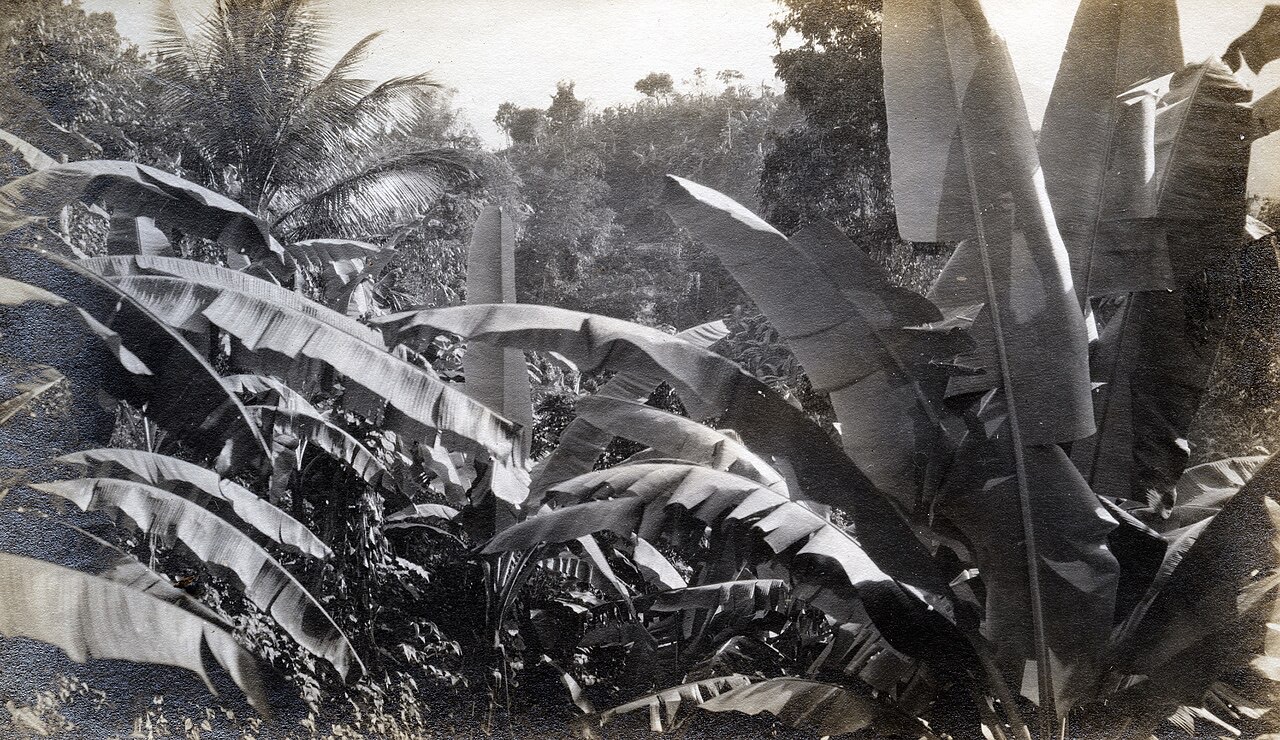
Banana is not a tree in the botanical sense but a giant perennial herb: its upright "trunk" is a pseudostem formed from tightly rolled leaf sheaths rather than woody tissue. After the plant flowers and produces a bunch of fruit, that pseudostem is cut down, and a new shoot (sucker) arising from the underground rhizome, or "mat," continues production in a ratoon cycle.
Most commercial dessert banana cultivars are sterile triploids propagated entirely vegetatively, through suckers or tissue-culture plantlets, rather than by seed. This genetic uniformity supports consistent fruit quality but also limits the crop's genetic diversity against pests and diseases.
Overview
Banana is among the most important fruit crops globally, grown both for export markets, largely as dessert Cavendish-type bananas, and for local consumption, where a wide diversity of dessert and cooking types (plantains) is grown by smallholders.
Because the crop is a perennial that regrows from its rhizome, a single planting can be cropped for multiple cycles before replanting is needed, though yield and vigor can decline over successive ratoons without good management.
Botanical classification
- Family
- Musaceae (banana family)
- Genus
- Musa
- Principal species/hybrids
- Musa acuminata and Musa balbisiana, and their interspecific hybrids
- Growth habit
- Giant perennial herb with a pseudostem of leaf sheaths, propagated by suckers or tissue culture
Origin and distribution
Banana originates from Southeast Asia and the island regions of New Guinea, where wild Musa species were domesticated and hybridized over thousands of years. It subsequently spread across the tropics of Asia, Africa, and eventually the Americas and the Pacific.
Banana is now grown throughout the humid and sub-humid tropics, with major production concentrated in tropical Asia, Latin America, and Africa.
Climate requirements
Banana requires consistently warm, humid, tropical conditions and grows poorly, or not at all, where temperatures fall much below its cold threshold. It has essentially no frost tolerance, and even brief exposure to freezing temperatures can kill above-ground growth.
High humidity and rainfall, or supplemental irrigation, support the crop's large leaf area and continuous vegetative and reproductive growth.
Soil requirements
Banana performs best on deep, fertile, well-drained loam soils with good organic matter and moisture-holding capacity, reflecting the crop's high water and nutrient demand and shallow, relatively fragile root system.
Plantation establishment and management
New plantings are established from disease-screened suckers or, increasingly, tissue-culture plantlets, which provide more uniform and disease-free planting material. Spacing and mat management balance yield with airflow and light penetration.
- Selection of clean, disease-free planting material (suckers or tissue-culture plants)
- Mat management, thinning follower suckers to maintain productive ratoon cycles
- Windbreaks or spacing adjustments, since the large leaf canopy is vulnerable to wind damage
- Bunch and leaf management practices adapted to local pest and disease pressure
Nutrient considerations
Banana is a heavy potassium feeder, since potassium is closely linked to bunch fill and fruit quality, alongside substantial nitrogen requirements to sustain its rapid vegetative growth and large leaf area.
Water and irrigation
Banana has a high and fairly continuous water requirement given its large leaf area and lack of true dormancy. In regions with a marked dry season, irrigation is used to maintain steady growth and bunch development.
Drip irrigation is increasingly used in commercial plantations to apply water efficiently to the root zone while limiting the humid canopy conditions that favor some foliar diseases.
Common diseases and pests
Fusarium wilt, historically known as Panama disease, is a soil-borne fungal disease that can persist in fields for many years and has devastated susceptible cultivars in several regions. Anthracnose is a widespread fungal disease affecting ripening and stored fruit. Plant-parasitic nematodes, including root-knot nematode, damage the root system, and thrips can scar developing fruit.
Management relies on clean planting material, resistant or tolerant cultivars where available, sanitation to limit soil-borne inoculum spread, and — where justified — locally authorized control products applied according to their labels.
Harvest
Banana bunches are typically harvested green, at a physiological maturity stage suited to the intended market and transport distance, and ripened under controlled conditions afterward. Harvest and post-harvest handling are timed to minimize bruising of the fruit and pseudostem damage to the mat.
Uses
- Fresh dessert fruit consumption
- Cooking plantains and other starchy cooking types as a staple food
- Processing into chips, purée, flour, and other products
- Pseudostem and leaves used locally for fiber, fodder, or packaging
What this page covers
clone group conceptThis page covers banana as a crop. Commercial bananas are not a wild species: they are sterile clones, usually triploid, derived from two wild species and described by genome group such as AAA or AAB.
What is grown commercially is not a wild species but a set of clones, described by genome group or parentage.
| Taxon | In this corpus | Role |
|---|---|---|
| Musa acuminataWild banana (A genome) | held as a verified taxon — listed in the taxa register, no page of its own | Contributes the A genome. Cavendish is AAA — three sets from this species. |
| Musa balbisianaWild banana (B genome) | held as a verified taxon — listed in the taxa register, no page of its own | Contributes the B genome, and with it much of the drought and disease tolerance of the cooking clones. |
| Musa × paradisiacaPlantain | held as a verified taxon | The AAB cooking hybrid, held as its own taxon and published as its own page. |
When a taxon here earns its own page: A genome group is not a taxon, so nothing can be promoted out of this concept by splitting. What can be published separately is a hybrid the authorities accept as a taxon — which is why plantain has a page and Cavendish does not.
Botanical identity
Genus-level crop concept- Accepted name
- MusaL.
- Family
- Musaceae
- Genus
- Musa
- Harvested part
- fruit
- Agricultural use
- human food
- Crop group
- Fruit
What the authorities say
Commercial bananas are not a wild species. They are cultivated clones derived from Musa acuminata and Musa balbisiana, usually triploid, and described by genome group (AAA, AAB, ABB) rather than by species. Cavendish is AAA. Publishing a single species identity for "banana" would assert a wild taxon that commercial bananas are not. Both parent species are held separately with verified identities, and plantain is held as the hybrid.
- Commercial banana cultivars are sterile clones described by genome group (AAA, AAB, ABB), not by species. Their agronomy — disease susceptibility above all — follows the clone, not a species name.
Botanical identity here is what the consulted taxonomic authorities publish, on the date they were read. Where authorities disagree, both readings are shown rather than one being chosen silently.
Traded as
This crop is traded as one commodity in this corpus.
What AgricultureID holds for this crop
- 76 crop calendar records
- 4 pests and diseases naming this crop as a host
- 1 soil references
- 2 climate references
- 282 market price series
- 2 related crops
Not held
- No published cultivars — not researched
- No official variety registrations — source exists not mapped
- No verified extension resources — source exists not ingested
- No farm economics observations — source exists not mapped
An absence here means this corpus holds no such record, not that none exists.
How to read figures on this page
Production, area and trade figures for any crop change from season to season and are compiled by FAO and by national agricultural statistics agencies. Take current numbers from those primary sources, dated to the period you mean, rather than from a secondary summary — including this one.
Crop water requirements are estimated from reference evapotranspiration and local climate data, following methods published by FAO and national agricultural agencies. A requirement quoted without the reference method and the local climate behind it is not a number that can be applied to a field.
Part of
Related crops
Planting and harvest calendar
Usual sowing and harvest windows across 76 jurisdictions, covering banana and banana — season 1 and banana — season 2.
Authorised inputs (France)
The French register records 33 currently authorised products whose authorised use names this crop, held by 27 authorisation holders. This is a count of what exists on the register, not a recommendation and not a shortlist.
By function
- Insecticide 10
- Fongicide 10
- Régulateur de croissance 4
- Herbicide 4
- Acaricide 3
- Stimulateur des défenses naturelles 2
Targets named on the register
- Cercosporioses 6
- Cochenilles 6
- Acariens 5
- Thrips 5
- Act. Qual. Fruits 4
- Aleurodes 4
Use scope is recorded as the register writes it. Collective terms cover several crops at once and are left unmapped rather than expanded, because expanding one entry into several would invent authorisations that were never granted.
Authorisation is specific to one jurisdiction, one legal object and one moment. It is not a recommendation, and it says nothing about how a product may be used: always read the current official label at the source before acting.
Tools for this
Each tool shows its formula, constants and sources, and starts empty — nothing is filled in from this page.
- Seed-rate calculator
Convert a target plant stand into a seed rate, allowing for germination and establishment.
- Row spacing calculator
Work out in-row spacing and plants per metre of row for a target density.
- Production, area and yield calculator
Relate a harvested area and a yield to a production total, in either direction.
- Growing degree-days calculator
Accumulate heat units against a base temperature.
Relationships
Evidence-backed connections in the knowledge graph.
Susceptible to
Suitable soils
Irrigation methods
Managed with
Farming systems
Harvested commodities
The traded commodities harvested from this crop. A commodity is the harvested lot, described by its own quality, grading, and storage evidence — not by the agronomy of the plant.
Scope & limitations
Geographic scope: Global overview of tropical production. Cultivar choice and management practices vary widely by region.
Climate context: Tropical perennial herb with no frost tolerance, requiring consistently warm, humid conditions.
- Cultivar diversity and disease pressure (including Fusarium wilt strains) vary substantially by region and are not detailed here.
- Production statistics change annually and should be taken from primary datasets such as FAOSTAT.
Sources
This article draws on the following authoritative sources. See our sources & methodology for how they are selected.
- [1]FAO — Food and Agriculture Organization (opens in a new tab)Authoritative
Food and Agriculture Organization of the United Nations (FAO)
Cited for: Global banana production and food-security role
- Type:
- Intergovernmental organization
- Jurisdiction:
- Global
- Accessed:
- 2026-07-12
- [2]FAOSTAT — FAO statistical database (opens in a new tab)Authoritative
Food and Agriculture Organization of the United Nations (FAO)
Cited for: Production and area statistics
- Type:
- Intergovernmental organization
- Jurisdiction:
- Global
- Accessed:
- 2026-07-12
- Authoritative
Cited for: Classification and nomenclature
- Type:
- Reference database
- Jurisdiction:
- United States
- Accessed:
- 2026-07-12
- [4]CABI Digital Library — Crop Protection Compendium (opens in a new tab)High
CABI (Centre for Agriculture and Bioscience International)
Cited for: Banana disease and pest compendium data
- Type:
- Reference database
- Jurisdiction:
- Global
- Accessed:
- 2026-07-12
Cited for: Banana genetic resources and disease research
- Type:
- Research institute
- Jurisdiction:
- Global
- Accessed:
- 2026-07-12