Plant Disease · Plant disease
Citrus Canker
Xanthomonas citri subsp. citri (syn. Xanthomonas axonopodis pv. citri)
Also known as: Bacterial canker of citrus
Citrus canker is a bacterial disease causing raised, corky lesions on the leaves, stems, and fruit of orange and other citrus. It is spread mainly by wind-driven rain and readily moved on contaminated plant material, equipment, and clothing.
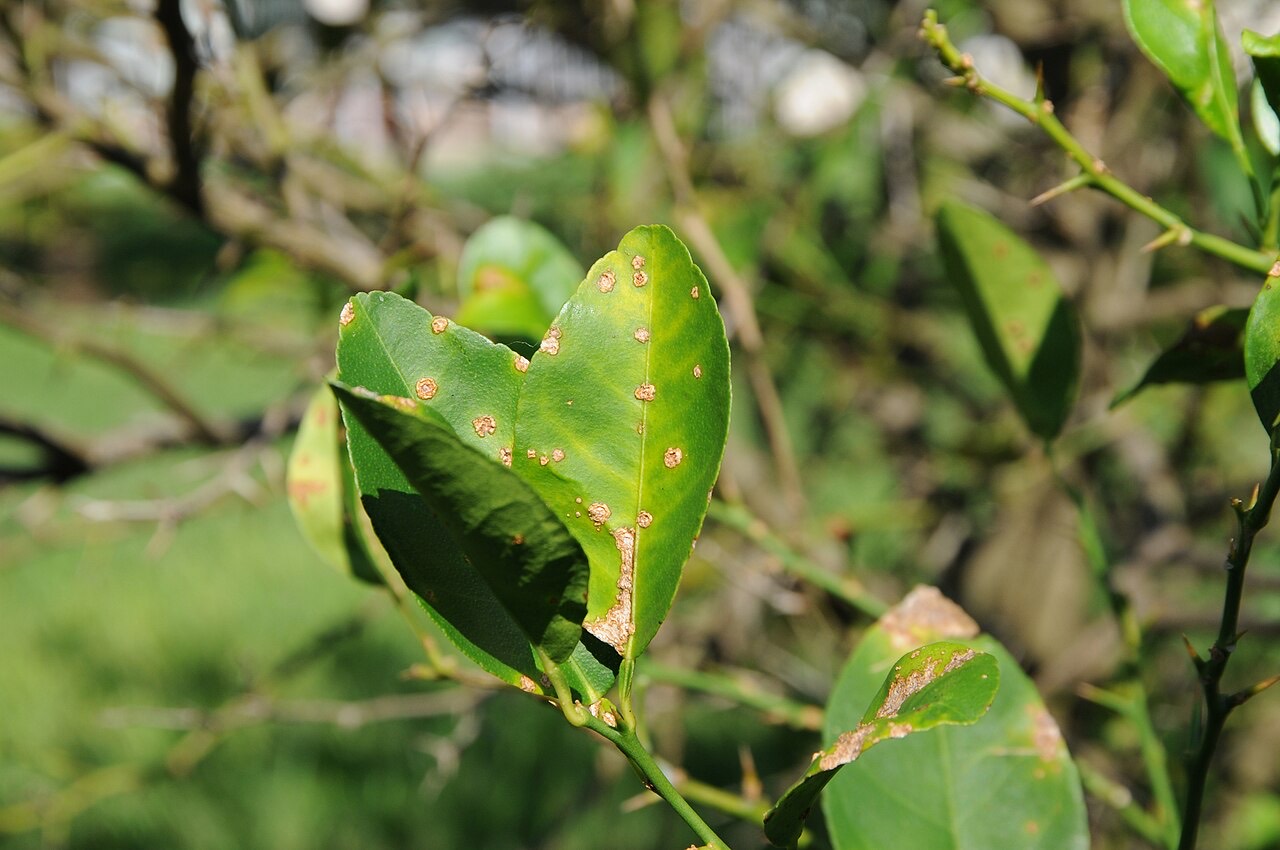
Citrus canker, caused by the bacterium Xanthomonas citri subsp. citri, produces raised, corky lesions on leaves, twigs, and fruit of orange and many other citrus species. It is a regulated quarantine pest in a number of citrus-producing regions because of its economic significance and capacity for long-distance spread through infected material.
Within an affected area, the disease spreads mainly over short distances via wind-driven rain, while longer-distance introductions typically involve movement of infected nursery stock, budwood, fruit, or contaminated equipment and clothing.
Identification
Lesions appear as raised, corky spots, often tan to brown with a water-soaked margin and a yellow halo, on leaves, twigs, and fruit. Under severe infection, lesions can coalesce, causing defoliation and blemished fruit that affects marketability even when the interior is unaffected.
Biology and disease cycle
Bacteria ooze from existing lesions in wet conditions and are dispersed mainly by wind-driven rain over short distances within and between nearby trees. The bacteria enter host tissue through stomata or wounds, including wounds created by leaf-mining insects, which substantially increase infection success.
- Wind-driven rain, especially during storms, is the main driver of local spread
- Leaf-miner damage creates wounds that greatly increase infection efficiency
- Long-distance spread occurs mainly through movement of infected nursery stock, fruit, or contaminated equipment and clothing
Affected hosts
Orange and many other citrus species and hybrids are susceptible to citrus canker, though susceptibility varies among citrus types and cultivars.
Risk factors
- Windy, rainy, or humid weather, especially during storms
- Presence of leaf-miner damage creating entry wounds
- Movement of infected nursery stock or contaminated equipment between groves
- Dense plantings with overlapping canopies
Prevention and monitoring
Because citrus canker is a regulated pest in many regions and spreads readily through wind-driven rain and contaminated material, prevention combines clean planting material, physical barriers, sanitation, and compliance with local regulations.
- Use certified, disease-free nursery stock
- Manage leaf-miner populations as part of an integrated approach
- Establish windbreaks where practical to reduce wind-driven rain spread
- Sanitise equipment and restrict movement between groves, and follow official reporting protocols where citrus canker is a regulated pest
Regulatory status
Official listings recorded for this organism. Listing is a regulatory fact and is separate from where the organism actually occurs.
EPPO A1 Listversion 2025-09
Listed as: Xanthomonas citri subsp. citri and Xanthomonas citri subsp. aurantifolii
EPPO region · recorded status: recommended for regulation · verified 2026-08-20
- EPPO A1 and A2 entries are recommendations to EPPO member countries, not statutory quarantine status in any particular country. Confirm the position with the national plant health authority.
- A1 pests are listed by EPPO as absent from the EPPO region. Listing reflects recommended regulation, not presence.
EPPO A1 List of pests recommended for regulation as quarantine pestsEPPO Global Database
Regulatory status is jurisdiction-specific and changes. Confirm the current position with the responsible plant health authority before acting on it. All recorded listings
Relationships
Evidence-backed connections in the knowledge graph.
Affects
Scope & limitations
Geographic scope: Occurs in a number of citrus-producing regions worldwide; regulated as a quarantine pest in several countries, with strict controls on movement of citrus material.
Climate context: Favoured by windy, rainy, or humid weather, particularly storms, which drive short-distance spread; humid conditions also favour bacterial survival and lesion development.
- This is a general overview; citrus canker is a regulated quarantine pest in many jurisdictions, and specific reporting and control obligations vary by region and are not covered here.
- Control-product recommendations are jurisdiction-specific and are deliberately not provided here.
Sources
This article draws on the following authoritative sources. See our sources & methodology for how they are selected.
- [1]CABI Digital Library — Crop Protection Compendium (opens in a new tab)High
CABI (Centre for Agriculture and Bioscience International)
Cited for: Pathogen biology, disease cycle, and host range
- Type:
- Reference database
- Jurisdiction:
- Global
- Accessed:
- 2026-07-12
- [2]EPPO Global Database (opens in a new tab)Authoritative
European and Mediterranean Plant Protection Organization (EPPO)
Cited for: Pathogen nomenclature and distribution
- Type:
- Reference database
- Jurisdiction:
- Global
- Accessed:
- 2026-07-12
- [3]USDA APHIS — Animal and Plant Health Inspection Service (opens in a new tab)Authoritative
USDA Animal and Plant Health Inspection Service (APHIS)
Cited for: Regulatory status and quarantine considerations
- Type:
- Government agency
- Jurisdiction:
- United States
- Accessed:
- 2026-07-12
- [4]UC Statewide Integrated Pest Management Program (UC IPM) (opens in a new tab)High
University of California Agriculture and Natural Resources (UC ANR)
Cited for: Identification and management principles
- Type:
- University extension service
- Jurisdiction:
- United States (California)
- Accessed:
- 2026-07-12