Crop · Tree fruit crop
Lime
Citrus aurantiifolia (key lime); Citrus latifolia (Persian/Tahiti lime)
Also known as: Key lime, Mexican lime, Persian lime, Tahiti lime
Lime is an evergreen citrus tree grown on grafted rootstocks across tropical and warm subtropical regions. Two distinct commercial types are grown: key (Mexican) lime and Persian (Tahiti) lime, which differ in fruit size, seed content, and market role.
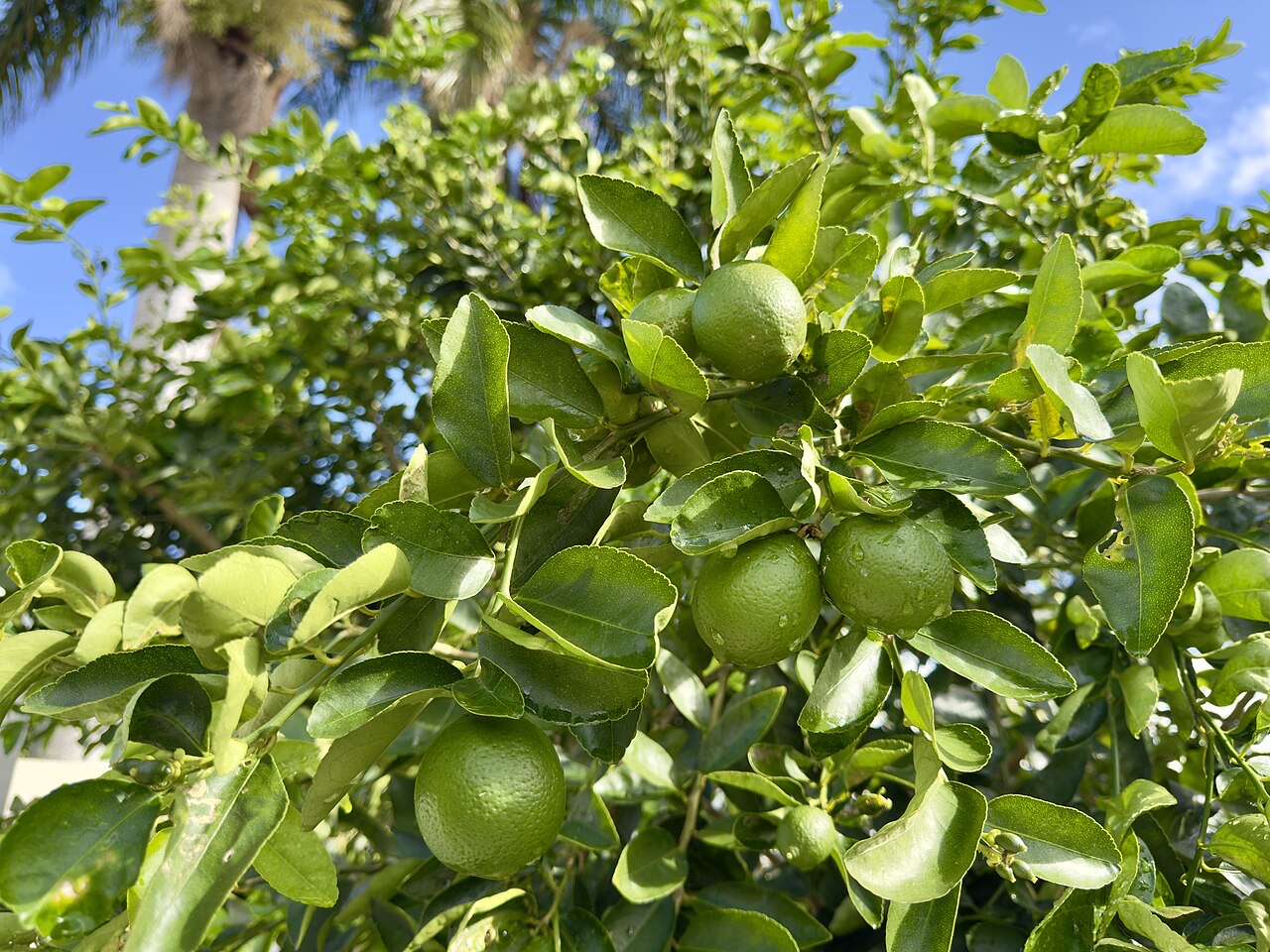
Lime is an evergreen citrus tree cultivated mainly in tropical and warm subtropical regions for fresh fruit, juice, and zest. Commercial trees are grafted onto a rootstock selected for the site, as with other citrus crops, since rootstock strongly affects vigor, disease tolerance, and soil adaptation.
Two commercially important, botanically distinct lime types are grown: key lime (also called Mexican lime), Citrus aurantiifolia, which produces smaller, more seeded fruit and is widely grown in tropical smallholdings; and Persian lime (also called Tahiti lime), Citrus latifolia, which produces larger, generally seedless fruit and dominates much of the export and commercial fresh-market trade. Lime is generally among the more cold-sensitive citrus types, requiring consistently warm, tropical-to-subtropical conditions.
Overview
Lime trees are grown as grafted, long-lived evergreen perennials, concentrated in tropical and warm subtropical growing regions where consistently warm conditions are available. Production includes both large commercial Persian lime plantings destined for fresh export markets and smaller-scale key lime production, often for local and regional markets.
Because key lime and Persian lime differ meaningfully in tree habit, fruit characteristics, and market use, orchard planning should identify which type is intended from the outset, since management and market expectations differ between them.
Botanical classification
- Family
- Rutaceae (citrus family)
- Genus
- Citrus
- Principal species
- Citrus aurantiifolia (key or Mexican lime) and Citrus latifolia (Persian or Tahiti lime)
- Growth habit
- Evergreen tree, commercially propagated by grafting a fruiting cultivar onto a selected citrus rootstock
| Aspect | Key (Mexican) lime | Persian (Tahiti) lime |
|---|---|---|
| Fruit size | Smaller | Larger |
| Seed content | More seeded | Generally seedless |
| Cold tolerance and vigor | Generally less vigorous, more cold-sensitive | Generally more vigorous |
| Main commercial role | Widely grown in tropical smallholdings; local and regional markets | Dominant in commercial export and fresh-market trade |
Origin and distribution
Key lime is believed to have originated in Southeast Asia and spread historically through trade routes into the Middle East, the Mediterranean, and later the Americas. Persian lime is understood to be a later hybrid selection that has become the dominant type in much of the modern commercial trade due to its larger, seedless fruit.
Climate requirements
Lime is generally among the more cold-sensitive commercial citrus types and requires consistently warm, tropical-to-subtropical conditions for good growth and production; it is typically less cold-tolerant than lemon and many oranges. Cold events can damage or kill foliage, twigs, and fruit, making site selection important in marginal climates.
Key lime in particular is often considered more cold-sensitive and less vigorous than Persian lime, reinforcing the importance of matching lime type to local climate.
Soil requirements
Lime performs best on deep, well-drained soils with good structure; loams and sandy loams are generally favored. As with citrus generally, lime has poor tolerance of prolonged waterlogging, which restricts rooting and increases the risk of root diseases.
Orchard establishment and management
Establishing a lime orchard begins with selecting the appropriate lime type (key or Persian) and a rootstock and cultivar combination suited to the site, since rootstocks vary in vigor, cold tolerance, disease resistance, and soil adaptation across citrus generally.
- Selection of key lime versus Persian lime based on market and climate
- Rootstock selection for vigor, cold tolerance, and disease resistance
- Site selection favoring consistently warm conditions given lime’s cold sensitivity
- Training and canopy management appropriate to the planting system
Nutrient considerations
Nitrogen strongly influences vegetative growth, flowering, and fruit yield in citrus generally. Zinc and boron are micronutrients of particular importance in citrus nutrition, supporting normal leaf development and flowering and fruit set respectively.
Water and irrigation
Lime is grown both rain-fed in humid tropical regions and under irrigation in drier subtropical citrus-growing areas. Drip irrigation and micro-sprinkler irrigation are both used in lime production, applying water efficiently to the root zone.
Irrigation scheduling aims to support consistent growth and fruit development while avoiding the waterlogging that citrus tolerates poorly.
Common diseases and pests
Citrus canker, caused by the bacterium Xanthomonas citri, is a serious, quarantine-significant disease affecting lime and citrus generally, producing raised lesions on leaves, stems, and fruit and prompting strict regulatory controls in many regions. Anthracnose can also affect lime, causing lesions on leaves, twigs, and fruit.
Scale insects and fruit flies are common citrus pests affecting lime, feeding on plant tissue or damaging fruit through larval development. Citrus psyllids are a group of concern citrus-wide as vectors of huanglongbing (citrus greening) in some regions; their presence and vector status should be assessed against local plant health authority guidance rather than assumed.
Management combines resistant or tolerant rootstocks where available, sanitation, monitoring, quarantine compliance, and — where justified — locally authorized control products applied according to their labels.
Harvest
Lime is generally hand-harvested, with maturity assessed through indicators such as fruit size, color, and juice content, since lime does not continue to ripen significantly after picking. Persian lime is typically harvested and marketed while still green, whereas ripeness indicators and harvest practices for key lime can differ by market and region.
Uses
- Fresh-market fruit
- Juice for beverages, culinary, and food-processing uses
- Zest and essential oil extracted from the peel
- Garnish and flavoring uses in food and beverage preparation
Botanical identity
Interspecific hybrid- Accepted name
- Citrus × aurantiifolia
- Family
- Rutaceae
- Genus
- Citrus
- Harvested part
- fruit
- Agricultural use
- human food
- Crop group
- Fruit
What the authorities say
- World Flora Online — Taxonomic Backbone
- Citrus × aurantiifolia
- Plants of the World Online
- Citrus × aurantiifolia
Key lime keeps its own hybrid name under both authorities. Persian lime is a different taxon, Citrus × latifolia, which only Plants of the World Online resolved.
- "Lime" covers several cultivated citrus. This identity is key lime, Citrus × aurantiifolia; Persian lime (Citrus × latifolia) and makrut lime (Citrus hystrix) are different plants.
Botanical identity here is what the consulted taxonomic authorities publish, on the date they were read. Where authorities disagree, both readings are shown rather than one being chosen silently.
What AgricultureID holds for this crop
- 2 verified extension resources
- 1 pests and diseases naming this crop as a host
- 2 soil references
- 2 climate references
- 7 related crops
Not held
- No crop calendar records — source exists not mapped
- No published cultivars — not researched
- No official variety registrations — source exists not mapped
- No farm economics observations — source exists not mapped
- No market price series — source exists not mapped
An absence here means this corpus holds no such record, not that none exists.
How to read figures on this page
Production, area and trade figures for any crop change from season to season and are compiled by FAO and by national agricultural statistics agencies. Take current numbers from those primary sources, dated to the period you mean, rather than from a secondary summary — including this one.
Crop water requirements are estimated from reference evapotranspiration and local climate data, following methods published by FAO and national agricultural agencies. A requirement quoted without the reference method and the local climate behind it is not a number that can be applied to a field.
Part of
Related crops
- Same crop concept
- Citrus, Grapefruit, Makrut Lime, Lemon, Mandarin, Orange, Pomelo
Official extension guidance
2 resources indexed from public extension publishers. Each was written for a particular place; read it at the source.
Optimising soil pH with lime to reduce emissions
Guide published by AHDB for Great Britain. It addresses lime. The source is organised around “Benefits for the environment and your farm business”, “Increased yield” and “Nutrient availability”.
Agriculture and Horticulture Development Board · Nutrient management, Farm management · publisher states no date; reachable 2026-08-27
Factsheet published by Ohio State University Extension for Ohio. It addresses lime. The source is organised around “Comparing Lime Products”, “Determining Application Rate and Cost” and “Utilizing Lime Labels”.
Ohio State University Extension · Crop establishment, Nutrient management, Farm management · publisher states no date; reachable 2026-08-27
These are pointers to guidance published by others. Each was written for a particular place and season and is revised by its publisher; read it at the source, and check it applies where you farm.
Tools for this
Each tool shows its formula, constants and sources, and starts empty — nothing is filled in from this page.
- Seed-rate calculator
Convert a target plant stand into a seed rate, allowing for germination and establishment.
- Row spacing calculator
Work out in-row spacing and plants per metre of row for a target density.
- Production, area and yield calculator
Relate a harvested area and a yield to a production total, in either direction.
- Growing degree-days calculator
Accumulate heat units against a base temperature.
Relationships
Evidence-backed connections in the knowledge graph.
Susceptible to
Suitable soils
Climate sensitivity
Irrigation methods
Machinery
Related topics
Scope & limitations
Geographic scope: Global overview of tropical and warm subtropical citrus regions. Choice of lime type, rootstock, and cold-risk management are region-specific.
Climate context: Tropical to warm subtropical evergreen citrus; generally more cold-sensitive than many other commercial citrus types.
- Cold-hardiness thresholds and harvest-maturity indicators vary by lime type, cultivar, and region and are not stated here as universal values.
- Production and cultivar-popularity statistics change over time and should be taken from primary datasets such as FAOSTAT.
Sources
This article draws on the following authoritative sources. See our sources & methodology for how they are selected.
- [1]FAO — Food and Agriculture Organization (opens in a new tab)Authoritative
Food and Agriculture Organization of the United Nations (FAO)
Cited for: Global lime and citrus production context
- Type:
- Intergovernmental organization
- Jurisdiction:
- Global
- Accessed:
- 2026-07-12
- [2]FAOSTAT — FAO statistical database (opens in a new tab)Authoritative
Food and Agriculture Organization of the United Nations (FAO)
Cited for: Production and area statistics
- Type:
- Intergovernmental organization
- Jurisdiction:
- Global
- Accessed:
- 2026-07-12
- [3]CABI Digital Library — Crop Protection Compendium (opens in a new tab)High
CABI (Centre for Agriculture and Bioscience International)
Cited for: Citrus canker and citrus pest compendium data
- Type:
- Reference database
- Jurisdiction:
- Global
- Accessed:
- 2026-07-12
- [4]UC Statewide Integrated Pest Management Program (UC IPM) (opens in a new tab)High
University of California Agriculture and Natural Resources (UC ANR)
Cited for: Integrated pest management guidelines for citrus
- Type:
- University extension service
- Jurisdiction:
- United States (California)
- Accessed:
- 2026-07-12
- Authoritative
Cited for: Classification and nomenclature
- Type:
- Reference database
- Jurisdiction:
- United States
- Accessed:
- 2026-07-12