Plant Disease · Plant disease
Sclerotinia
Sclerotinia sclerotiorum
Also known as: Sclerotinia stem rot, White mould, White mold, Cottony rot
Sclerotinia is a fungal stem and pod rot caused by Sclerotinia sclerotiorum, affecting a very wide range of broadleaf crops including oilseed rape, soybean, sunflower, and common bean. It is favoured by cool, wet conditions during and after flowering, and typically begins on senescing flower petals.
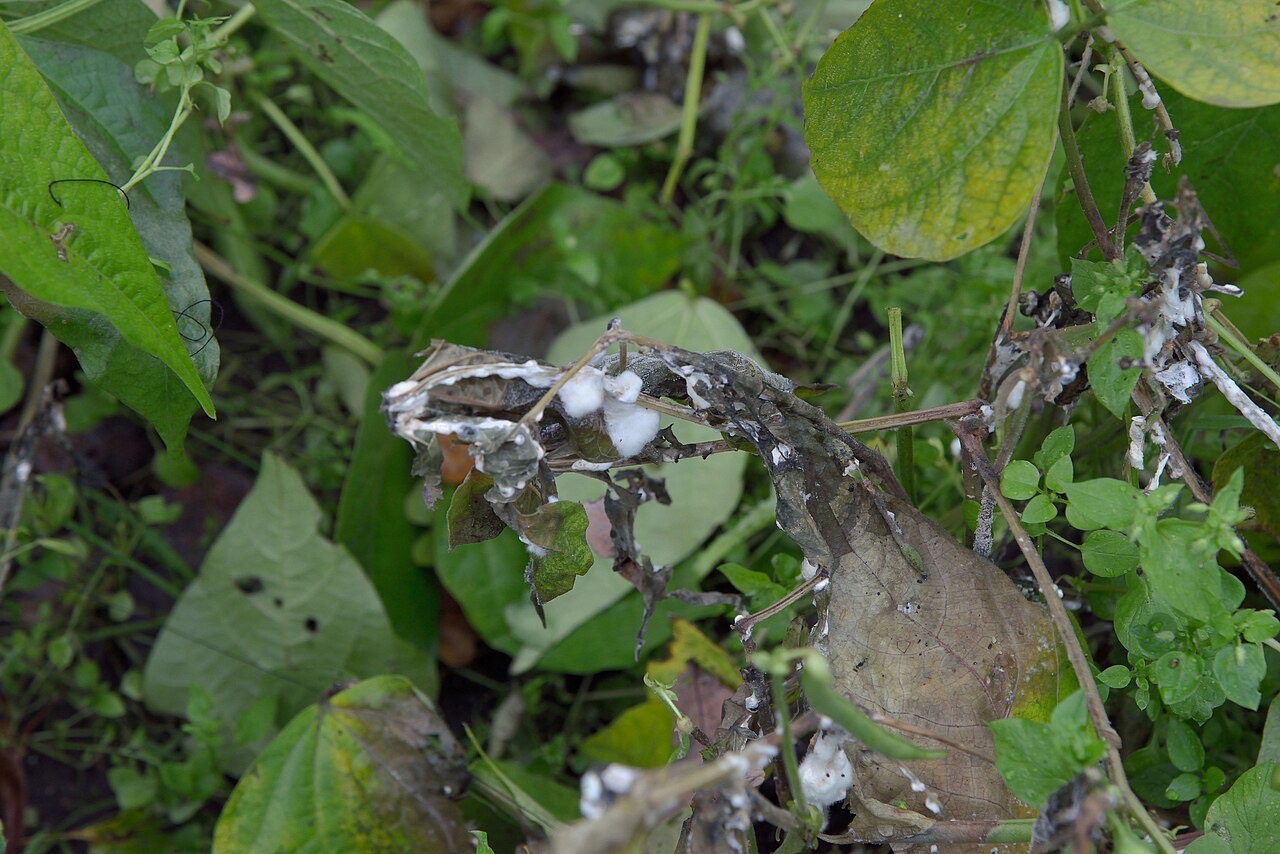
Sclerotinia stem rot, caused by the fungus Sclerotinia sclerotiorum, is one of the most broadly host-adapted fungal diseases affecting field and horticultural crops, with oilseed rape, soybean, sunflower, and common bean among its economically significant hosts.
A distinctive feature of the disease is that infection in many crops begins on senescing flower petals rather than directly on healthy green tissue: petals infected by airborne spores fall onto leaves and stems, providing the nutrient base the fungus needs to establish a stem infection.
Identification
Infected stems and pods develop bleached, straw-coloured lesions covered in white, cottony fungal growth under humid conditions. Hard, black, irregularly shaped sclerotia form inside hollowed stems or on the outer surface, and heavily infected stems can lodge or die prematurely.
Biology and disease cycle
Sclerotia surviving in soil for extended periods germinate under cool, moist conditions to produce small, mushroom-like apothecia that release airborne ascospores. These spores commonly infect senescing flower petals, which then fall onto leaves and stems and provide the nutrient source the fungus needs to invade healthy tissue.
- Sclerotia can survive in soil for a number of years even without a susceptible host
- Petal-mediated infection is a well-documented pathway in crops such as oilseed rape and soybean
- Dense canopies retain the moisture needed for apothecia development and infection
Affected hosts
Sclerotinia sclerotiorum has a very wide host range across many broadleaf crops and weeds. Oilseed rape, soybean, sunflower, and common bean are among the economically important hosts, and a history of any of these crops in rotation can build soil sclerotia levels for the others.
Risk factors
- Cool, wet weather during and immediately after flowering
- Dense canopies that restrict airflow and retain moisture at the base of the plant
- A history of susceptible broadleaf hosts in rotation, raising soil sclerotia levels
- Excess nitrogen promoting lush, dense canopy growth
- Irrigation timed close to flowering in already humid conditions
Prevention and monitoring
Because infection is closely tied to flowering and canopy moisture, prevention emphasises canopy management, rotation, and monitoring around the flowering period.
- Use wider row spacing or seeding rates that improve airflow through the canopy
- Use longer rotations away from other susceptible broadleaf hosts
- Avoid excess nitrogen that promotes dense, humid canopies
- Monitor weather-based risk information or petal testing where available around flowering
Relationships
Evidence-backed connections in the knowledge graph.
Risk increases under
Related topics
Scope & limitations
Geographic scope: Global; sclerotinia stem rot occurs in most temperate and subtropical regions growing susceptible broadleaf crops, with severity varying by season and rotation history.
Climate context: Favoured by cool, wet weather during and after flowering, which supports apothecia development and prolongs the moist conditions needed for infection.
- This is a general overview; the fungus has an unusually wide host range and specific risk varies greatly by crop, region, and rotation history.
- Control-product recommendations are jurisdiction-specific and are deliberately not provided here.
Sources
This article draws on the following authoritative sources. See our sources & methodology for how they are selected.
- [1]CABI Digital Library — Crop Protection Compendium (opens in a new tab)High
CABI (Centre for Agriculture and Bioscience International)
Cited for: Pathogen biology, disease cycle, and host range
- Type:
- Reference database
- Jurisdiction:
- Global
- Accessed:
- 2026-07-12
- [2]EPPO Global Database (opens in a new tab)Authoritative
European and Mediterranean Plant Protection Organization (EPPO)
Cited for: Pathogen nomenclature and distribution
- Type:
- Reference database
- Jurisdiction:
- Global
- Accessed:
- 2026-07-12
- [3]UC Statewide Integrated Pest Management Program (UC IPM) (opens in a new tab)High
University of California Agriculture and Natural Resources (UC ANR)
Cited for: Identification and management principles
- Type:
- University extension service
- Jurisdiction:
- United States (California)
- Accessed:
- 2026-07-12
- [4]Cornell CALS — Plant pathology and crop resources (opens in a new tab)High
Cornell University College of Agriculture and Life Sciences
Cited for: Field crop risk factors and canopy management guidance
- Type:
- University extension service
- Jurisdiction:
- United States (New York)
- Accessed:
- 2026-07-12