Crop · Oilseed crop
Oilseed rape
Brassica napus
Also known as: Canola, Rapeseed
Oilseed rape is a cool-season brassica grown for its oil-rich seed, used for cooking oil, industrial oil, biodiesel, and protein-rich meal. It is grown as winter or spring types depending on climate.
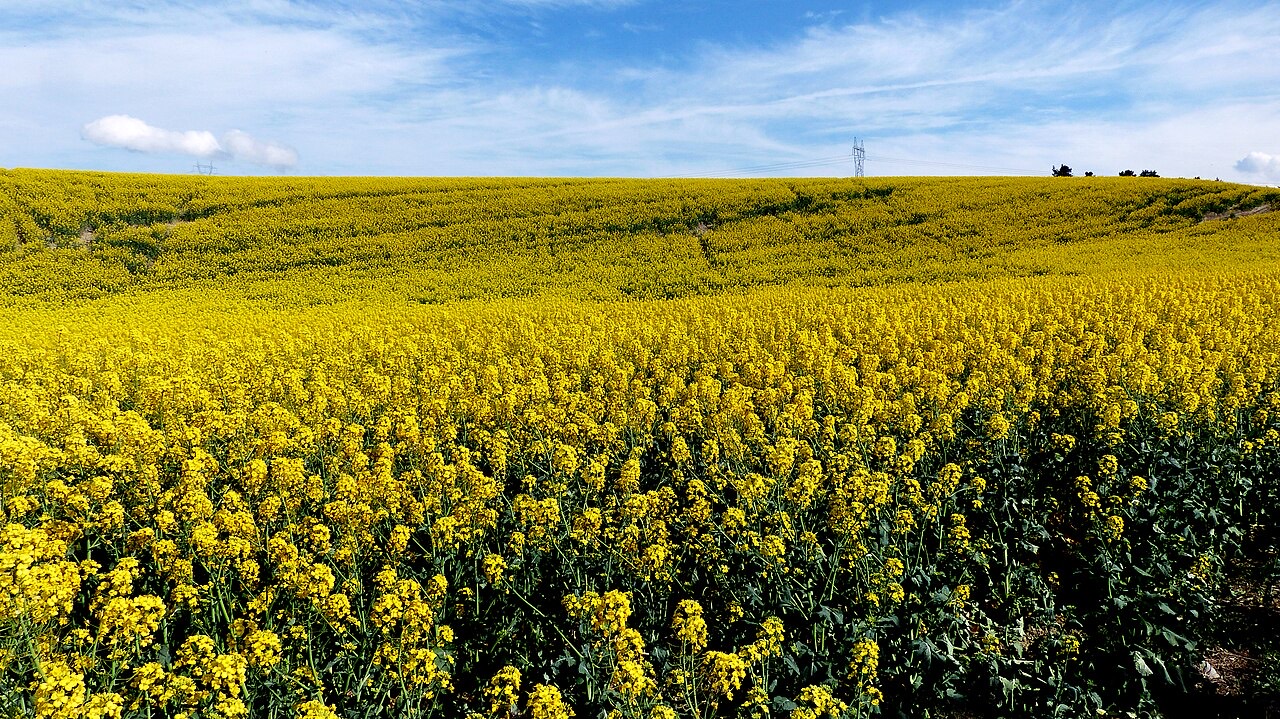
Oilseed rape, known in some markets by the trademarked term canola for its edible-oil-quality cultivars, is a brassica grown primarily for its seed, which is crushed to yield vegetable oil and a protein-rich meal. Like wheat, it is grown as winter types, sown in autumn and requiring vernalization to flower, or spring types, sown after the coldest part of the year.
Modern edible-oil cultivars are bred to have low levels of erucic acid and glucosinolates, distinguishing "canola-quality" oilseed rape from older industrial rapeseed types still grown for specialized non-food oil uses.
Overview
Oilseed rape is one of the world's leading oilseed crops, grown widely across temperate cereal-growing regions, where it also serves as a valuable break crop in rotation with cereals such as wheat.
As with other brassica crops, small seed size and a relatively slow early growth phase make careful seedbed preparation and establishment particularly important for a successful stand.
Botanical classification
- Family
- Brassicaceae (mustard family)
- Genus
- Brassica
- Principal species
- Brassica napus
- Growth habit
- Cool-season broadleaf crop producing branched stems with pods that shatter readily at maturity
Origin and distribution
Brassica napus arose from the hybridization of Brassica rapa and Brassica oleracea, and has been cultivated in Europe for centuries, initially mainly for industrial oil. Breeding of low-erucic-acid, low-glucosinolate "canola-quality" cultivars from the 1970s onward expanded its use as an edible oil crop and its cultivation worldwide.
Oilseed rape is now grown across major temperate production regions, including Europe, North America, and parts of Asia.
Climate requirements
Winter oilseed rape is sown in autumn, establishes before winter, and requires a period of cold (vernalization) to flower the following spring, tolerating moderate frost once established, though flowering itself remains vulnerable to hard frost.
Spring types are sown after the coldest part of the year in regions where autumn establishment is not viable, completing their life cycle within a single growing season without a vernalization requirement.
Soil requirements
Oilseed rape is generally grown on well-drained loams and clay loams with good structure, and it is sensitive to waterlogging, particularly during germination and early establishment, when its small seedlings are most vulnerable.
Establishment and crop management
Establishment depends on precise, shallow sowing into a fine, firm, moist seedbed, since oilseed rape's small seed reserves provide little tolerance for poor seed-to-soil contact or excessive sowing depth.
- Variety selection matched to winter/spring type and end use (edible oil versus industrial)
- Use as a break crop in rotation with cereals to disrupt weed and disease cycles
- Fine, firm seedbed preparation appropriate to the small seed size
- Early and effective weed and pest management during slow initial establishment
Nutrient considerations
Oilseed rape has a distinctively high sulfur requirement among field crops, reflecting sulfur's role in oil and glucosinolate biosynthesis, alongside substantial nitrogen demand to support yield and oil content. Phosphorus and potassium support establishment and seed fill.
Water and irrigation
Oilseed rape is predominantly grown rain-fed in temperate production regions such as much of Europe, with supplemental irrigation used in some drier growing areas.
The crop is particularly sensitive to moisture stress during flowering and pod fill, when water deficits can reduce seed number and oil content.
Common diseases and pests
Downy mildew can affect seedlings and cotyledons, particularly under cool, moist conditions, while powdery mildew can develop on foliage and stems later in the season. Aphids are a significant pest, both through direct feeding and as vectors of plant viruses, and cutworms can damage seedlings at establishment.
Management combines resistant or tolerant varieties, rotation, monitoring, and — where justified — locally authorized control products applied according to their labels.
Harvest
Oilseed rape pods are prone to shattering as they dry, so harvest timing and method — direct combining or swathing followed by combining — are chosen to balance yield retention against local weather risk. Harvested seed is dried to a moisture content suitable for safe storage.
Uses
- Vegetable (canola) oil for cooking and food processing
- Biodiesel and other industrial oil applications
- Protein-rich meal by-product used in livestock feed
- Break-crop role in cereal rotations
What this page covers
genus conceptThis page covers the rapeseed crop, which is two species and not one. Brassica napus is the amphidiploid that most of the world grows and that this page is keyed to; Brassica rapa subsp. oleifera, turnip rape, is the diploid grown where the season is too short for napus, and the rapeseed trade does not separate them.
The page covers several cultivated species of one genus. Each is a real, separately verifiable taxon; the page exists because the trade name covers all of them.
| Taxon | In this corpus | Role |
|---|---|---|
| Brassica rapa subsp. oleiferaTurnip rape | held as a verified taxon — listed in the taxa register, no page of its own | The short-season rapeseed, still grown in northern Europe and Canada where Brassica napus does not finish. Held as a taxon: the authorities also disagree about its rank, with one sinking the subspecies into the species, which is a second reason not to publish it separately. |
When a taxon here earns its own page: Turnip rape would earn its own page if its agronomy could be stated without repeating this one — and the difference is season length and ploidy, which are two facts rather than an article. It would also need the rank disagreement between the authorities resolved.
Botanical identity
Species- Accepted name
- Brassica napus
- Family
- Brassicaceae
- Genus
- Brassica
- Harvested part
- oilseed
- Agricultural use
- oilseed, animal feed, bioenergy
- Crop group
- Oilseeds
What the authorities say
- World Flora Online — Taxonomic Backbone
- Brassica napus
- Plants of the World Online
- Brassica napus
Botanical identity here is what the consulted taxonomic authorities publish, on the date they were read. Where authorities disagree, both readings are shown rather than one being chosen silently.
Traded as
This crop is traded as one commodity in this corpus.
What AgricultureID holds for this crop
- 47 crop calendar records
- 2 verified extension resources
- 3 pests and diseases naming this crop as a host
- 2 soil references
- 2 climate references
- 363 market price series
- 11 related crops
Not held
- No published cultivars — not researched
- No official variety registrations — source exists not mapped
- No farm economics observations — source exists not mapped
An absence here means this corpus holds no such record, not that none exists.
How to read figures on this page
Production, area and trade figures for any crop change from season to season and are compiled by FAO and by national agricultural statistics agencies. Take current numbers from those primary sources, dated to the period you mean, rather than from a secondary summary — including this one.
Crop water requirements are estimated from reference evapotranspiration and local climate data, following methods published by FAO and national agricultural agencies. A requirement quoted without the reference method and the local climate behind it is not a number that can be applied to a field.
Part of
Brassica — one genus, many crops · Brassicaceae — the cabbage family · Oilseeds
Related crops
- Same genus
- Broccoli, Brussels Sprouts, Cabbage, Cauliflower, Chinese Cabbage, Kale, Kohlrabi, Mustard, Pak Choi, Swede, Turnip
Planting and harvest calendar
Usual sowing and harvest windows across 47 jurisdictions, covering colza(rapeseed) and colza(rapeseed) — season 1 and colza(rapeseed) — season 2.
Official extension guidance
2 resources indexed from public extension publishers. Each was written for a particular place; read it at the source.
Cabbage stem flea beetle (CSFB) and its management in oilseed rape
Guide published by AHDB for Great Britain. It addresses cabbage. The source is organised around “Why cabbage stem flea beetle is an issue”, “Cabbage stem flea beetle IPM” and “Cabbage stem flea beetle treatment thresholds”.
Agriculture and Horticulture Development Board · Crop establishment, Pest management · publisher states no date; reachable 2026-08-27
Oilseed rape disease management guidance
Guide published by AHDB for Great Britain. It addresses oilseed rape. The source is organised around “Sclerotinia stem rot”, “Verticillium stem stripe” and “Rhizoctonia solani”.
Agriculture and Horticulture Development Board · Disease management · publisher states no date; reachable 2026-08-27
These are pointers to guidance published by others. Each was written for a particular place and season and is revised by its publisher; read it at the source, and check it applies where you farm.
Tools for this
Each tool shows its formula, constants and sources, and starts empty — nothing is filled in from this page.
- Seed-rate calculator
Convert a target plant stand into a seed rate, allowing for germination and establishment.
- Row spacing calculator
Work out in-row spacing and plants per metre of row for a target density.
- Production, area and yield calculator
Relate a harvested area and a yield to a production total, in either direction.
- Growing degree-days calculator
Accumulate heat units against a base temperature.
Relationships
Evidence-backed connections in the knowledge graph.
Susceptible to
Climate sensitivity
Machinery
Managed with
Farming systems
Related topics
Harvested commodities
The traded commodities harvested from this crop. A commodity is the harvested lot, described by its own quality, grading, and storage evidence — not by the agronomy of the plant.
Scope & limitations
Geographic scope: Global overview. Winter/spring type suitability and end use (edible versus industrial oil) are region-specific.
Climate context: Cool-season oilseed grown across temperate regions; winter types require vernalization and tolerate moderate frost once established.
- Sowing dates, seeding rates, and variety choice are region-specific decisions not covered by universal values here.
- Production statistics change annually and should be taken from primary datasets such as FAOSTAT.
Sources
This article draws on the following authoritative sources. See our sources & methodology for how they are selected.
- [1]FAO — Food and Agriculture Organization (opens in a new tab)Authoritative
Food and Agriculture Organization of the United Nations (FAO)
Cited for: Role of oilseed rape in global oilseed production
- Type:
- Intergovernmental organization
- Jurisdiction:
- Global
- Accessed:
- 2026-07-12
- [2]FAOSTAT — FAO statistical database (opens in a new tab)Authoritative
Food and Agriculture Organization of the United Nations (FAO)
Cited for: Production and area statistics
- Type:
- Intergovernmental organization
- Jurisdiction:
- Global
- Accessed:
- 2026-07-12
- [3]European Commission — Agriculture and rural development (opens in a new tab)Authoritative
European Commission, Directorate-General for Agriculture
Cited for: European Union oilseed rape production and market context
- Type:
- Government agency
- Jurisdiction:
- European Union
- Accessed:
- 2026-07-12
- [4]AHDB — Agriculture and Horticulture Development Board (opens in a new tab)High
Agriculture and Horticulture Development Board (AHDB)
Cited for: Regional oilseed rape agronomy and management
- Type:
- Government agency
- Jurisdiction:
- United Kingdom
- Accessed:
- 2026-07-12
- [5]CABI Digital Library — Crop Protection Compendium (opens in a new tab)High
CABI (Centre for Agriculture and Bioscience International)
Cited for: Oilseed rape disease and pest compendium data
- Type:
- Reference database
- Jurisdiction:
- Global
- Accessed:
- 2026-07-12