Plant Disease · Plant disease
Stem Rust
Puccinia graminis (host-specialised formae speciales, e.g. f. sp. tritici on wheat)
Also known as: Black rust, Black stem rust
Stem rust is a historically damaging fungal rust disease of wheat, barley, oats, and rye, caused by Puccinia graminis. It produces elongated, reddish-brown pustules mainly on stems and leaf sheaths and can cause severe yield loss when a virulent race meets susceptible varieties under favourable weather.
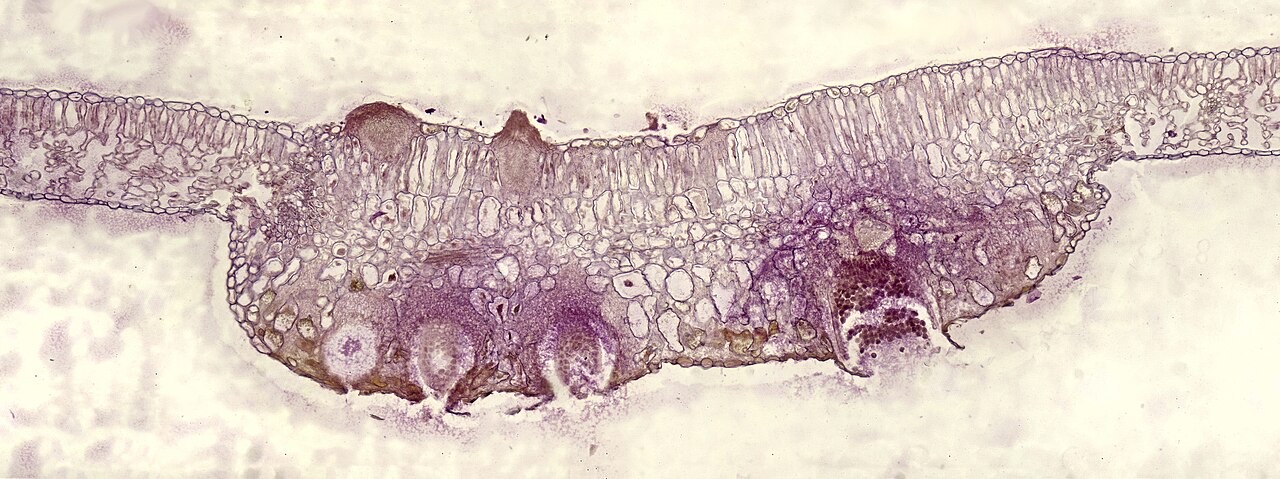
Stem rust, caused by the fungus Puccinia graminis, is one of the three classic cereal rust diseases alongside leaf rust and stripe rust. Distinct, host-specialised forms of the fungus attack different cereals: Puccinia graminis f. sp. tritici on wheat and Puccinia graminis f. sp. secalis on rye are the best known, though the fungus also affects barley and oats.
The disease has repeatedly caused severe historical epidemics, and the emergence of new virulent lineages, such as the Ug99 group first identified in East Africa, has periodically renewed international concern over resistance breakdown in widely grown wheat varieties. In some regions, the fungus completes a sexual stage on an alternate host, the barberry shrub (Berberis spp.), which generates new genetic combinations.
Identification
Stem rust produces elongated, blister-like pustules filled with reddish-brown spores, mainly on stems and leaf sheaths but sometimes on leaves and heads. As pustules mature they rupture the plant surface, giving affected tissue a rough, torn appearance, and heavily infected stems can weaken and lodge.
Biology and disease cycle
Puccinia graminis is an obligate parasite that depends on living cereal tissue for most of its life cycle. Repeating cycles of wind-dispersed urediniospores allow disease to build up rapidly through a season under favourable warm, moist conditions, with a new generation of pustules appearing roughly one to two weeks after infection.
- Volunteer cereal plants and infected residue can carry the fungus between growing seasons in some regions
- Where present, barberry acts as an alternate host allowing a sexual stage that generates new genetic variation in the pathogen
- Long-distance, wind-borne spore movement can introduce new inoculum into a region each season
Affected hosts
Wheat is the most economically significant host of stem rust, but barley, oats, and rye are also affected by forms of Puccinia graminis adapted to those hosts. Susceptibility varies considerably between cultivars and over time as pathogen populations shift.
Risk factors
- Warm temperatures combined with dew, rain, or high humidity during the growing season
- Susceptible varieties, especially where a single resistance gene has become widely deployed
- Nearby susceptible barberry plants in regions where the alternate host occurs
- Inoculum arriving from other regions on prevailing winds
- Dense, lush canopies produced by high nitrogen supply
Prevention and monitoring
Because stem rust can spread quickly across large distances once established, management relies heavily on genetic resistance, regional monitoring, and early detection rather than reacting after an epidemic is underway.
- Grow resistant or tolerant varieties recommended for the local region
- Follow regional rust surveillance and forecasting information from extension or agricultural authorities
- Manage or avoid susceptible barberry plantings where regulated in the local area
- Avoid excessive nitrogen that produces dense, highly susceptible canopies
- Scout fields regularly, particularly during periods of favourable weather
Relationships
Evidence-backed connections in the knowledge graph.
Risk increases under
Related topics
Scope & limitations
Geographic scope: Global; stem rust has historically occurred in nearly all wheat, barley, oat, and rye growing regions, with severity varying by season, region, and the resistance genes present in local varieties.
Climate context: Favoured by warm temperatures together with dew, rain, or high humidity that allow spores to germinate and infect plant tissue; long-distance wind dispersal can move spores between regions and seasons.
- This is a general overview and does not replace field diagnosis or region-specific extension guidance.
- Rust pathogen populations shift over time and by region, which affects which resistance genes remain effective; consult local authorities for current status.
- Control-product recommendations are jurisdiction-specific and are deliberately not provided here.
Sources
This article draws on the following authoritative sources. See our sources & methodology for how they are selected.
- [1]CABI Digital Library — Crop Protection Compendium (opens in a new tab)High
CABI (Centre for Agriculture and Bioscience International)
Cited for: Pathogen biology, disease cycle, and host range
- Type:
- Reference database
- Jurisdiction:
- Global
- Accessed:
- 2026-07-12
- [2]EPPO Global Database (opens in a new tab)Authoritative
European and Mediterranean Plant Protection Organization (EPPO)
Cited for: Pathogen nomenclature and distribution
- Type:
- Reference database
- Jurisdiction:
- Global
- Accessed:
- 2026-07-12
- [3]CIMMYT — International Maize and Wheat Improvement Center (opens in a new tab)High
International Maize and Wheat Improvement Center (CIMMYT)
Cited for: Global wheat rust monitoring and resistance breeding context
- Type:
- Research institute
- Jurisdiction:
- Global
- Accessed:
- 2026-07-12
- [4]UC Statewide Integrated Pest Management Program (UC IPM) (opens in a new tab)High
University of California Agriculture and Natural Resources (UC ANR)
Cited for: Identification and management principles
- Type:
- University extension service
- Jurisdiction:
- United States (California)
- Accessed:
- 2026-07-12