Crop · Cereal crop
Triticale
×Triticosecale spp. (intergeneric hybrid of wheat, Triticum, and rye, Secale)
Also known as: Wheat-rye hybrid
Triticale is a human-made cereal hybrid of wheat and rye grown mainly for livestock feed and forage, combining wheat-like grain yield potential with rye-like hardiness and tolerance of poorer soils.
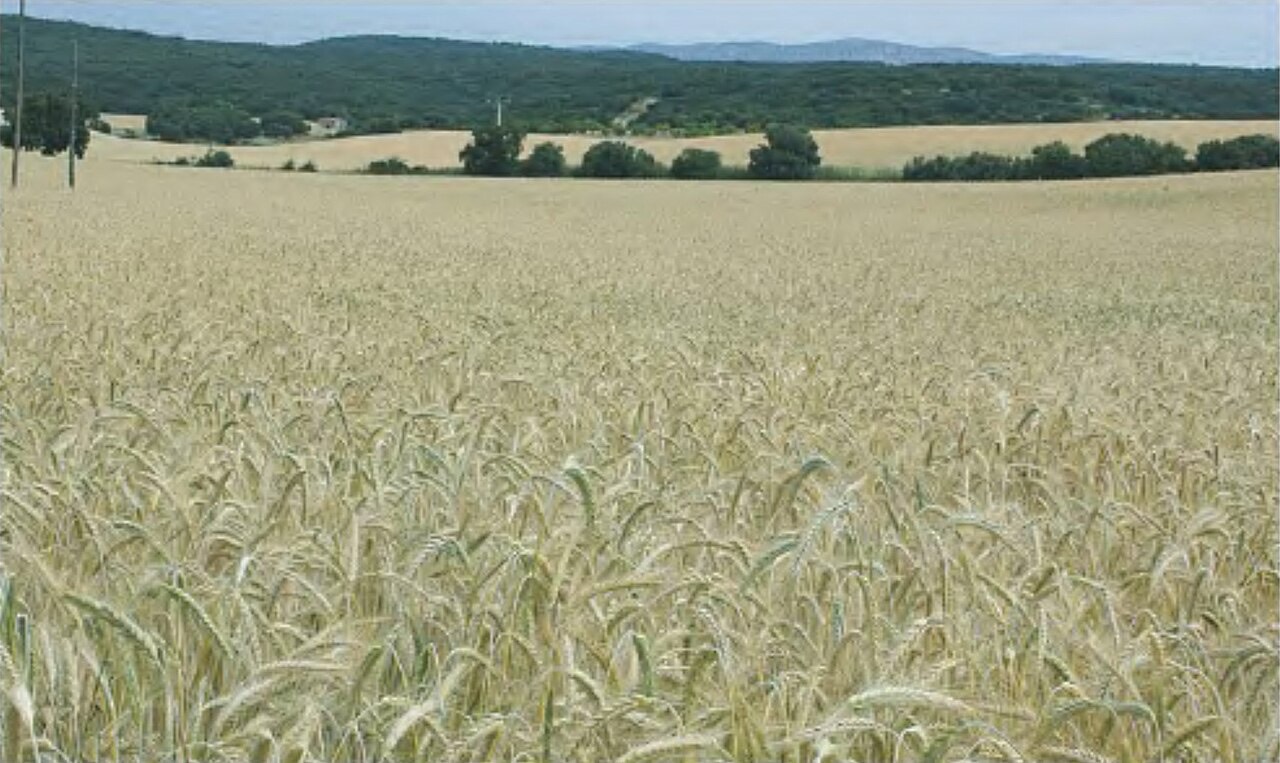
Triticale is a cereal created by crossing wheat (Triticum) with rye (Secale), then doubling the chromosome number to produce a fertile hybrid combining traits of both parents. Breeding aimed to combine the grain quality and yield potential of wheat with the hardiness, disease tolerance, and soil adaptability of rye.
It is grown mainly for animal feed and forage, and to a lesser extent for food and industrial uses, particularly on land or under conditions where wheat performs less reliably. As with wheat and rye, both winter and spring types are cultivated depending on regional climate.
Overview
Triticale is a synthetic cereal species, produced through deliberate hybridization rather than arising through natural domestication, and is one of relatively few crop species developed largely through modern plant breeding rather than long-term traditional selection.
It is grown as an alternative to wheat where soil, climate, or disease pressure favor a hardier crop, and is widely used where feed grain and forage quality, rather than milling quality, are the primary objectives.
Botanical classification
- Family
- Poaceae (grass family)
- Origin
- Intergeneric hybrid of Triticum (wheat) and Secale (rye), with the hybrid genome subsequently stabilized as an amphidiploid
- Taxonomic designation
- ×Triticosecale
- Growth habit
- Tillering annual grass producing spikes similar in form to wheat
Origin and distribution
Triticale was first produced experimentally in the late 19th century and developed into agronomically useful varieties through 20th-century breeding programs, notably in Europe and the Americas, aiming to combine wheat productivity with rye hardiness.
It is now grown across a range of temperate regions, though on a smaller total area than wheat, rye, or barley. Production statistics are compiled by national and international bodies and change over time.
Climate requirements
Triticale generally shows better cold tolerance and stress resilience than wheat, reflecting its rye parentage, while retaining reasonable yield potential under a range of temperate conditions.
As with related small grains, grain fill is sensitive to heat and drought, and winter types require a period of cold to trigger flowering.
Soil requirements
Triticale tolerates lighter, more acidic, and lower-fertility soils better than wheat, making it a useful option on marginal land, though it still responds positively to improved soil conditions.
Establishment and crop management
Establishment follows similar principles to wheat and rye: an even, well-anchored stand sown at a locally appropriate depth and rate into a firm, moist seedbed, with winter or spring type chosen according to local climate.
- Variety selection matched to winter/spring type and intended feed or forage use
- Crop rotation to manage soil-borne diseases and weeds
- Seedbed preparation appropriate to the tillage system in use
- Timely weed management during early growth
Nutrient considerations
Nitrogen, phosphorus, and potassium requirements broadly resemble those of wheat, adjusted for the lower-fertility soils on which triticale is often grown and its typical use as a feed rather than milling grain.
Water and irrigation
Triticale is grown both rain-fed and under irrigation, with water demand highest around stem elongation, heading, and grain filling, similar to wheat and rye.
Common diseases and pests
Triticale generally shows good resistance to several wheat diseases inherited from its rye parentage, though it can still be affected by stem rust and powdery mildew under favorable conditions, along with aphids that can transmit viruses.
Management combines resistant varieties, rotation, monitoring, and — where justified — locally authorized control products used according to their labels.
Harvest
Grain triticale is harvested by combining once the crop has dried to a moisture content suitable for safe storage. Where grown for whole-crop forage, it is cut and conserved as silage at an earlier growth stage matched to feed-quality goals.
Uses
- Livestock feed grain for poultry, pigs, and ruminants
- Whole-crop silage and forage
- Some use in bread and other food products, generally blended with wheat flour
- Straw for bedding or as a soil amendment
What this page covers
nothogenus conceptThis page covers triticale, the wheat–rye cross. The crop is the cross itself: commercial triticale spans several nothospecies distinguished by which wheat was used as the female parent, and naming any one of them as "triticale" would be wrong about the rest.
The crop is an intergeneric cross. Naming any one nothospecies would be wrong about the rest.
| Taxon | In this corpus | Role |
|---|---|---|
| ×Triticosecale rimpauiHexaploid triticale | not held by this corpus | The hexaploid cross, from bread wheat and rye. Most commercial grain triticale is of this kind. |
| ×Triticosecale neoblaringhemiiTetraploid-derived triticale | not held by this corpus | The cross from durum wheat and rye, giving the octoploid and secondary hexaploid lines used in forage breeding. |
When a taxon here earns its own page: Nothing splits out of a nothogenus concept while the corpus holds no nothospecies identity. The parent crops are published separately in their own right, and are linked from this page as parents rather than as constituents.
Botanical identity
Intergeneric hybridsingle source- Accepted name
- ×TriticosecaleWittm. ex A.Camus
- Family
- Poaceae
- Genus
- ×Triticosecale
- Harvested part
- grain, forage biomass
- Agricultural use
- animal feed, forage, human food
- Crop group
- Cereals
What the authorities say
- Plants of the World Online
- ×Triticosecale
A nothogenus, not a species. POWO holds ×Triticosecale Wittm. ex A.Camus as the accepted intergeneric hybrid of Triticum and Secale; WFO’s name matcher does not resolve the nothogenus, so only one authority speaks here. Naming any single ×Triticosecale species as "triticale" would be wrong: the crop is the cross, and commercial triticale spans several of them.
- Triticale is an intergeneric hybrid of wheat (Triticum) and rye (Secale). It has no single species identity, and the parentage of commercial material varies.
Botanical identity here is what the consulted taxonomic authorities publish, on the date they were read. Where authorities disagree, both readings are shown rather than one being chosen silently.
Traded as
This crop is traded as one commodity in this corpus.
What AgricultureID holds for this crop
- 25 crop calendar records
- 1 verified extension resources
- 6 pests and diseases naming this crop as a host
- 2 soil references
- 1 climate references
- 161 market price series
- 2 related crops
Not held
- No published cultivars — not researched
- No official variety registrations — source exists not mapped
- No farm economics observations — source exists not mapped
An absence here means this corpus holds no such record, not that none exists.
How to read figures on this page
Production, area and trade figures for any crop change from season to season and are compiled by FAO and by national agricultural statistics agencies. Take current numbers from those primary sources, dated to the period you mean, rather than from a secondary summary — including this one.
Crop water requirements are estimated from reference evapotranspiration and local climate data, following methods published by FAO and national agricultural agencies. A requirement quoted without the reference method and the local climate behind it is not a number that can be applied to a field.
Part of
Related crops
Planting and harvest calendar
Usual sowing and harvest windows across 25 jurisdictions, covering triticale.
Official extension guidance
1 resource indexed from public extension publishers. Each was written for a particular place; read it at the source.
Effect of Soil Fertility on Triticale Yield and Quality
Factsheet published by University of Maryland Extension for Maryland. It addresses triticale. The source is organised around “Take Home & Conclusions”, “Future Plans” and “Agronomy News: Volume 16, Issue 8: November 2025”.
University of Maryland Extension · Nutrient management · publisher states 2025-11-25
These are pointers to guidance published by others. Each was written for a particular place and season and is revised by its publisher; read it at the source, and check it applies where you farm.
Tools for this
Each tool shows its formula, constants and sources, and starts empty — nothing is filled in from this page.
- Seed-rate calculator
Convert a target plant stand into a seed rate, allowing for germination and establishment.
- Row spacing calculator
Work out in-row spacing and plants per metre of row for a target density.
- Production, area and yield calculator
Relate a harvested area and a yield to a production total, in either direction.
- Growing degree-days calculator
Accumulate heat units against a base temperature.
Relationships
Evidence-backed connections in the knowledge graph.
Susceptible to
Suitable soils
Climate sensitivity
Machinery
Farming systems
Harvested commodities
The traded commodities harvested from this crop. A commodity is the harvested lot, described by its own quality, grading, and storage evidence — not by the agronomy of the plant.
Scope & limitations
Geographic scope: Global overview. Agronomic details (timing, rates, varieties) are region-specific and vary widely.
Climate context: Cool-season hybrid cereal combining wheat productivity with rye-derived hardiness and stress tolerance.
- As a relatively recent hybrid crop, regional agronomic guidance is less extensive than for wheat or rye and should be sought from local extension sources.
- Production statistics change annually and should be taken from primary datasets such as FAOSTAT.
Sources
This article draws on the following authoritative sources. See our sources & methodology for how they are selected.
- [1]FAO — Food and Agriculture Organization (opens in a new tab)Authoritative
Food and Agriculture Organization of the United Nations (FAO)
Cited for: Role of triticale in feed and forage systems
- Type:
- Intergovernmental organization
- Jurisdiction:
- Global
- Accessed:
- 2026-07-12
- [2]FAOSTAT — FAO statistical database (opens in a new tab)Authoritative
Food and Agriculture Organization of the United Nations (FAO)
Cited for: Production, area, and trade statistics
- Type:
- Intergovernmental organization
- Jurisdiction:
- Global
- Accessed:
- 2026-07-12
- Authoritative
Cited for: Classification and nomenclature
- Type:
- Reference database
- Jurisdiction:
- United States
- Accessed:
- 2026-07-12
- [4]CIMMYT — International Maize and Wheat Improvement Center (opens in a new tab)High
International Maize and Wheat Improvement Center (CIMMYT)
Cited for: Triticale breeding and agronomy research
- Type:
- Research institute
- Jurisdiction:
- Global
- Accessed:
- 2026-07-12
- [5]AHDB — Agriculture and Horticulture Development Board (opens in a new tab)High
Agriculture and Horticulture Development Board (AHDB)
Cited for: Regional hybrid cereal agronomy and management
- Type:
- Government agency
- Jurisdiction:
- United Kingdom
- Accessed:
- 2026-07-12