Soil · Soil type
Podzol
Also known as: Podsol, Spodosol
Podzol is a strongly leached, acidic soil typically formed under coniferous or heath vegetation on coarse, sandy parent material in cool, humid climates. It is characterised by a distinctive pale, nutrient-depleted surface horizon over a darker layer where leached organic matter, iron, and aluminium accumulate.
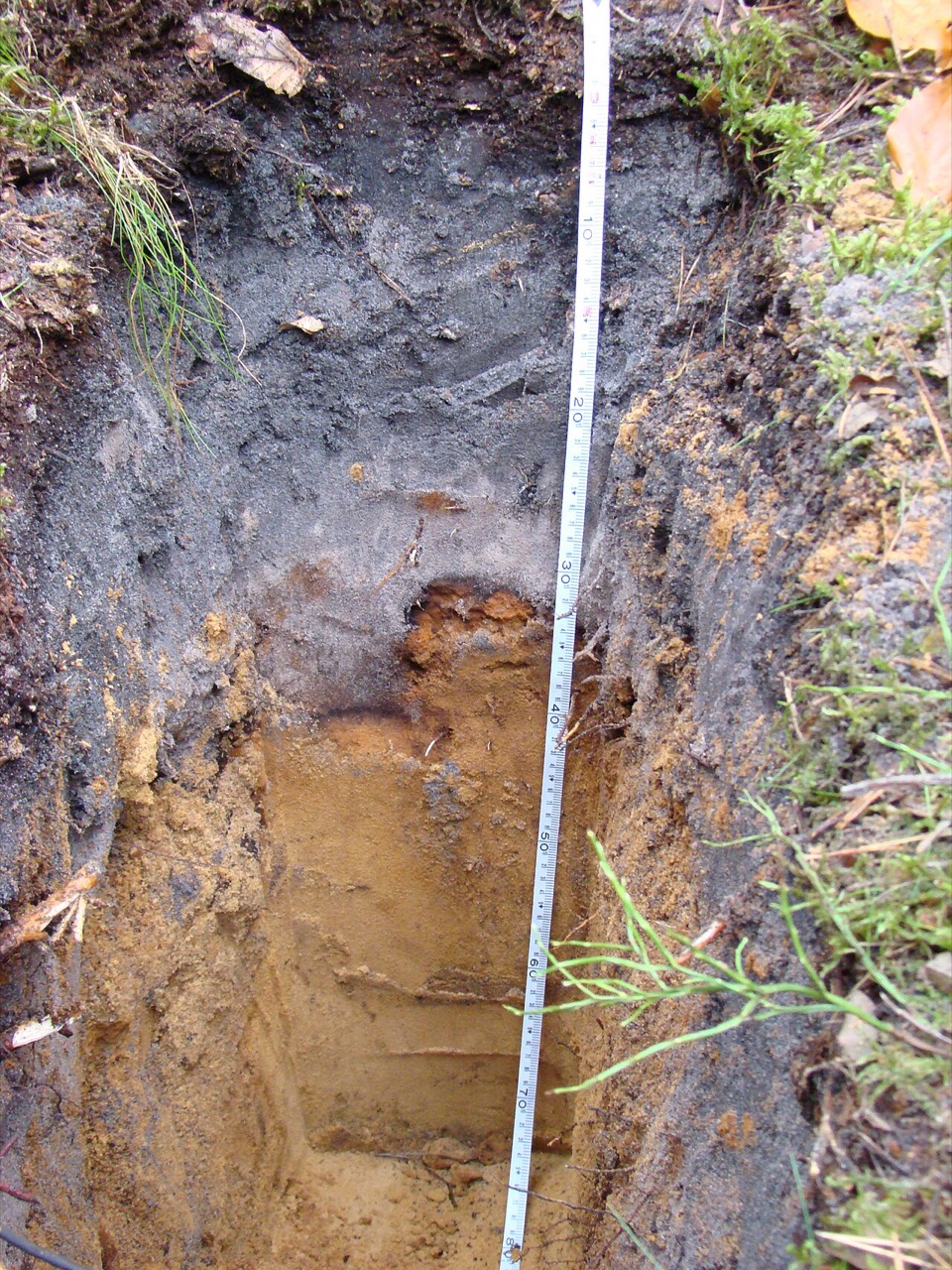
Podzols form through a process called podzolization, in which organic acids from coniferous litter or heath vegetation mobilise iron, aluminium, and organic matter from the upper soil and carry them downward. This leaches the upper horizon of these materials, leaving a pale, ash-like, silica-dominated layer that gives the soil its name, from the Russian "under ash."
The leached materials accumulate in a lower horizon, forming a darker, often reddish-brown layer enriched in organic-iron-aluminium complexes. The resulting soils are typically strongly acidic, sandy-textured, and naturally low in fertility, with limited nutrient retention.
Overview
Podzols, classified as Spodosols in some soil taxonomies, are defined by the distinctive leaching process of podzolization rather than by a fixed particle-size class alone, though coarse, sandy parent material strongly favours their formation by allowing rapid downward water movement.
Formation
Acidic organic compounds released by decomposing coniferous litter or heath vegetation dissolve and mobilise iron, aluminium, and organic matter from the upper soil. These materials move downward with percolating water and are redeposited in a lower horizon, leaving the upper horizon pale and depleted while the lower horizon darkens and accumulates the leached material.
Physical and chemical properties
- Acidity
- Podzolization and the acidic vegetation that drives it typically leave these soils strongly acidic.
- Low fertility and nutrient retention
- The coarse, leached upper horizon has limited capacity to retain nutrients, contributing to naturally low fertility.
- Coarse texture
- Sandy parent material is common and favours the rapid water movement that drives podzolization.
- Distinct horizonation
- A pale, bleached eluvial horizon over a darker, organic-iron-aluminium-enriched horizon is the clearest diagnostic feature.
Management considerations
Managing podzols for agriculture generally requires substantial amendment to overcome naturally low fertility and strong acidity, and many podzols remain under forest or semi-natural vegetation for this reason.
- Apply lime to raise pH where crop production is intended and locally appropriate
- Add organic matter and nutrients to compensate for naturally low fertility and limited retention capacity
- Choose acid-tolerant crops suited to the natural soil chemistry rather than attempting to fully neutralise very acidic profiles
- Manage irrigation and fertilizer carefully given the low retention capacity typical of sandy, leached soils
Crop suitability
Acid-tolerant crops such as blueberry are well suited to naturally acidic podzols without heavy liming. Most other agricultural crops require significant pH correction and fertility inputs to perform well on unmodified podzols.
Relationships
Evidence-backed connections in the knowledge graph.
Scope & limitations
Geographic scope: General soil-science overview of podzols (Spodosols) found in cool, humid coniferous forest and heath regions worldwide, including northern Europe, Russia, and Canada; degree of leaching and fertility vary by site.
Climate context: Podzolization requires sustained high rainfall relative to evaporation to drive the leaching of iron, aluminium, and organic matter that defines the soil; it is most pronounced in cool, humid boreal and temperate climates.
- Podzol properties vary with parent material, vegetation history, and degree of leaching; this is a general overview, not a substitute for local soil testing.
- Agricultural potential without substantial amendment is limited compared with many other soil types, and suitable crop choice is narrower than for more fertile soils.
Sources
This article draws on the following authoritative sources. See our sources & methodology for how they are selected.
- [1]USDA NRCS — Natural Resources Conservation Service (opens in a new tab)Authoritative
USDA Natural Resources Conservation Service (NRCS)
Cited for: Soil texture, drainage, and management
- Type:
- Government agency
- Jurisdiction:
- United States
- Accessed:
- 2026-07-12
- Authoritative
Cited for: Soil function and classification context
- Type:
- Intergovernmental organization
- Jurisdiction:
- Global
- Accessed:
- 2026-07-12
- High
Cited for: Global soil properties and information
- Type:
- Research institute
- Jurisdiction:
- Global
- Accessed:
- 2026-07-12
- Authoritative
Cited for: Crop–soil suitability context
- Type:
- Reference database
- Jurisdiction:
- United States
- Accessed:
- 2026-07-12