Crop · Fruit crop
Blueberry
Vaccinium corymbosum (northern highbush blueberry); other cultivated Vaccinium species and hybrids are grown regionally
Also known as: Highbush blueberry
Blueberry is a perennial deciduous shrub of the heath family grown for its fresh and processed fruit, distinguished by a strict requirement for acidic, well-drained, organic-rich soil.
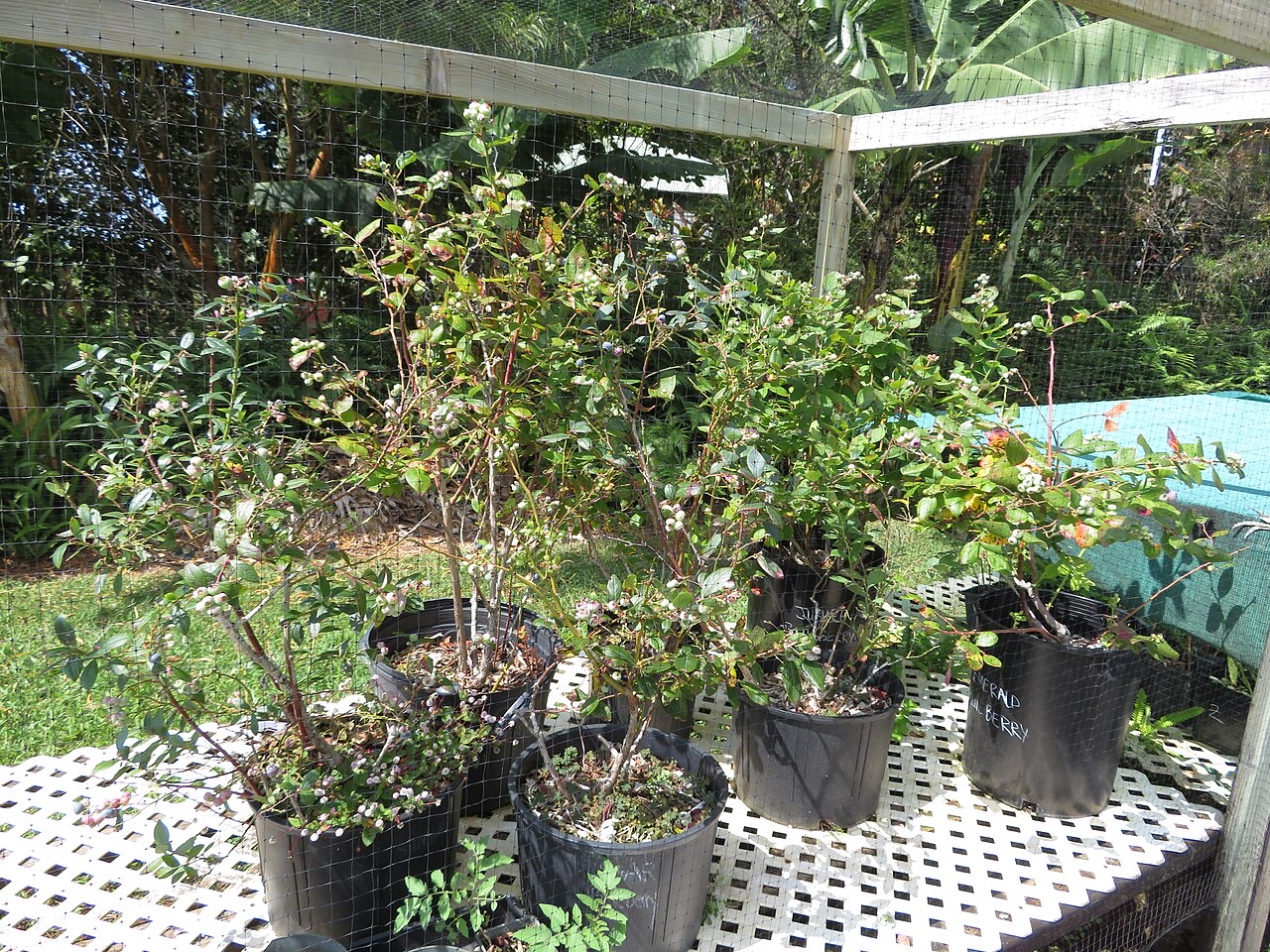
Blueberry is a woody perennial shrub cultivated for its small, dark-blue fruit, eaten fresh or processed into juice, jam, and baked and frozen products. Commercial production centers on highbush types in most regions, with lowbush and rabbiteye types important in specific climates.
Unlike most fruit crops, blueberry belongs to the Ericaceae (heath family) along with cranberry, azalea, and rhododendron, and shares their characteristic requirement for distinctly acidic soil. This soil requirement is fundamental to successful establishment and is one of the most site-limiting factors in blueberry production.
Overview
Blueberry is grown as a long-lived perennial shrub, planted once and cropped over many years. Commercial plantings are established from rooted cuttings or containerized nursery plants of selected cultivars rather than from seed.
Because soil acidity requirements are so specific and difficult to fully correct after planting, site selection and pre-plant soil preparation are among the most consequential decisions in establishing a productive planting.
Botanical classification
- Family
- Ericaceae (heath family)
- Genus
- Vaccinium
- Principal species
- Vaccinium corymbosum (northern highbush); other species and hybrids include southern highbush, rabbiteye (V. virgatum), and lowbush (V. angustifolium) types
- Growth habit
- Deciduous, multi-stemmed woody shrub, commercially propagated by cuttings or tissue culture
Origin and distribution
Blueberry is native to North America, where wild Vaccinium species were long harvested before 20th-century breeding produced the cultivated highbush types that underlie most modern commercial production. Cultivation has since spread to other temperate and some subtropical regions with suitable acidic soils.
Climate requirements
Most blueberry types require a period of winter chilling to break dormancy and flower normally, with the specific chilling requirement varying by cultivar and type; low-chill cultivars have been bred for milder climates.
Spring frost during bloom is a significant risk, as flowers and young fruit are frost-sensitive, and can substantially reduce yield in an affected season.
Soil requirements
Blueberry requires distinctly acidic soil, generally well below the pH range suited to most other fruit and vegetable crops, along with good drainage and high organic matter content; peat and sandy, organic-amended soils are commonly favored.
Planting and establishment
Blueberry is established from container-grown or bare-root nursery plants set into pre-acidified, organic-matter-amended soil or raised beds, since correcting soil pH broadly across a planted field afterward is slow and difficult.
- Cultivar selection matched to local chilling accumulation and market window
- Pre-plant soil acidification and organic matter incorporation where native soil pH is unsuitable
- Wide row spacing and raised beds in poorly drained sites to improve rooting conditions
- Cross-pollination between compatible cultivars, which can improve fruit size and set in many types
Nutrient considerations
Blueberry has a shallow, fibrous root system adapted to acidic, low-nutrient soils and is notably prone to iron deficiency (chlorosis) when grown at insufficiently acidic pH, since iron availability to the plant depends strongly on soil acidity.
Water and irrigation
Blueberry has a shallow root system with limited drought tolerance and benefits from consistent soil moisture, particularly during fruit development. Drip irrigation is widely used to supply water precisely while avoiding prolonged waterlogging, which the shallow root system tolerates poorly.
Common diseases and pests
Gray mold (Botrytis) can affect blossoms and ripening fruit, particularly under cool, humid conditions, and anthracnose (ripe rot) affects fruit quality in warm, humid climates. Fruit flies, including species that attack ripening rather than only overripe fruit, are a significant insect pest concern in many regions, along with aphids. The taxonomy of these fly pests is mixed: blueberry maggot is a true fruit fly (family Tephritidae), whereas the most damaging modern fly pest in many regions, spotted-wing drosophila, belongs to a different fly family (Drosophilidae) and is not profiled separately here.
Management combines resistant cultivars, canopy management for airflow, monitoring, and — where justified — locally authorized control products applied according to their labels.
Harvest
Blueberry is harvested by hand for the fresh market and increasingly by machine for processing markets, picked when fruit has reached full color and characteristic flavor, since the fruit does not continue ripening significantly after picking.
Uses
- Fresh-market eating berries
- Individually quick-frozen (IQF) fruit for food manufacturing
- Processed products including jam, juice, and baked-good fillings
- Dried and powdered products for supplements and food ingredients
What this page covers
genus conceptThis page covers highbush blueberry, Vaccinium corymbosum, the planted bush crop sold fresh. Lowbush blueberry is a different species and a different system entirely — a managed native stand on a two-year cycle — and has its own page.
The page covers several cultivated species of one genus. Each is a real, separately verifiable taxon; the page exists because the trade name covers all of them.
| Taxon | In this corpus | Role |
|---|---|---|
| Vaccinium angustifoliumLowbush blueberry | held as a verified taxon | Not planted: commercial fields are native stands brought into management, cropped in alternate years and sold frozen. Published in Wave 39; this page listed its name as an alternative name until Wave 41 removed it. |
| Vaccinium virgatumRabbiteye blueberry | held as a verified taxon — listed in the taxa register, no page of its own | The southern planted blueberry, lower in chilling requirement and grown where highbush will not crop. Held as a taxon and deliberately not published: its agronomy is highbush agronomy with a different chilling figure. |
When a taxon here earns its own page: A second blueberry earns its own page when the production system, not the plant, is different. Lowbush met that — a managed wild stand is not an orchard. Rabbiteye does not: it is a planted bush crop managed like highbush.
Botanical identity
Species- Accepted name
- Vaccinium corymbosum
- Family
- Ericaceae
- Genus
- Vaccinium
- Harvested part
- berry
- Agricultural use
- human food
- Crop group
- Fruit
What the authorities say
- World Flora Online — Taxonomic Backbone
- Vaccinium corymbosum
- Plants of the World Online
- Vaccinium corymbosum
Botanical identity here is what the consulted taxonomic authorities publish, on the date they were read. Where authorities disagree, both readings are shown rather than one being chosen silently.
Traded as
This crop is traded as one commodity in this corpus.
What AgricultureID holds for this crop
- 3 verified extension resources
- 1 pests and diseases naming this crop as a host
- 3 soil references
- 2 climate references
- 130 market price series
- 2 related crops
Not held
- No crop calendar records — source exists not mapped
- No published cultivars — not researched
- No official variety registrations — source exists not mapped
- No farm economics observations — source exists not mapped
An absence here means this corpus holds no such record, not that none exists.
How to read figures on this page
Production, area and trade figures for any crop change from season to season and are compiled by FAO and by national agricultural statistics agencies. Take current numbers from those primary sources, dated to the period you mean, rather than from a secondary summary — including this one.
Crop water requirements are estimated from reference evapotranspiration and local climate data, following methods published by FAO and national agricultural agencies. A requirement quoted without the reference method and the local climate behind it is not a number that can be applied to a field.
Part of
Related crops
- Same genus
- Cranberry
- Same crop concept
- Lowbush Blueberry
Official extension guidance
3 resources indexed from public extension publishers. Each was written for a particular place; read it at the source.
Blueberry Disease - Botrytis Blight and Fruit Rot
Factsheet published by Penn State Extension for Pennsylvania. It addresses blueberry. The source is organised around “Symptoms and Disease Cycle” and “Disease Management”.
Penn State Extension · Disease management · publisher states 2026-03-26
Factsheet published by NC State Extension for North Carolina. It addresses blueberry. The source is organised around “General Information”, “Symptoms and Disease Cycles” and “Other Links”.
NC State Extension · Disease management · publisher states no date; reachable 2026-08-27
Mummy Berry Disease of Blueberry
Factsheet published by NC State Extension for North Carolina. It addresses blueberry. The source is organised around “General Information”, “Symptoms and Signs” and “Pathogen and Disease Cycle”.
NC State Extension · Disease management · publisher states 2026-06-15
These are pointers to guidance published by others. Each was written for a particular place and season and is revised by its publisher; read it at the source, and check it applies where you farm.
Tools for this
Each tool shows its formula, constants and sources, and starts empty — nothing is filled in from this page.
- Seed-rate calculator
Convert a target plant stand into a seed rate, allowing for germination and establishment.
- Row spacing calculator
Work out in-row spacing and plants per metre of row for a target density.
- Production, area and yield calculator
Relate a harvested area and a yield to a production total, in either direction.
- Growing degree-days calculator
Accumulate heat units against a base temperature.
Relationships
Evidence-backed connections in the knowledge graph.
Susceptible to
Nutrients required
Suitable soils
Climate sensitivity
Irrigation methods
Managed with
Related topics
Harvested commodities
The traded commodities harvested from this crop. A commodity is the harvested lot, described by its own quality, grading, and storage evidence — not by the agronomy of the plant.
Scope & limitations
Geographic scope: Global overview. Cultivar, chilling requirement, and soil-acidification methods are region- and site-specific.
Climate context: Temperate deciduous shrub requiring winter chill in most types; vulnerable to spring frost during bloom.
- Required soil pH ranges and chilling hours vary by species type and cultivar and should be confirmed with local extension guidance before site selection.
- Production and cultivar-popularity statistics change over time and should be taken from primary datasets such as FAOSTAT.
Sources
This article draws on the following authoritative sources. See our sources & methodology for how they are selected.
- [1]FAO — Food and Agriculture Organization (opens in a new tab)Authoritative
Food and Agriculture Organization of the United Nations (FAO)
Cited for: Global blueberry production and trade context
- Type:
- Intergovernmental organization
- Jurisdiction:
- Global
- Accessed:
- 2026-07-12
- [2]FAOSTAT — FAO statistical database (opens in a new tab)Authoritative
Food and Agriculture Organization of the United Nations (FAO)
Cited for: Production and area statistics
- Type:
- Intergovernmental organization
- Jurisdiction:
- Global
- Accessed:
- 2026-07-12
- Authoritative
Cited for: Classification and nomenclature
- Type:
- Reference database
- Jurisdiction:
- United States
- Accessed:
- 2026-07-12
- [4]CABI Digital Library — Crop Protection Compendium (opens in a new tab)High
CABI (Centre for Agriculture and Bioscience International)
Cited for: Blueberry disease and pest compendium data
- Type:
- Reference database
- Jurisdiction:
- Global
- Accessed:
- 2026-07-12
- [5]University of Minnesota Extension — Crop and pest resources (opens in a new tab)High
University of Minnesota Extension
Cited for: Blueberry soil acidification and management guidance
- Type:
- University extension service
- Jurisdiction:
- United States (Minnesota)
- Accessed:
- 2026-07-12
- [6]Cornell CALS — Plant pathology and crop resources (opens in a new tab)High
Cornell University College of Agriculture and Life Sciences
Cited for: Blueberry cultivar and production research
- Type:
- University extension service
- Jurisdiction:
- United States (New York)
- Accessed:
- 2026-07-12