Crop · Spice crop
Cinnamon
Cinnamomum verum (syn. Cinnamomum zeylanicum); bark of related Cinnamomum species (notably C. cassia) is also traded commercially as cinnamon or cassia
Also known as: Ceylon cinnamon, True cinnamon
Cinnamon is a perennial evergreen tree grown for its inner bark, which is peeled, dried, and rolled into the familiar quills used as a culinary spice, traditionally managed by regular coppicing rather than allowed to grow to full tree height.
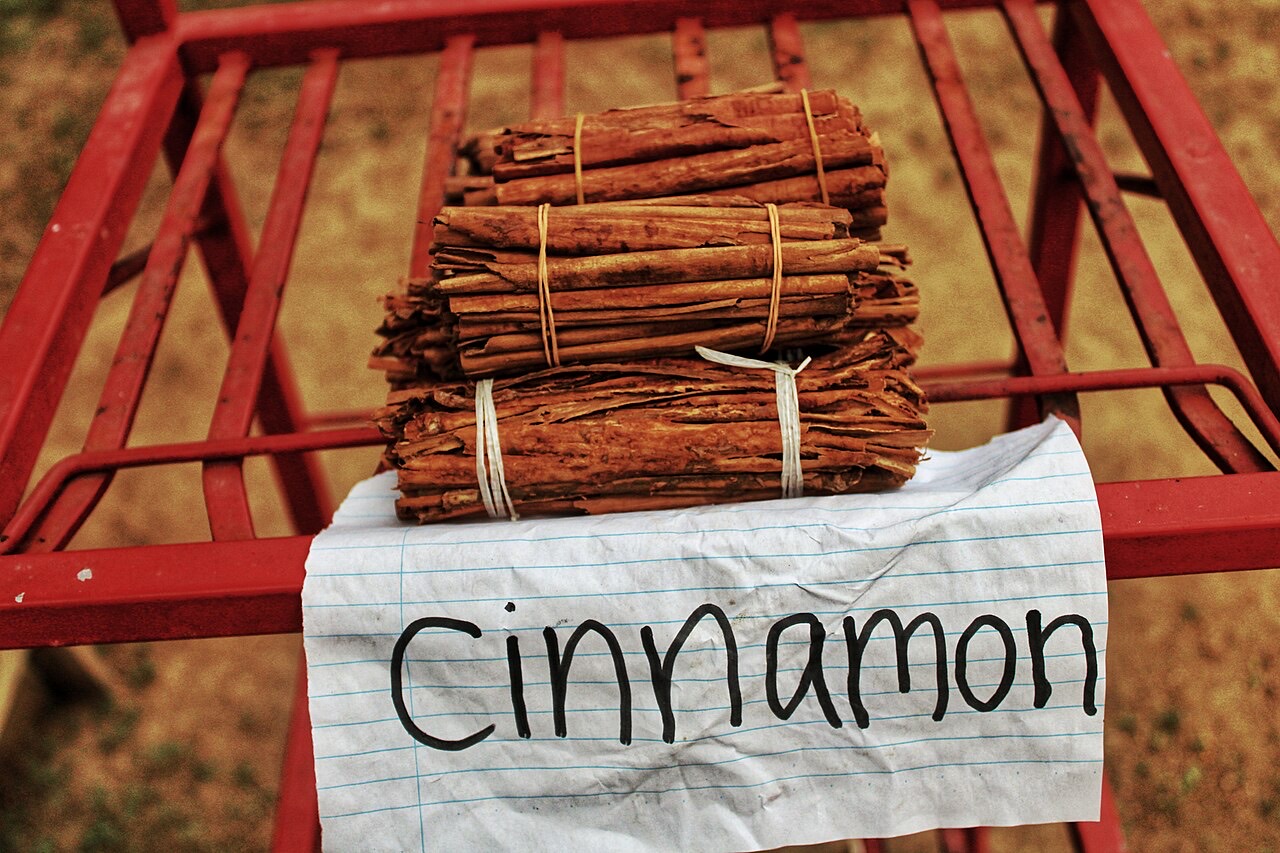
Cinnamon is harvested from the inner bark of young shoots, so cultivated trees are typically coppiced — cut back regularly near the base — to stimulate a continuous supply of harvestable young stems rather than being allowed to grow into large, single-trunked trees.
True cinnamon (Cinnamomum verum), often marketed as Ceylon cinnamon, is distinguished in trade from cassia, the bark of related Cinnamomum species with a stronger, coarser flavor, though both are commonly sold under the general name "cinnamon" in different markets.
Overview
Cinnamon is grown mainly by smallholder farmers in a limited number of tropical producing regions, most notably Sri Lanka for true cinnamon, with cassia-type bark produced from related species in parts of South and Southeast Asia.
Because harvesting relies on skilled hand-peeling of young stems, cinnamon production remains a labor-intensive, specialized craft, often passed down within farming communities in traditional producing areas.
Botanical classification
- Family
- Lauraceae (laurel family)
- Genus
- Cinnamomum
- Principal species
- Cinnamomum verum (true or Ceylon cinnamon); related species including C. cassia yield bark traded as cassia or cinnamon
- Growth habit
- Evergreen tree managed as a coppiced shrub, producing multiple young stems harvested in rotation for their bark
Origin and distribution
True cinnamon is native to Sri Lanka and parts of southern India, where it has been cultivated and traded as a valuable spice for centuries, historically driving long-distance trade connections between South Asia and other regions.
Sri Lanka remains the leading producer of true cinnamon today, while cassia-type bark is produced mainly in China, Indonesia, and Vietnam.
Climate requirements
Cinnamon requires warm, humid tropical lowland conditions with well-distributed rainfall, supporting the vigorous young shoot growth from which bark is harvested.
The tree has essentially no cold or frost tolerance, restricting cultivation to consistently warm tropical zones.
Soil requirements
Cinnamon is traditionally grown on well-drained sandy and lateritic soils, including coastal sandy soils in parts of Sri Lanka, reflecting adaptation to soils of moderate fertility provided drainage is adequate.
Plantation establishment and management
New plantings are established from seedlings or cuttings, with young plants coppiced after an initial establishment period to encourage the multiple-stem growth habit used for ongoing bark harvest.
- Selection of true cinnamon or cassia-type species according to target market
- Coppicing regime established once plants reach sufficient size, then repeated on a cycle
- Shade or intercrop management in some traditional smallholder systems
- Long-term stool (stump) management to sustain multiple harvestable stems over many years
Nutrient considerations
Nitrogen supports the vigorous regrowth of young stems needed for repeated bark harvest, while potassium contributes to overall plant vigor and stem quality across coppicing cycles.
Water and irrigation
Cinnamon is grown predominantly under rain-fed conditions in consistently humid tropical regions, since traditional production areas typically receive well-distributed rainfall throughout the year.
Supplemental irrigation is used in some newer or drier production areas, primarily to support establishment and regrowth after coppicing.
Common diseases and pests
Anthracnose can affect leaves and young shoots under humid conditions, while root rot can weaken or kill stems, particularly in poorly drained soils. Scale insects and mealybugs are common sap-feeding pests that can affect foliage and young stems.
Management relies on well-drained sites, field sanitation, monitoring, and — where justified — locally authorized control products applied according to their labels.
Harvest
Young stems of an appropriate age and diameter are cut, and the inner bark is carefully hand-peeled, dried, and rolled into quills, a skilled process that determines much of the final product’s grade and quality.
Uses
- Dried bark quills and ground powder used as a culinary spice
- Cinnamon leaf and bark oil extracted for food and fragrance industries
- By-products such as lower-grade bark and chips used in extraction and processing
- Ornamental and smallholder intercrop value in traditional producing regions
What this page covers
genus conceptThis page covers cinnamon as it is traded, which is bark from more than one Cinnamomum species. Cinnamomum verum is true or Ceylon cinnamon and is what the page is keyed to; Cinnamomum aromaticum, cassia, is the bulk of what is sold as cinnamon in much of the world and is covered here rather than beside it.
The page covers several cultivated species of one genus. Each is a real, separately verifiable taxon; the page exists because the trade name covers all of them.
| Taxon | In this corpus | Role |
|---|---|---|
| Cinnamomum aromaticumCassia cinnamon | held as a verified taxon — listed in the taxa register, no page of its own | Thicker, harder bark with a stronger, blunter flavour, grown mainly in China, Vietnam and Indonesia and sold as cinnamon in markets that do not distinguish it. Held as a taxon; Wave 39 stopped it because this page had not declared its scope, and this record is that declaration. |
When a taxon here earns its own page: Cassia would earn its own page if the coumarin question, the two countries’ production systems and the labelling rules that separate the two barks were assembled into an article that did not repeat this one. Wave 39 stopped it on scope; that block is now lifted and the remaining condition is editorial.
Botanical identity
Species- Accepted name
- Cinnamomum verum
- Family
- Lauraceae
- Genus
- Cinnamomum
- Harvested part
- bark
- Agricultural use
- spice
- Crop group
- Spices and herbs
What the authorities say
- World Flora Online — Taxonomic Backbone
- Cinnamomum verum
- Plants of the World Online
- Cinnamomum verum
Botanical identity here is what the consulted taxonomic authorities publish, on the date they were read. Where authorities disagree, both readings are shown rather than one being chosen silently.
What AgricultureID holds for this crop
- 2 soil references
- 2 climate references
Not held
- No crop calendar records — source exists not mapped
- No published cultivars — not researched
- No official variety registrations — source exists not mapped
- No verified extension resources — source exists not ingested
- No pests and diseases naming this crop as a host — source exists not ingested
- No farm economics observations — source exists not mapped
- No market price series — source exists not mapped
- No related crops — not applicable
An absence here means this corpus holds no such record, not that none exists.
How to read figures on this page
Production, area and trade figures for any crop change from season to season and are compiled by FAO and by national agricultural statistics agencies. Take current numbers from those primary sources, dated to the period you mean, rather than from a secondary summary — including this one.
Crop water requirements are estimated from reference evapotranspiration and local climate data, following methods published by FAO and national agricultural agencies. A requirement quoted without the reference method and the local climate behind it is not a number that can be applied to a field.
Tools for this
Each tool shows its formula, constants and sources, and starts empty — nothing is filled in from this page.
- Seed-rate calculator
Convert a target plant stand into a seed rate, allowing for germination and establishment.
- Row spacing calculator
Work out in-row spacing and plants per metre of row for a target density.
- Production, area and yield calculator
Relate a harvested area and a yield to a production total, in either direction.
- Growing degree-days calculator
Accumulate heat units against a base temperature.
Relationships
Evidence-backed connections in the knowledge graph.
Susceptible to
Suitable soils
Farming systems
Related topics
Scope & limitations
Geographic scope: Global overview of production concentrated in Sri Lanka (true cinnamon) and South/Southeast Asia (cassia-type bark).
Climate context: Warm, humid tropical lowland tree crop with no cold tolerance; managed by coppicing rather than free growth.
- True cinnamon and cassia differ in species, flavor, and market classification, which is not detailed exhaustively here.
- Production statistics change annually and should be taken from primary datasets such as FAOSTAT.
Sources
This article draws on the following authoritative sources. See our sources & methodology for how they are selected.
- [1]FAO — Food and Agriculture Organization (opens in a new tab)Authoritative
Food and Agriculture Organization of the United Nations (FAO)
Cited for: Global cinnamon and cassia production context
- Type:
- Intergovernmental organization
- Jurisdiction:
- Global
- Accessed:
- 2026-07-12
- [2]FAOSTAT — FAO statistical database (opens in a new tab)Authoritative
Food and Agriculture Organization of the United Nations (FAO)
Cited for: Production and area statistics
- Type:
- Intergovernmental organization
- Jurisdiction:
- Global
- Accessed:
- 2026-07-12
- [3]CABI Digital Library — Crop Protection Compendium (opens in a new tab)High
CABI (Centre for Agriculture and Bioscience International)
Cited for: Cinnamon disease and pest compendium data
- Type:
- Reference database
- Jurisdiction:
- Global
- Accessed:
- 2026-07-12
- Authoritative
Cited for: Classification and nomenclature
- Type:
- Reference database
- Jurisdiction:
- United States
- Accessed:
- 2026-07-12