Plant Disease · Plant disease
Anthracnose
Colletotrichum spp.
Also known as: Colletotrichum leaf and fruit rot
Anthracnose is a group of fungal diseases caused by Colletotrichum species, producing sunken, dark lesions on leaves, stems, pods, and fruit. It affects a wide range of crops, including common bean, mango, banana, and cucurbits, and is a major cause of post-harvest fruit losses.
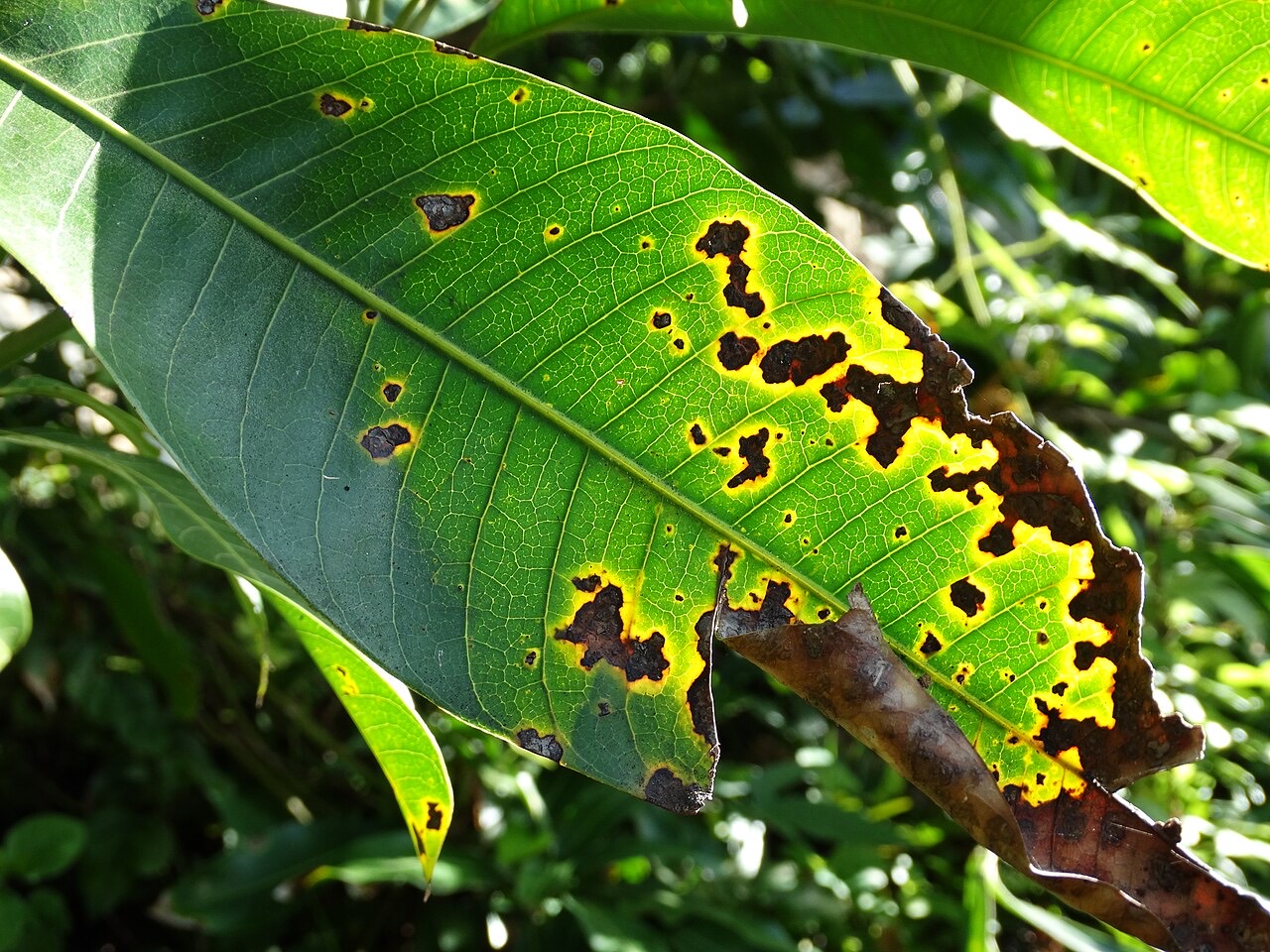
Anthracnose refers to a group of related diseases caused by fungi in the genus Colletotrichum, which infect many different crops through host-adapted species and strains. Symptoms typically include sunken, dark, water-soaked lesions on leaves, stems, pods, and fruit.
On tropical fruit such as mango and banana, Colletotrichum species are notable for a quiescent, or latent, infection strategy: the fungus infects immature, green fruit but does not produce visible symptoms until the fruit begins to ripen, making anthracnose a major challenge in post-harvest handling and storage.
Identification
Anthracnose typically appears as sunken, dark brown to black lesions on leaves, stems, pods, or fruit. In humid weather, small fruiting structures called acervuli often develop within the lesions, producing masses of pink to orange, sticky spores that give affected areas a distinctive salmon-coloured sheen. On bean pods, lesions often form dark, sunken cankers; on mango and banana fruit, lesions expand rapidly as fruit ripens.
Biology and disease cycle
Colletotrichum species produce spores in acervuli on infected tissue that are dispersed mainly by rain splash over short distances, though infected seed and planting material can move the fungus over long distances. On some hosts, spores can infect young, immature tissue and then remain quiescent, resuming active growth only as the tissue matures or ripens and its natural defences change.
- Survives between seasons in infected crop debris, seed, and, on perennial hosts, in twigs and old lesions
- Warm, wet, or humid weather with splashing rain favours spore release and new infections
- Wounds and natural openings provide additional infection points on some hosts
Affected hosts
Anthracnose affects a very wide range of crops through different, largely host-adapted Colletotrichum species. Common bean is affected by pod and leaf lesions that can reduce seed quality; mango and banana suffer serious post-harvest fruit rot; and cucurbits such as cucumber can develop leaf, stem, and fruit lesions in the field.
- Common bean: leaf, pod, and stem lesions that can affect seed quality
- Mango and banana: quiescent fruit infections that develop into rot after harvest
- Cucumber and other cucurbits: leaf spots, stem lesions, and fruit rot
Risk factors
- Warm temperatures combined with rain, dew, or high humidity
- Overhead or splash-prone irrigation that disperses spores
- Infected or untreated seed and planting material
- Dense canopies and poor air circulation
- Rough handling of fruit that creates wounds during and after harvest
Prevention and monitoring
Because several Colletotrichum species can establish quiescent infections well before symptoms appear, management emphasises clean planting material, sanitation, and careful post-harvest handling alongside field-level prevention.
- Use certified, disease-free seed and planting material where available
- Choose resistant or tolerant varieties where available
- Remove and destroy infected plant debris and prunings
- Improve air movement through spacing and canopy management
- Handle harvested fruit carefully to minimise wounds and manage post-harvest storage conditions
Official extension guidance
1 resource indexed from public extension publishers. Each was written for a particular place; read it at the source.
Anthracnose in Home Plantings of Brambles
Factsheet published by Penn State Extension for Pennsylvania. It addresses anthracnose. The source is organised around “Disease Cycle” and “Disease Management”.
Penn State Extension · Crop establishment, Disease management · publisher states 2026-04-03
These are pointers to guidance published by others. Each was written for a particular place and season and is revised by its publisher; read it at the source, and check it applies where you farm.
Relationships
Evidence-backed connections in the knowledge graph.
Risk increases under
Scope & limitations
Geographic scope: Global; anthracnose occurs wherever susceptible crops are grown, with particular importance in warm, humid regions and in tropical fruit supply chains.
Climate context: Favoured by warm temperatures combined with rain, dew, or high humidity that disperse spores and support infection.
- This is a general overview of a disease group with many host-adapted causal species; specific biology and risk vary by crop and region.
- Quiescent infections on some hosts can complicate timing of both field monitoring and post-harvest inspection.
- Control-product recommendations are jurisdiction-specific and are deliberately not provided here.
Sources
This article draws on the following authoritative sources. See our sources & methodology for how they are selected.
- [1]CABI Digital Library — Crop Protection Compendium (opens in a new tab)High
CABI (Centre for Agriculture and Bioscience International)
Cited for: Colletotrichum biology, host range, and disease cycle
- Type:
- Reference database
- Jurisdiction:
- Global
- Accessed:
- 2026-07-12
- [2]EPPO Global Database (opens in a new tab)Authoritative
European and Mediterranean Plant Protection Organization (EPPO)
Cited for: Pathogen nomenclature and distribution
- Type:
- Reference database
- Jurisdiction:
- Global
- Accessed:
- 2026-07-12
- [3]UC Statewide Integrated Pest Management Program (UC IPM) (opens in a new tab)High
University of California Agriculture and Natural Resources (UC ANR)
Cited for: Identification and management principles
- Type:
- University extension service
- Jurisdiction:
- United States (California)
- Accessed:
- 2026-07-12
- [4]University of Minnesota Extension — Crop and pest resources (opens in a new tab)High
University of Minnesota Extension
Cited for: Field crop and vegetable risk factors
- Type:
- University extension service
- Jurisdiction:
- United States (Minnesota)
- Accessed:
- 2026-07-12
Related topics
Crops
- Abaca
- Adzuki Bean
- Almond
- Aloe vera
- Arabica Coffee
- Arrowroot
- Asian Pear
- Avocado
- Banana
- Birdsfoot Trefoil
- Bitter Gourd
- Black Gram
- Black pepper
- Blackberry
- Blackcurrant
- Blueberry
- Bottle Gourd
- Brazil Nut
- Breadfruit
- Cape Gooseberry
- Cardamom
- Cashew
- Cassava
- Chayote
- Chestnut
- Chili pepper
- Cinnamon
- Citrus
- Clove
- Cocksfoot
- Cocoa
- Coconut
- Coffee
- Common Bean
- Cowpea
- Cranberry
- Cucumber
- Dragon Fruit
- Durian
- Fig
- Grapefruit
- Greenleaf Desmodium
- Groundnut
- Guar
- Guava
- Guinea Grass
- Hazelnut
- Horse Gram
- Jack Bean
- Jackfruit
- Jatropha
- Jicama
- Job's Tears
- Jute
- Kapok
- Kenaf
- Kola Nut
- Lablab
- Lemon
- Lima Bean
- Lime
- Loquat
- Lowbush Blueberry
- Lupin
- Lychee
- Macadamia
- Makrut Lime
- Mandarin
- Mango
- Mangosteen
- Mashua
- Moth Bean
- Mung Bean
- Napier Grass
- Nutmeg
- Oca
- Olive
- Orange
- Papaya
- Passion Fruit
- Pecan
- Persimmon
- Pistachio
- Plantain
- Pomelo
- Quince
- Ramie
- Raspberry
- Red Clover
- Rhodes Grass
- Rice Bean
- Robusta Coffee
- Rubber
- Signal Grass
- Sisal
- Sorghum
- Sour Cherry
- Star Anise
- Stylo
- Switchgrass
- Tamarind
- Tannia
- Tea
- Ulluco
- Upland Cotton
- Vanilla
- Velvet Bean
- Walnut
- Water Spinach
- Winged Bean
- Yam
- Yardlong Bean
- Yerba Mate