Crop · Spice crop
Ginger
Zingiber officinale
Also known as: Common ginger
Ginger is a perennial herbaceous plant grown for its aromatic underground rhizome, propagated from rhizome pieces and cultivated across warm, humid regions as a spice crop.
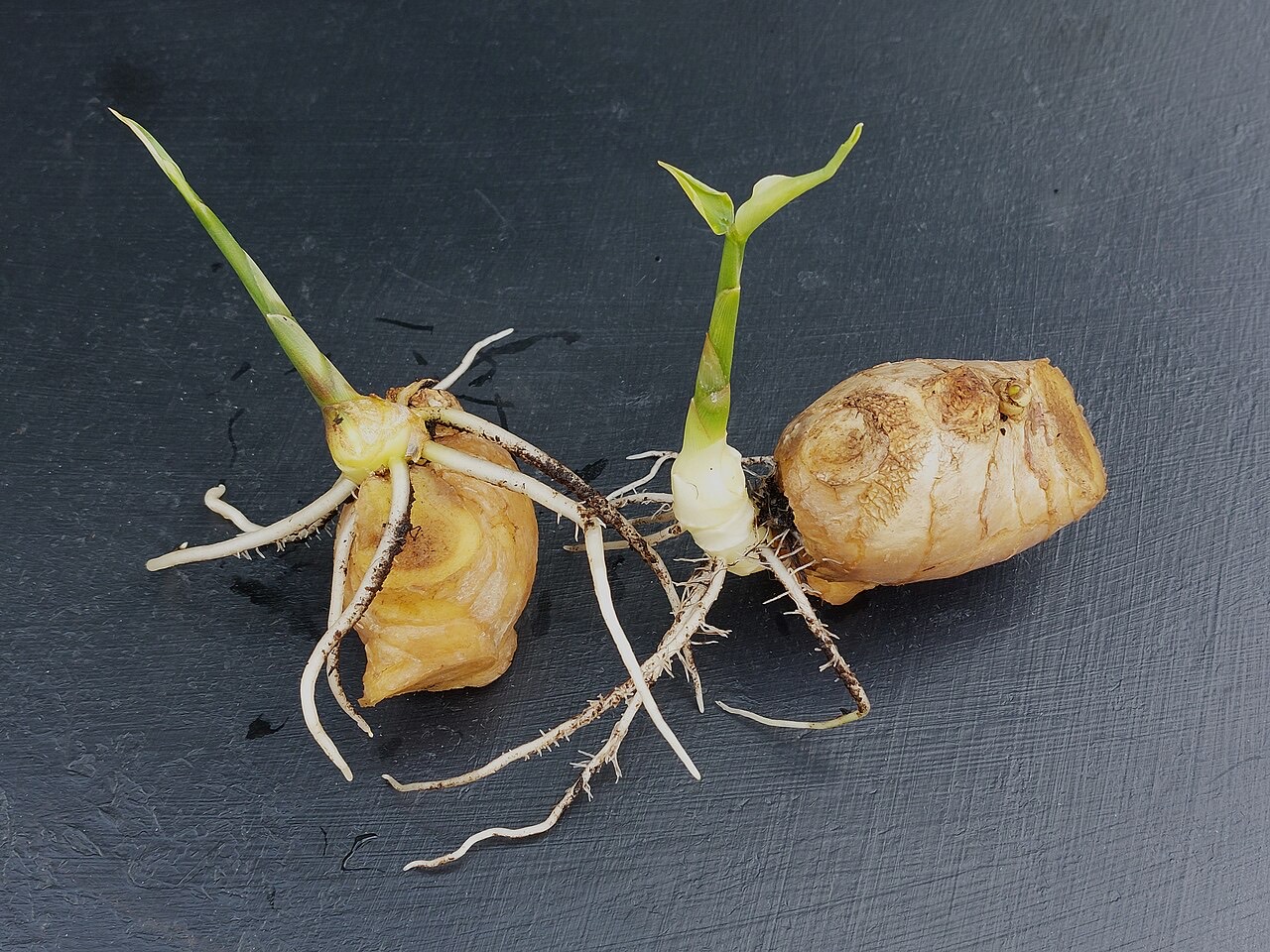
Ginger is grown for its swollen underground rhizome, which develops beneath a stand of reed-like leafy stems arising from the planted rhizome piece. Commercial crops are propagated vegetatively from healthy rhizome sections rather than from seed.
This entry covers ginger as an agricultural crop — its botany, climate and soil needs, cultivation, and culinary and food-industry uses. Any medicinal or health-related claims associated with ginger are outside the scope of this reference and are subject to separate regulatory requirements.
Overview
Ginger is grown mainly by smallholder farmers across warm, humid regions of Asia, Africa, and the Pacific, often as an intercrop under partial shade in diversified farming systems, alongside more intensive commercial production in some areas.
Because the crop is propagated from rhizome pieces, a portion of each harvest is commonly retained as planting material (seed rhizome) for the following season, an important factor in production planning.
Botanical classification
- Family
- Zingiberaceae (ginger family)
- Genus and species
- Zingiber officinale
- Growth habit
- Perennial herb grown as an annual; the harvested rhizome is also the planting material, so each crop is taken out of the last one
- Propagation
- Vegetative, from healthy rhizome pieces (setts) rather than from seed
Origin and distribution
Ginger is believed to have originated in tropical Southeast Asia, where it has been cultivated for millennia, and spread through trade to South Asia, Africa, and eventually the Americas and the Pacific as demand for the spice grew.
It is grown today across warm, humid regions of Asia, Africa, and Latin America.
Climate requirements
Ginger requires warm, humid conditions with well-distributed rainfall during active growth, followed by a drier period that supports rhizome maturation and facilitates harvest.
The crop has limited cold and frost tolerance, restricting outdoor cultivation to tropical and warm subtropical growing zones.
Soil requirements
Ginger requires loose, friable, well-drained soils, such as lateritic soils and light loams, that allow the rhizome to expand freely and reduce the risk of waterlogging around the below-ground plant parts.
Establishment and crop management
Ginger is established by planting healthy, disease-free rhizome pieces, often into raised beds or ridges that further improve drainage around the developing rhizome.
- Selection of healthy, disease-free seed rhizomes for planting
- Raised bed or ridge preparation to maximize drainage
- Mulching to conserve soil moisture and moderate soil temperature
- Partial shading in some traditional intercropped production systems
Nutrient considerations
Potassium supports rhizome development and quality, while nitrogen contributes to the leafy pseudostem growth that sustains photosynthesis feeding rhizome expansion.
Water and irrigation
Ginger requires consistent moisture during active vegetative growth, whether from reliable rainfall or supplemental irrigation, but is highly sensitive to waterlogging around the rhizome.
Irrigation, where used, is typically applied to maintain even moisture while drainage measures prevent standing water at the root zone.
Common diseases and pests
Bacterial wilt can cause rapid yellowing and collapse of pseudostems, spreading through infected planting material and soil, while rhizome and root rot are among the most damaging diseases, favored by poor drainage and waterlogged conditions. Root-knot nematodes damage the rhizome and reduce marketable quality, and shoot borers can tunnel into pseudostems.
Ginger is prone to soil-borne rhizome rots that arrive with the planting material, so seed rhizome selection is the main control point and there is no effective treatment once a crop is infected. Raised beds and a rotation away from other host crops are the standard cultural measures, and land with a history of the disease is usually avoided rather than treated.
Harvest
Rhizomes are lifted by hand once pseudostems begin to yellow and dry, with harvest timing set according to whether the crop is intended for fresh (immature, milder) or mature, more fibrous processing use.
Uses
- Fresh rhizome used as a culinary ingredient and flavoring
- Dried and ground rhizome as a spice powder
- Processed products including preserved, candied, and extracted forms for food and beverage use
- Seed rhizomes retained for the following planting cycle
Botanical identity
Species- Accepted name
- Zingiber officinale
- Family
- Zingiberaceae
- Genus
- Zingiber
- Harvested part
- rhizome
- Agricultural use
- spice, human food
- Crop group
- Spices and herbs, Roots and tubers
What the authorities say
- World Flora Online — Taxonomic Backbone
- Zingiber officinale
- Plants of the World Online
- Zingiber officinale
Botanical identity here is what the consulted taxonomic authorities publish, on the date they were read. Where authorities disagree, both readings are shown rather than one being chosen silently.
What AgricultureID holds for this crop
- 15 crop calendar records
- 1 pests and diseases naming this crop as a host
- 2 soil references
- 1 climate references
Not held
- No published cultivars — not researched
- No official variety registrations — source exists not mapped
- No verified extension resources — source exists not ingested
- No farm economics observations — source exists not mapped
- No market price series — source exists not mapped
- No related crops — not applicable
An absence here means this corpus holds no such record, not that none exists.
How to read figures on this page
Production, area and trade figures for any crop change from season to season and are compiled by FAO and by national agricultural statistics agencies. Take current numbers from those primary sources, dated to the period you mean, rather than from a secondary summary — including this one.
Crop water requirements are estimated from reference evapotranspiration and local climate data, following methods published by FAO and national agricultural agencies. A requirement quoted without the reference method and the local climate behind it is not a number that can be applied to a field.
Part of
Planting and harvest calendar
Usual sowing and harvest windows across 15 jurisdictions, covering ginger and ginger — season 1 and ginger — season 2.
Tools for this
Each tool shows its formula, constants and sources, and starts empty — nothing is filled in from this page.
- Seed-rate calculator
Convert a target plant stand into a seed rate, allowing for germination and establishment.
- Row spacing calculator
Work out in-row spacing and plants per metre of row for a target density.
- Production, area and yield calculator
Relate a harvested area and a yield to a production total, in either direction.
- Growing degree-days calculator
Accumulate heat units against a base temperature.
Relationships
Evidence-backed connections in the knowledge graph.
Susceptible to
Suitable soils
Climate sensitivity
Irrigation methods
Farming systems
Related topics
Scope & limitations
Geographic scope: Global overview of production concentrated in warm, humid regions of Asia, Africa, and Latin America.
Climate context: Warm, humid perennial rhizome crop with limited cold tolerance; highly sensitive to waterlogged soil.
- This entry addresses ginger solely as an agricultural crop; medicinal or health-related claims are outside its scope and are subject to separate regulatory requirements.
- Production statistics change annually and should be taken from primary datasets such as FAOSTAT.
Sources
This article draws on the following authoritative sources. See our sources & methodology for how they are selected.
- [1]FAO — Food and Agriculture Organization (opens in a new tab)Authoritative
Food and Agriculture Organization of the United Nations (FAO)
Cited for: Global ginger production and trade context
- Type:
- Intergovernmental organization
- Jurisdiction:
- Global
- Accessed:
- 2026-07-12
- [2]FAOSTAT — FAO statistical database (opens in a new tab)Authoritative
Food and Agriculture Organization of the United Nations (FAO)
Cited for: Production and area statistics
- Type:
- Intergovernmental organization
- Jurisdiction:
- Global
- Accessed:
- 2026-07-12
- [3]CABI Digital Library — Crop Protection Compendium (opens in a new tab)High
CABI (Centre for Agriculture and Bioscience International)
Cited for: Ginger disease and pest compendium data
- Type:
- Reference database
- Jurisdiction:
- Global
- Accessed:
- 2026-07-12
- Authoritative
Cited for: Classification and nomenclature
- Type:
- Reference database
- Jurisdiction:
- United States
- Accessed:
- 2026-07-12