Irrigation Method · Irrigation method
Drip Irrigation
Also known as: Trickle irrigation, Micro-irrigation
Drip irrigation delivers water slowly and directly to the root zone of individual plants or rows through a network of tubing and emitters, minimising evaporation and runoff compared with methods that wet the whole field surface.
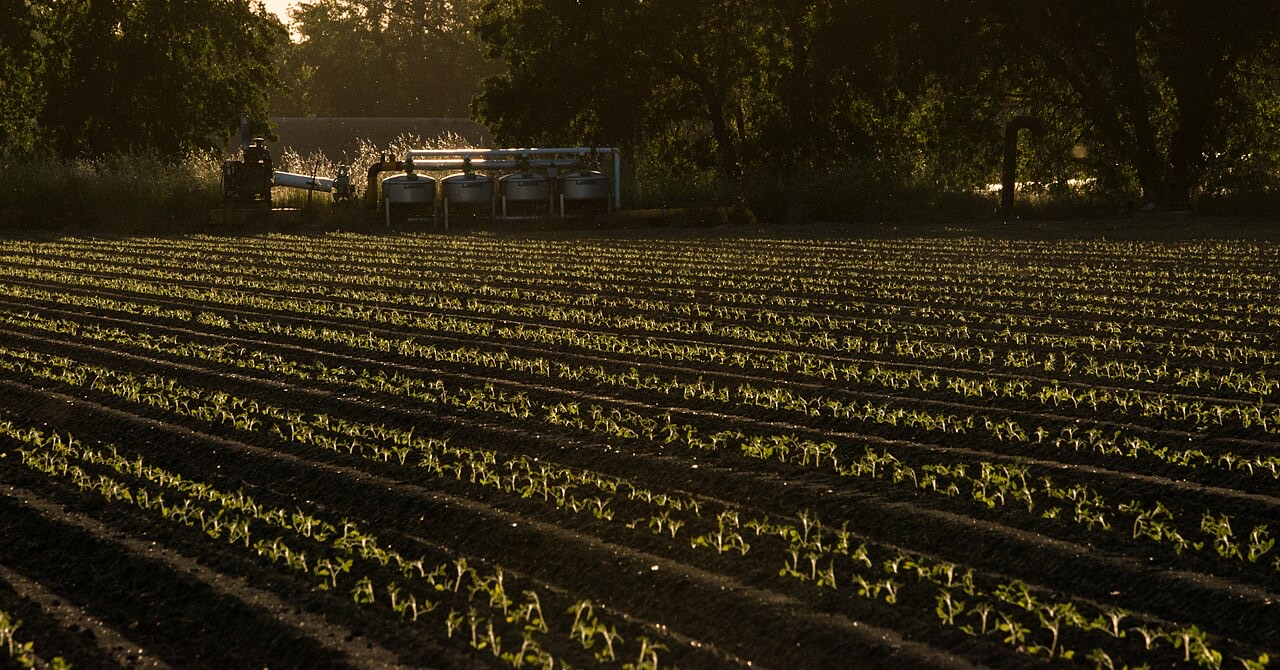
Drip (or trickle) irrigation applies water at low flow rates through small emitters set along tubing laid on or below the soil surface, close to plant roots. Rather than flooding or spraying the whole field, it wets only a limited zone around each plant or row, which reduces water lost to evaporation from bare soil between plants and to deep percolation beyond the root zone.
Because it can deliver water — and, blended into the water, soluble fertilizer (fertigation) — with fine control over timing and volume, drip irrigation is closely associated with high-value horticultural crops and with production systems such as greenhouses where precise input control is valuable.
How it works
- Water is filtered and, often, pressure-regulated before entering the distribution network
- A mainline and submains carry water to individual field sections
- Lateral drip lines run along or beneath crop rows, fitted with inline or point-source emitters
- Emitters release water slowly at a controlled rate directly to the soil near the plant
- Soluble fertilizer can be injected into the system (fertigation) to deliver nutrients with the water
Where it suits
Drip irrigation suits row and orchard crops where plants are spaced widely enough to make individual or per-row water delivery practical, and where the value of the crop or the constraints of water supply justify the higher initial investment in tubing and emitters. It is widely used for vegetables, orchard fruit, and vine crops, and is a standard feature of many greenhouse production systems.
Efficiency and water use
Because water is applied directly near the root zone rather than across the whole field surface, drip irrigation generally achieves higher application efficiency than surface or many sprinkler methods, with less water lost to evaporation from wetted foliage or bare soil and, when well managed, less deep percolation loss.
Matching the volume and frequency of drip application to crop water demand — informed by evapotranspiration estimates and soil moisture monitoring — is what realises these efficiency gains in practice; an oversized or poorly scheduled system does not automatically save water.
Environmental and economic aspects
By limiting wetted area and controlling application volume closely, drip irrigation can help reduce nutrient leaching and runoff compared with methods that wet or flood the whole field, particularly when combined with fertigation to deliver nutrients in smaller, more frequent doses matched to crop uptake.
Automation of drip systems (timers and controllers) can reduce labour input for irrigation once installed, though the higher upfront cost of tubing, emitters, and filtration is a factor growers weigh against expected water, nutrient, and labour savings over the system’s working life.
Considerations
Emitters are prone to clogging from sediment, mineral precipitates, or biological growth, so filtration, water-quality management, and periodic system flushing are routine maintenance requirements. Initial equipment cost per unit area is typically higher than for surface irrigation, though it can be offset by water and, in some systems, labour savings over time.
Official extension guidance
2 resources indexed from public extension publishers. Each was written for a particular place; read it at the source.
Drip Irrigation for Vegetable Production
Factsheet published by Penn State Extension for Pennsylvania. It addresses drip irrigation. The source is organised around “Advantages of Drip Irrigation”, “Disadvantages and Limitations of Drip Irrigation” and “Drip Irrigation System Components”.
Penn State Extension · Irrigation · publisher states 2016-02-23
Using Plastic Mulches and Drip Irrigation for Vegetables
Factsheet published by NC State Extension for North Carolina. It addresses drip irrigation. The source is organised around “Preparation of the Soil”, “Bedding the Soil” and “Fall vs. Spring”.
NC State Extension · Irrigation · publisher states no date; reachable 2026-08-27
These are pointers to guidance published by others. Each was written for a particular place and season and is revised by its publisher; read it at the source, and check it applies where you farm.
Tools for this
Each tool shows its formula, constants and sources, and starts empty — nothing is filled in from this page.
- Irrigation volume calculator
Convert an application depth over an area into a net and gross volume.
- Irrigation flow and time calculator
Relate that volume to a steady delivery rate and a run time.
Relationships
Evidence-backed connections in the knowledge graph.
Scope & limitations
Geographic scope: General overview of drip irrigation as used across horticultural and orchard production worldwide. System design and suitability depend on local water quality, crop, and cost factors.
Climate context: Drip irrigation is often favoured in water-scarce or drought-prone regions because of its comparatively high application efficiency, though crop water demand still rises with temperature and evapotranspiration.
- This entry describes drip irrigation function and use in general terms; it does not specify emitter spacing, flow rates, or scheduling volumes, which are crop-, soil-, and region-specific.
- Efficiency gains depend on proper design, maintenance, and scheduling; a poorly managed drip system does not automatically outperform other methods.
Sources
This article draws on the following authoritative sources. See our sources & methodology for how they are selected.
- Authoritative
Cited for: Drip irrigation principles and crop water use
- Type:
- Intergovernmental organization
- Jurisdiction:
- Global
- Accessed:
- 2026-07-12
- [2]USDA NRCS — Natural Resources Conservation Service (opens in a new tab)Authoritative
USDA Natural Resources Conservation Service (NRCS)
Cited for: Micro-irrigation system design and maintenance context
- Type:
- Government agency
- Jurisdiction:
- United States
- Accessed:
- 2026-07-12
- [3]AHDB — Agriculture and Horticulture Development Board (opens in a new tab)High
Agriculture and Horticulture Development Board (AHDB)
Cited for: Irrigation management context for horticultural crops
- Type:
- Government agency
- Jurisdiction:
- United Kingdom
- Accessed:
- 2026-07-12
- [4]FAO — Food and Agriculture Organization (opens in a new tab)Authoritative
Food and Agriculture Organization of the United Nations (FAO)
Cited for: Role of localized irrigation in water-use efficiency
- Type:
- Intergovernmental organization
- Jurisdiction:
- Global
- Accessed:
- 2026-07-12
Related topics
Crops
- Almond
- Apple
- Apricot
- Artichoke
- Asian Pear
- Asparagus
- Avocado
- Banana
- Basil
- Bitter Gourd
- Black pepper
- Blackberry
- Blackcurrant
- Blueberry
- Cabbage
- Cape Gooseberry
- Carrot
- Cashew
- Celery
- Chamomile
- Cherry
- Chestnut
- Chicory
- Chili pepper
- Chinese Cabbage
- Citrus
- Clove
- Cocoa
- Coconut
- Coffee
- Common Bean
- Coriander
- Cucumber
- Date Palm
- Dill
- Dragon Fruit
- Durian
- Eggplant
- Fennel
- Fig
- Garlic
- Gboma Eggplant
- Ginger
- Grape
- Grapefruit
- Guava
- Hazelnut
- Hops
- Jicama
- Jojoba
- Kiwifruit
- Kohlrabi
- Lavender
- Lemon
- Lettuce
- Lima Bean
- Lime
- Loquat
- Lychee
- Macadamia
- Makrut Lime
- Mandarin
- Mango
- Mangosteen
- Melon
- Nutmeg
- Oil palm
- Okra
- Onion
- Orange
- Oregano
- Pak Choi
- Papaya
- Parsley
- Passion Fruit
- Peach
- Pear
- Pecan
- Persimmon
- Pineapple
- Pistachio
- Plum
- Pomegranate
- Pomelo
- Quince
- Raspberry
- Robusta Coffee
- Rocket
- Rosemary
- Sage
- Scarlet Eggplant
- Sour Cherry
- Stevia
- Strawberry
- Sweet Pepper
- Sweetcorn
- Swiss Chard
- Thyme
- Tomatillo
- Tomato
- Upland Cotton
- Vanilla
- Walnut
- Waterleaf
- Watermelon
- Yardlong Bean
- Zucchini