Machinery · Agricultural machinery
Planter
Also known as: Row-crop planter, Precision planter
A planter is a precision seeding implement that singulates individual seeds and places them at controlled spacing and depth in rows, used mainly for wider-spaced row crops such as maize, soybean, and sugar beet.
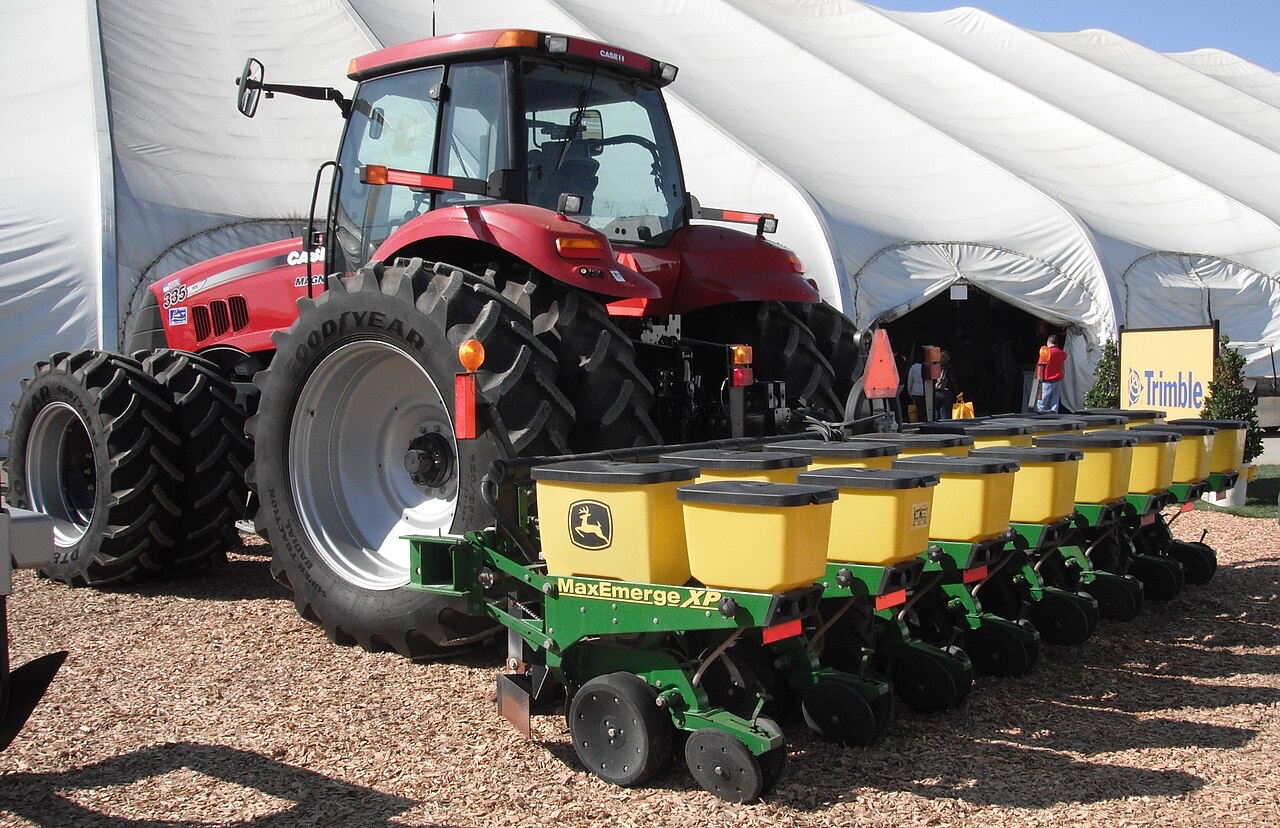
A planter differs from a seed drill in purpose and precision: rather than metering a continuous stream of seed into narrow, closely spaced rows for crops like cereals, a planter singulates individual seeds and places each one at a set spacing along wider rows. This row-and-spacing precision matters most for crops planted at relatively low populations per unit area, where uniform spacing between plants directly affects competition for light, water, and nutrients.
Each row unit on a planter typically combines a seed meter, a furrow opener, seed tubes or seed-delivery systems, and closing and press wheels, all mounted on a toolbar that can carry many identical row units side by side. Row spacing, seed spacing, and planting depth are set to match the crop, seed size, and target plant population for the field.
What a planter is
A planter is built around singulation — separating a bulk seed supply into individually spaced seeds — rather than metering a continuous flow, which is the defining difference from a seed drill. This makes planters the standard establishment tool for row crops planted at wider spacing and lower population than cereals.
- Places individual seeds at set spacing rather than a continuous seed stream
- Used mainly for wider-row crops planted at lower populations than cereals
- Row units can often be added or removed to match different row widths
How it works
- Seed is loaded into a hopper or central seed system feeding each row unit
- A seed meter (vacuum, finger, or plate type) picks up and releases single seeds at a set interval
- A furrow opener cuts a slot in the soil ahead of the seed-delivery point
- The seed drops or is placed into the furrow at a controlled depth
- Closing wheels or discs cover the seed and press the soil to firm seed-to-soil contact
Role in the production cycle
Planting establishes the crop stand for the season, and uniform seed spacing and depth from the planter strongly influence emergence timing, plant-to-plant competition, and ultimately yield potential. Inconsistent spacing or depth can create gaps or crowding that a crop cannot fully compensate for later in the season.
Planters are frequently integrated with precision-agriculture systems, using GPS guidance for pass-to-pass accuracy and variable-rate seeding to adjust population across zones of a field with different yield potential.
Types and variations
- Vacuum planter
- Uses air suction to hold and release single seeds from a metering disc, common on modern row-crop planters.
- Finger-pickup planter
- Uses mechanical fingers to separate and release individual seeds from a seed pool.
- No-till planter
- Fitted with heavier down force and residue-cutting components to place seed accurately into undisturbed soil or residue.
Considerations
Planting speed, down force, and row-unit maintenance all affect placement accuracy; excessive speed or worn components can reduce spacing uniformity even on well-designed planters. Seed size, shape, and seed-treatment coatings can also require meter adjustments between seed lots.
Relationships
Evidence-backed connections in the knowledge graph.
Farming systems
Related topics
Scope & limitations
Geographic scope: General overview of planters as used in mechanised row-crop planting worldwide. Row spacing, population targets, and planter scale vary by crop and region.
- This entry describes planter function and types in general terms; it does not recommend specific seed populations or spacings, which are crop- and region-specific.
- Precision-agriculture integration (GPS, variable-rate seeding) depends on equipment and data infrastructure not detailed here.
Sources
This article draws on the following authoritative sources. See our sources & methodology for how they are selected.
- [1]Iowa State University Extension and Outreach (opens in a new tab)High
Iowa State University Extension and Outreach
Cited for: Planter metering systems and placement accuracy
- Type:
- University extension service
- Jurisdiction:
- United States (Iowa)
- Accessed:
- 2026-07-12
- [2]USDA ARS — Agricultural Research Service (opens in a new tab)Authoritative
USDA Agricultural Research Service (ARS)
Cited for: Row-crop planting and establishment research
- Type:
- Government agency
- Jurisdiction:
- United States
- Accessed:
- 2026-07-12
- [3]AHDB — Agriculture and Horticulture Development Board (opens in a new tab)High
Agriculture and Horticulture Development Board (AHDB)
Cited for: Row-crop establishment guidance context
- Type:
- Government agency
- Jurisdiction:
- United Kingdom
- Accessed:
- 2026-07-12
- [4]FAO — Food and Agriculture Organization (opens in a new tab)Authoritative
Food and Agriculture Organization of the United Nations (FAO)
Cited for: Role of precision seeding in crop establishment
- Type:
- Intergovernmental organization
- Jurisdiction:
- Global
- Accessed:
- 2026-07-12