Crop · Fiber crop
Cotton
Gossypium hirsutum (upland cotton); Gossypium barbadense (extra-long-staple cotton, including Pima and Egyptian types)
Also known as: Pima cotton
Cotton is a warm-season crop grown for the fiber (lint) surrounding its seeds, along with cottonseed oil and meal. It is cultivated as an annual across tropical and warm-temperate regions.
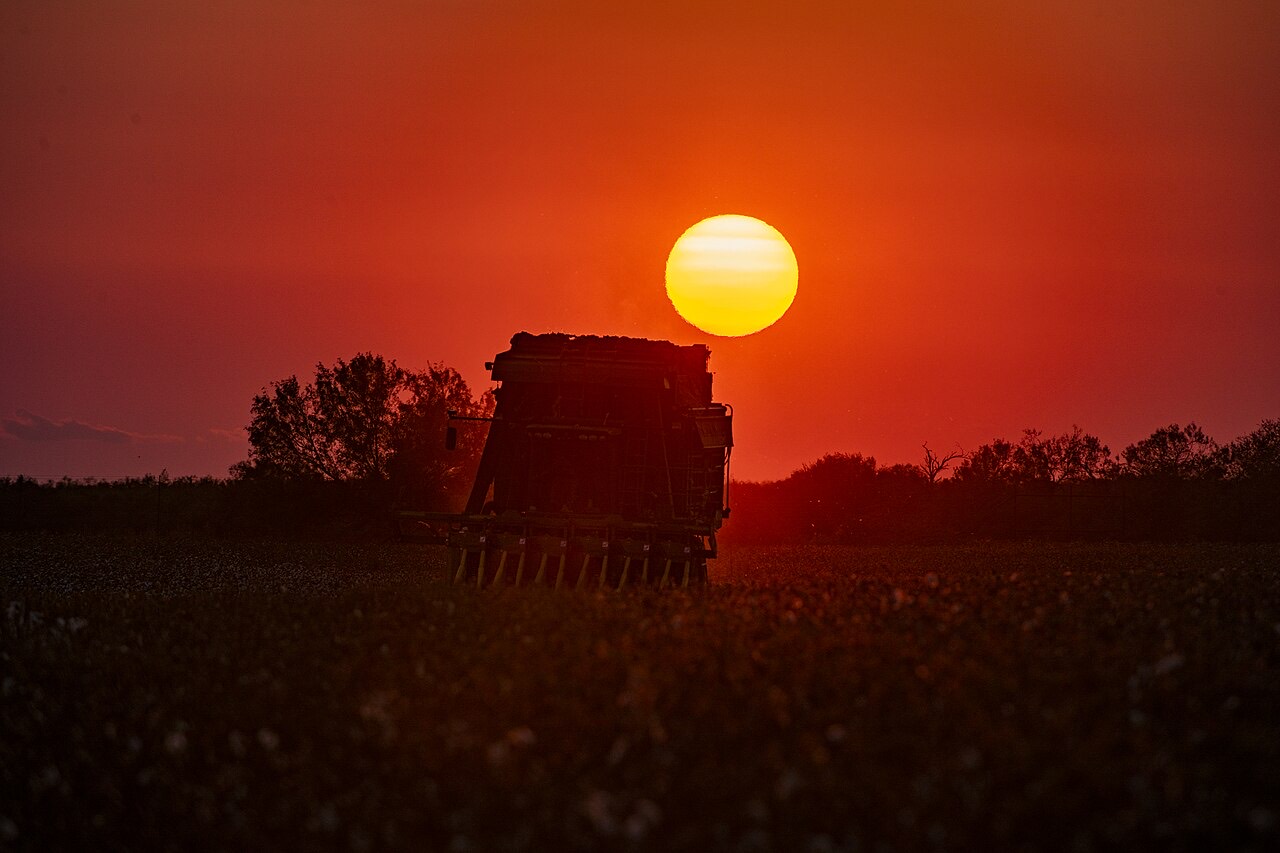
Cotton is grown primarily for the fiber, or lint, that develops around its seeds inside a protective boll. Although several Gossypium species are perennial shrubs in their native tropical habitats, cotton is cultivated commercially as an annual crop, planted from seed each season and harvested within a single growing period.
Two species dominate world production: Gossypium hirsutum, or upland cotton, which accounts for the large majority of global output, and Gossypium barbadense, grown for extra-long-staple fiber prized for fine, high-quality textiles.
Overview
Cotton is a globally significant fiber crop, grown across warm-temperate and tropical production regions and supporting a large downstream textile industry. Beyond fiber, the seed is processed into cottonseed oil, an edible vegetable oil, and cottonseed meal, a protein-rich livestock feed.
Production systems range from large, highly mechanized operations to smallholder cultivation, with input levels, irrigation, and pest-management approaches varying widely by region and production scale.
Botanical classification
- Family
- Malvaceae (mallow family)
- Genus
- Gossypium
- Principal species
- Gossypium hirsutum (upland cotton) and Gossypium barbadense (extra-long-staple cotton)
- Growth habit
- Broadleaf annual (cultivated) shrub producing a fibrous boll around the seed
Origin and distribution
Cotton fiber was independently domesticated in more than one region of the world, including Mesoamerica, where Gossypium hirsutum was developed, and South America, associated with Gossypium barbadense, alongside separate domestications of other Gossypium species in the Old World.
Today cotton is grown across warm-temperate and tropical regions on multiple continents.
Climate requirements
Cotton requires a long, warm, frost-free growing season, with germination and early growth sensitive to cool soil temperatures. Adequate heat accumulation over the season supports boll development and fiber maturation.
While cotton has some tolerance for heat, drought stress during flowering and boll development can reduce yield and fiber quality, making water availability at these stages a key management concern.
Soil requirements
Cotton is grown across a wide range of soil textures, from sandy loams to heavier clay soils, reflecting its deep rooting habit and moderate tolerance of a range of soil conditions, including some salinity relative to many other row crops.
Establishment and crop management
Cotton is planted after soils have warmed sufficiently for reliable germination, with plant population and row spacing set locally according to moisture availability, equipment, and expected boll load.
- Variety selection matched to fiber-quality target and disease/pest pressure
- Crop rotation to manage soil-borne diseases and weed pressure
- Seedbed preparation appropriate to the local tillage system
- Management of vegetative growth to avoid excessive "rank" growth that can delay boll set
Nutrient considerations
Nitrogen supports vegetative growth and boll development but is balanced carefully, since excess nitrogen can promote excessive vegetative growth at the expense of boll set and delay maturity. Potassium is important for fiber quality and is often in high demand during late-season boll fill.
Water and irrigation
Cotton is grown both rain-fed and under irrigation, with furrow irrigation historically dominant in many production regions, alongside increasing use of more efficient methods such as drip and center-pivot systems.
Water demand peaks around flowering and boll development, and drought stress during this window can reduce both yield and fiber quality.
Common diseases and pests
Fusarium wilt is a significant soil-borne fungal disease of cotton in many production regions, while bacterial blight can cause foliar and boll lesions under favorable conditions. Aphids, whiteflies, and spider mites are among the key insect and mite pests, with whiteflies also known for producing sticky honeydew that can stain lint.
Management combines resistant varieties, rotation, monitoring against locally established thresholds, and — where justified — locally authorized control products applied according to their labels.
Harvest
Cotton bolls are harvested once open and the fiber has dried, typically after the crop has been defoliated to ease mechanical picking. Harvested seed cotton is then ginned to separate lint from seed before further processing.
Uses
- Textile fiber (lint) for yarn and fabric production
- Cottonseed oil as an edible vegetable oil
- Cottonseed meal as a protein source in livestock feed
- Linters (short fibers) used in cellulose-based products
What this page covers
genus conceptThis page covers cotton as a crop. Four Gossypium species are grown for fibre; Gossypium hirsutum, the large majority of world production, has its own page and the other three are held as taxa.
The page covers several cultivated species of one genus. Each is a real, separately verifiable taxon; the page exists because the trade name covers all of them.
| Taxon | In this corpus | Role |
|---|---|---|
| Gossypium hirsutumUpland cotton | held as a verified taxon | The large majority of world lint. Medium staple. |
| Gossypium barbadenseBarbadense cotton | held as a verified taxon — listed in the taxa register, no page of its own | The extra-long staple trade, spun into fine-count yarns. |
| Gossypium arboreumTree cotton | held as a verified taxon — listed in the taxa register, no page of its own | An Old World diploid, still grown in parts of Asia. |
| Gossypium herbaceumLevant cotton | held as a verified taxon — listed in the taxa register, no page of its own | The other Old World diploid, grown in Asia and parts of Africa. |
When a taxon here earns its own page: The same standard as coffee. Upland cotton met it in Wave 32 because staple class, ginning and the Bt pest complex are species-level facts. The two diploids have not been reviewed for promotion.
Botanical identity
Genus-level crop concept- Accepted name
- GossypiumL.
- Family
- Malvaceae
- Genus
- Gossypium
- Harvested part
- fibre, oilseed
- Agricultural use
- fibre, oilseed, animal feed
- Crop group
- Fibre crops
What the authorities say
- Plants of the World Online
- Gossypium
Commercial cotton is grown from four domesticated species. Gossypium hirsutum is roughly ninety per cent of world production and G. barbadense supplies the extra-long staple trade; G. arboreum and G. herbaceum are still grown in Asia. All four are held separately. The existing page named only G. hirsutum, which is the largest of the four and not the whole crop.
- Staple length, spinning quality and disease susceptibility follow the species. A cotton figure that does not say which species it covers cannot be compared with one that does.
Botanical identity here is what the consulted taxonomic authorities publish, on the date they were read. Where authorities disagree, both readings are shown rather than one being chosen silently.
Traded as
This crop is traded as 3 distinct commodities, which are graded and priced separately.
What AgricultureID holds for this crop
- 16 crop calendar records
- 2 published cultivars
- 1 verified extension resources
- 6 pests and diseases naming this crop as a host
- 2 soil references
- 2 climate references
- 34 farm economics observations
- 584 market price series
- 1 related crops
Not held
- No official variety registrations — source exists not mapped
An absence here means this corpus holds no such record, not that none exists.
How to read figures on this page
Production, area and trade figures for any crop change from season to season and are compiled by FAO and by national agricultural statistics agencies. Take current numbers from those primary sources, dated to the period you mean, rather than from a secondary summary — including this one.
Crop water requirements are estimated from reference evapotranspiration and local climate data, following methods published by FAO and national agricultural agencies. A requirement quoted without the reference method and the local climate behind it is not a number that can be applied to a field.
Related crops
- Same crop concept
- Upland Cotton
Planting and harvest calendar
Usual sowing and harvest windows across 16 jurisdictions, covering cotonnier and cotton.
Cost of production, as forecast
United States national estimates for 2027, published by USDA Economic Research Service.
- Total costs listed
- 1000.66 USD
- Dollars per planted acre
- Operating costs
- 596.52 USD
- Dollars per planted acre
- Allocated overhead
- 404.14 USD
- Dollars per planted acre
A forecast of what a crop will cost to grow is not a record of what it cost. It is the source’s expectation for a year that has not finished.
These are costs only. The source publishes no revenue alongside them, so no margin, profit or break-even price is derived from them here.
Official extension guidance
1 resource indexed from public extension publishers. Each was written for a particular place; read it at the source.
Factsheet published by NC State Extension for North Carolina. It addresses cotton. The source is organised around “Environmental Factors Influencing Seedling Diseases”, “Disease Cycle” and “Disease Management”.
NC State Extension · Disease management · publisher states no date; reachable 2026-08-27
These are pointers to guidance published by others. Each was written for a particular place and season and is revised by its publisher; read it at the source, and check it applies where you farm.
Tools for this
Each tool shows its formula, constants and sources, and starts empty — nothing is filled in from this page.
- Seed-rate calculator
Convert a target plant stand into a seed rate, allowing for germination and establishment.
- Row spacing calculator
Work out in-row spacing and plants per metre of row for a target density.
- Production, area and yield calculator
Relate a harvested area and a yield to a production total, in either direction.
- Growing degree-days calculator
Accumulate heat units against a base temperature.
Relationships
Evidence-backed connections in the knowledge graph.
Susceptible to
Climate sensitivity
Irrigation methods
Machinery
Managed with
Farming systems
Related topics
Notable cultivars
Documented varieties tied to this species, with registry status and sources on each page. Not an exhaustive list.
- Acala cottonAcala is a group (type) of upland cotton (Gossypium hirsutum) known for stronger, longer staple, historically the standard fiber type of California cotton — not a single registered cultivar.
- Pima cottonPima (American Pima) is an extra-long-staple cotton type of Gossypium barbadense, developed by USDA and grown in the U.S. Southwest for fine, strong, premium fiber — a type/class, not one cultivar.
Harvested commodities
The traded commodities harvested from this crop. A commodity is the harvested lot, described by its own quality, grading, and storage evidence — not by the agronomy of the plant.
- Cotton LintCotton lint is the ginned fibre: the cotton commodity that is actually traded, shipped, and spun. It is baled at the gin and bought against a classing description covering staple length, micronaire, strength, uniformity, colour, and leaf.
- CottonseedCottonseed is the seed separated from lint when seed cotton is ginned. It arises as a co-product of a fibre crop yet is traded in its own right as an oilseed and as a livestock feed, and gossypol — a compound native to the seed — governs where it can be used.
- Seed CottonSeed cotton is cotton as it leaves the field: lint and seed together, still joined, as harvested from the opened boll. It is an intermediate commodity that exists only between picking and ginning, where it is separated into the two commodities that are actually traded.
Scope & limitations
Geographic scope: Global overview. Irrigation method, variety, and input levels vary widely by production region.
Climate context: Warm-season fiber crop requiring a long, frost-free growing season with adequate heat accumulation.
- Planting dates, plant populations, and input levels are region-specific decisions not covered by universal values here.
- Production and trade statistics change annually and should be taken from primary datasets such as FAOSTAT.
Sources
This article draws on the following authoritative sources. See our sources & methodology for how they are selected.
- [1]FAO — Food and Agriculture Organization (opens in a new tab)Authoritative
Food and Agriculture Organization of the United Nations (FAO)
Cited for: Global cotton production and trade context
- Type:
- Intergovernmental organization
- Jurisdiction:
- Global
- Accessed:
- 2026-07-12
- [2]FAOSTAT — FAO statistical database (opens in a new tab)Authoritative
Food and Agriculture Organization of the United Nations (FAO)
Cited for: Production and area statistics
- Type:
- Intergovernmental organization
- Jurisdiction:
- Global
- Accessed:
- 2026-07-12
- [3]USDA ARS — Agricultural Research Service (opens in a new tab)Authoritative
USDA Agricultural Research Service (ARS)
Cited for: Cotton research and disease information
- Type:
- Government agency
- Jurisdiction:
- United States
- Accessed:
- 2026-07-12
- [4]CABI Digital Library — Crop Protection Compendium (opens in a new tab)High
CABI (Centre for Agriculture and Bioscience International)
Cited for: Cotton disease and pest compendium data
- Type:
- Reference database
- Jurisdiction:
- Global
- Accessed:
- 2026-07-12
- [5]UC Statewide Integrated Pest Management Program (UC IPM) (opens in a new tab)High
University of California Agriculture and Natural Resources (UC ANR)
Cited for: Integrated pest management guidelines for cotton
- Type:
- University extension service
- Jurisdiction:
- United States (California)
- Accessed:
- 2026-07-12