Crop · Root and industrial crop
Sugar beet
Beta vulgaris subsp. vulgaris (Altissima Group)
Sugar beet is a biennial root crop grown as an annual for its sucrose-rich storage root, providing a temperate-climate alternative to sugarcane for sugar production.
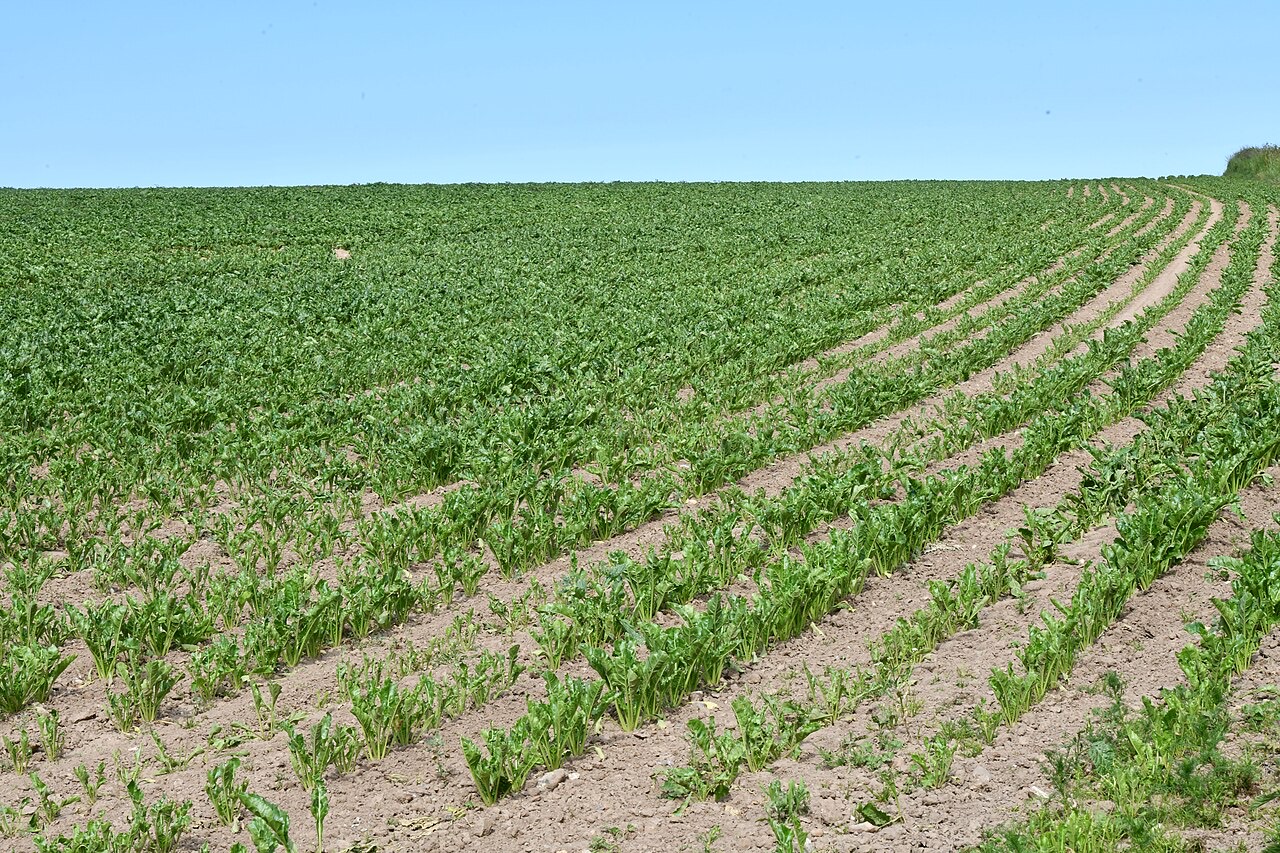
Sugar beet is naturally a biennial plant: in its first year it produces a large, sugar-storing taproot, and only in a second year, after exposure to winter cold, does it bolt and flower to set seed. Commercial sugar production exploits this biology by harvesting the crop at the end of its first growing season, before flowering, when root sugar content is highest.
Developed as a sugar crop in Europe in the late 18th and early 19th centuries from wild sea beet, sugar beet gave temperate regions an alternative to imported cane sugar and remains an important crop in cooler climates unsuited to sugarcane.
Overview
Sugar beet is grown in temperate regions as a major alternative source of sugar to sugarcane, particularly in parts of Europe, North America, and Asia where climate is unsuited to cane production.
Because the crop is harvested for its root before it would naturally flower, agronomic management focuses on maximizing root yield and sugar concentration within a single growing season while avoiding premature bolting.
Botanical classification
- Family
- Amaranthaceae (formerly classified in Chenopodiaceae)
- Genus
- Beta
- Principal species/group
- Beta vulgaris subsp. vulgaris, Altissima Group (sugar beet)
- Growth habit
- Biennial root crop producing a large storage taproot in its first year
Origin and distribution
Sugar beet was developed from wild sea beet (Beta vulgaris subsp. maritima), native to European and Mediterranean coastlines, through selective breeding in Europe beginning in the late 18th century, in response to disrupted access to cane sugar imports.
Sugar beet is now grown across temperate production regions in Europe, North America, and parts of Asia.
Climate requirements
Sugar beet is adapted to cool-to-temperate climates and, as a biennial, retains a vernalization response: exposure to cold during establishment can trigger premature bolting (flowering) in the first year, which is undesirable since it diverts resources away from root and sugar production.
Seedlings tolerate some cold but are vulnerable at emergence, and management practices, including sowing date and variety choice, are used to balance early establishment against bolting risk.
Soil requirements
Sugar beet performs best on deep, well-drained, medium-to-fine textured soils such as loams and silt loams, free of compaction, to allow the taproot to develop without restriction.
Establishment and crop management
Sugar beet is precision-sown, generally using pelleted seed, to establish a uniform final plant stand directly rather than relying on the manual thinning once common in the crop's history. A fine, level, firm seedbed supports even emergence.
- Precision sowing to a target plant population using pelleted seed
- Fine, firm seedbed preparation for even emergence
- Early and effective weed control, as beet competes poorly with weeds when young
- Variety and sowing-date choice balanced against bolting risk
Nutrient considerations
Sugar beet has a distinctive sensitivity to boron deficiency, which can cause root and crown disorders. Nitrogen is managed carefully, since excess nitrogen late in the season can increase root yield while reducing sugar concentration.
Water and irrigation
Sugar beet is grown both rain-fed in more humid temperate regions and under irrigation in drier production areas, where water availability during root bulking strongly influences yield.
Sprinkler irrigation is commonly used in semi-arid sugar beet production regions, with scheduling aimed at supporting root development while avoiding waterlogging.
Common diseases and pests
Powdery mildew is a common foliar disease of sugar beet, particularly under warm, dry late-season conditions, while root rots caused by soil-borne pathogens can significantly limit yield, especially in poorly drained fields. Aphids are a major pest both through direct feeding and as vectors of damaging viruses, and plant-parasitic nematodes, including root-knot nematode, can affect root quality and yield.
Management combines resistant or tolerant varieties, rotation, monitoring, and — where justified — locally authorized control products applied according to their labels.
Harvest
Sugar beet roots are lifted mechanically in autumn or early winter once sugar content peaks, with careful handling important to minimize root damage and associated sugar losses during subsequent storage before processing.
Uses
- Refined white sugar production
- Beet pulp, a fibrous by-product used in livestock feed
- Molasses for feed and industrial fermentation
- Bioethanol production in some regions
Botanical identity
Cultivar group- Accepted name
- Beta vulgaris Altissima Group
- Family
- Amaranthaceae
- Genus
- Beta
- Harvested part
- root
- Agricultural use
- sugar, animal feed, bioenergy
- Crop group
- Sugar crops, Roots and tubers
What the authorities say
- World Flora Online — Taxonomic Backbone
- Beta vulgaris
- Plants of the World Online
- Beta vulgaris
Beetroot, Swiss chard and sugar beet are the same species, Beta vulgaris, bred for storage root, leaf and stalk, and sugar content respectively. They are cultivar groups of one plant, not three species.
Botanical identity here is what the consulted taxonomic authorities publish, on the date they were read. Where authorities disagree, both readings are shown rather than one being chosen silently.
Traded as
This crop is traded as one commodity in this corpus.
What AgricultureID holds for this crop
- 58 crop calendar records
- 3 pests and diseases naming this crop as a host
- 2 soil references
- 2 climate references
- 214 market price series
- 2 related crops
Not held
- No published cultivars — not researched
- No official variety registrations — source exists not mapped
- No verified extension resources — source exists not ingested
- No farm economics observations — source exists not mapped
An absence here means this corpus holds no such record, not that none exists.
How to read figures on this page
Production, area and trade figures for any crop change from season to season and are compiled by FAO and by national agricultural statistics agencies. Take current numbers from those primary sources, dated to the period you mean, rather than from a secondary summary — including this one.
Crop water requirements are estimated from reference evapotranspiration and local climate data, following methods published by FAO and national agricultural agencies. A requirement quoted without the reference method and the local climate behind it is not a number that can be applied to a field.
Part of
Related crops
- Same genus
- Beetroot, Swiss Chard
Planting and harvest calendar
Usual sowing and harvest windows across 58 jurisdictions, covering beet, sugar and beet, sugar — season 1 and beet, sugar — season 2.
Tools for this
Each tool shows its formula, constants and sources, and starts empty — nothing is filled in from this page.
- Seed-rate calculator
Convert a target plant stand into a seed rate, allowing for germination and establishment.
- Row spacing calculator
Work out in-row spacing and plants per metre of row for a target density.
- Production, area and yield calculator
Relate a harvested area and a yield to a production total, in either direction.
- Growing degree-days calculator
Accumulate heat units against a base temperature.
Relationships
Evidence-backed connections in the knowledge graph.
Susceptible to
Climate sensitivity
Irrigation methods
Machinery
Managed with
Related topics
Harvested commodities
The traded commodities harvested from this crop. A commodity is the harvested lot, described by its own quality, grading, and storage evidence — not by the agronomy of the plant.
Scope & limitations
Geographic scope: Global overview of temperate production. Sowing date, variety, and bolting risk vary by region.
Climate context: Cool-to-temperate biennial root crop harvested as an annual before natural flowering; sensitive to bolting from cold exposure.
- Sowing dates, plant populations, and boron management are region-specific decisions not covered by universal values here.
- Production statistics change annually and should be taken from primary datasets such as FAOSTAT.
Sources
This article draws on the following authoritative sources. See our sources & methodology for how they are selected.
- [1]FAO — Food and Agriculture Organization (opens in a new tab)Authoritative
Food and Agriculture Organization of the United Nations (FAO)
Cited for: Role of sugar beet in global sugar production
- Type:
- Intergovernmental organization
- Jurisdiction:
- Global
- Accessed:
- 2026-07-12
- [2]FAOSTAT — FAO statistical database (opens in a new tab)Authoritative
Food and Agriculture Organization of the United Nations (FAO)
Cited for: Production and area statistics
- Type:
- Intergovernmental organization
- Jurisdiction:
- Global
- Accessed:
- 2026-07-12
- [3]European Commission — Agriculture and rural development (opens in a new tab)Authoritative
European Commission, Directorate-General for Agriculture
Cited for: European Union sugar beet production and market context
- Type:
- Government agency
- Jurisdiction:
- European Union
- Accessed:
- 2026-07-12
- [4]AHDB — Agriculture and Horticulture Development Board (opens in a new tab)High
Agriculture and Horticulture Development Board (AHDB)
Cited for: Regional sugar beet agronomy and management
- Type:
- Government agency
- Jurisdiction:
- United Kingdom
- Accessed:
- 2026-07-12
- [5]CABI Digital Library — Crop Protection Compendium (opens in a new tab)High
CABI (Centre for Agriculture and Bioscience International)
Cited for: Sugar beet disease and pest compendium data
- Type:
- Reference database
- Jurisdiction:
- Global
- Accessed:
- 2026-07-12