Crop · Vegetable crop
Sweetcorn
Zea mays var. saccharata (and var. rugosa)
Also known as: Sweet corn, Corn on the cob
Sweetcorn is a vegetable form of maize bred for high sugar content in the kernel, harvested immature at the milk stage and eaten fresh, canned, or frozen rather than dried for grain or feed.
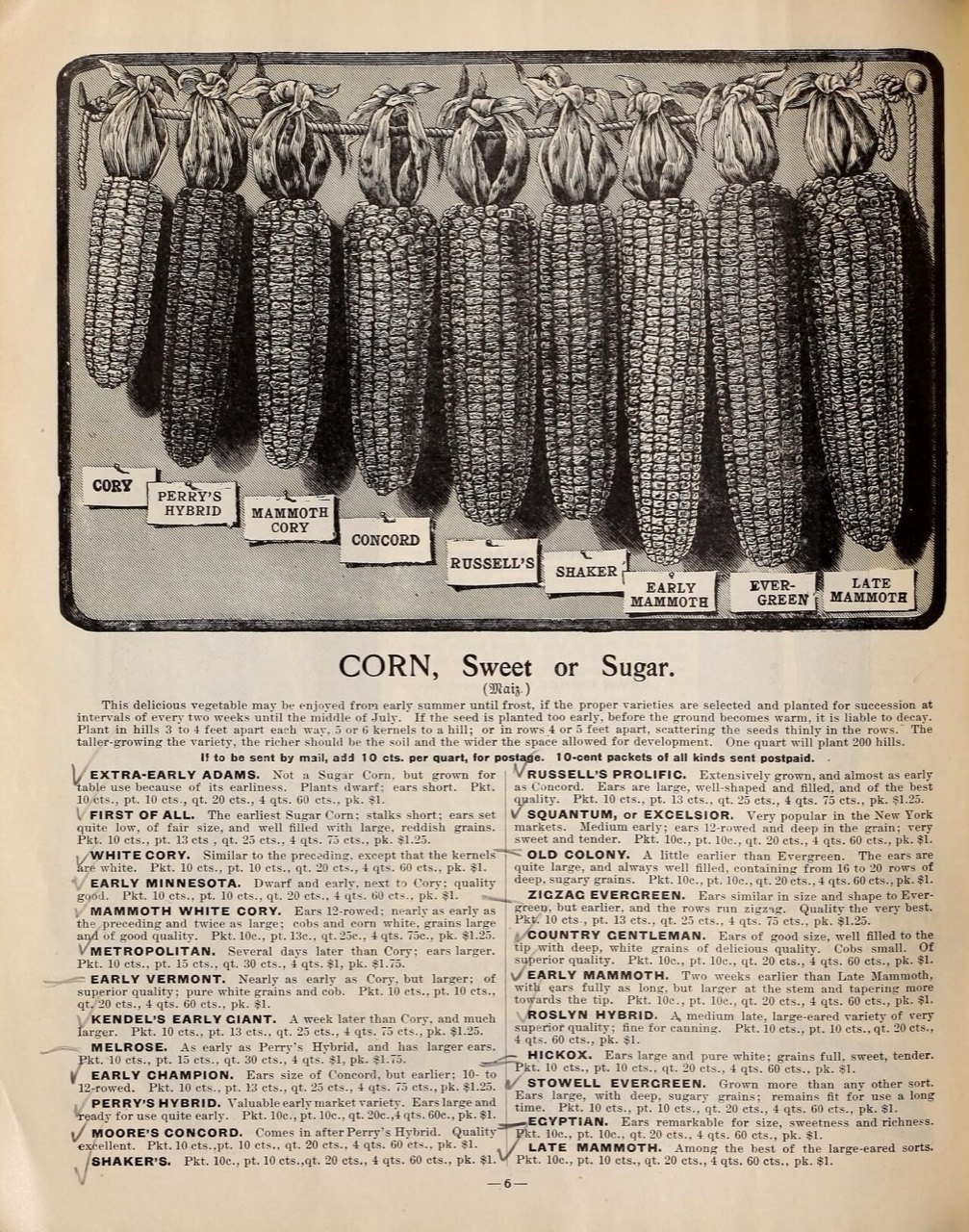
Sweetcorn belongs to the same species as field maize but carries genetic mutations that slow the conversion of sugar to starch in the kernel, giving it a sweeter taste when harvested at the immature, milk stage rather than left to mature and dry.
Unlike grain maize, sweetcorn is grown as a vegetable crop, with production and harvest timing centered on the relatively short window when ears are at peak eating quality.
Overview
Sweetcorn is grown for fresh-market, processing (canning and freezing), and home-garden use, with cultivar groups differing in sugar retention, kernel color, and maturity length.
Because kernel quality declines quickly after the optimal harvest stage, timing of harvest and rapid post-harvest cooling are important considerations, particularly for fresh-market production.
Botanical classification
- Family
- Poaceae (grass family)
- Genus
- Zea
- Principal species
- Zea mays, sweet-type cultivars (var. saccharata and var. rugosa)
- Growth habit
- Tall annual grass producing a single main stalk with tassel (male) and ear (female) inflorescences on the same plant
Origin and distribution
Sweetcorn originated from mutations in maize populations grown by Indigenous peoples in the Americas, where maize itself was domesticated thousands of years ago. Sweet types were selected and popularized in North America before spreading globally.
Today, sweetcorn is grown widely across temperate and subtropical regions for fresh, canned, and frozen markets, with production data typically reported separately from grain maize statistics at the national level.
Climate and soil requirements
Sweetcorn is a warm-season crop with no frost tolerance; seed germinates poorly in cold soil, and growth is fastest under warm days and nights with adequate sunlight.
Fertile, well-drained loams and sandy loams support strong root and stalk development. Compacted or poorly drained soils restrict rooting and can increase disease pressure.
Cultivation and management
- Cultivar selection matched to maturity length, sweetness type, and target market (fresh, canning, or freezing)
- Block planting rather than long single rows to support adequate wind pollination of ears
- Succession sowing used in fresh-market production to extend the harvest window
- Isolation from field maize and other corn types where seed and kernel purity matter
Nutrient considerations
Nitrogen strongly influences stalk growth, ear development, and yield, making it a central input in sweetcorn nutrition programs, while potassium supports overall plant vigor and stalk strength.
Water and irrigation
Sweetcorn has a high water requirement, particularly around tasseling, silking, and ear fill, when moisture stress can significantly reduce yield and kernel quality.
Center-pivot and drip irrigation are both used in commercial production depending on scale and region, with scheduling based on local evapotranspiration estimates.
Common diseases and pests
Common smut, causing distinctive swollen galls on ears, stalks, and tassels, is a well-known disease of sweetcorn and other maize types, and downy mildew of maize can affect foliage in some production regions under favorable conditions. The fall armyworm and European corn borer are major caterpillar pests that damage foliage and ears, and aphids are common sap-feeding pests that can also spread viruses.
| Problem | Type | Notes |
|---|---|---|
| Common smut | Disease | Causes swollen galls on ears, stalks, and tassels |
| Downy mildew | Disease | Affects foliage under favorable regional conditions |
| Fall armyworm | Pest | Caterpillar pest damaging foliage and ears |
| European corn borer | Pest | Caterpillar pest boring into stalks and ears |
| Aphids | Pest | Sap-feeding insects that can spread viruses |
Harvest
Ears are picked at the milk stage, when kernels are plump and sugar content is at its peak, either by hand for fresh-market sale or by mechanical harvester for processing, followed by rapid cooling to preserve sweetness and quality.
Uses
- Fresh ears eaten boiled, grilled, or roasted as a vegetable
- Canned and frozen kernels for retail and food-service markets
- Ingredient in prepared foods, soups, and salads
- Stalks and crop residue sometimes used as livestock forage or soil-incorporated residue after harvest
Botanical identity
Cultivar group- Accepted name
- Zea mays Saccharata Group
- Family
- Poaceae
- Genus
- Zea
- Harvested part
- grain
- Agricultural use
- human food
- Crop group
- Vegetables, Cereals
What the authorities say
- Plants of the World Online
- Zea mays
Sweetcorn is a cultivated form of Zea mays carrying mutations that slow the conversion of sugar to starch. Plants of the World Online resolves var. saccharata to Zea mays subsp. mays. It is a cultivar group of maize, not a separate species.
Botanical identity here is what the consulted taxonomic authorities publish, on the date they were read. Where authorities disagree, both readings are shown rather than one being chosen silently.
Traded as
This crop is traded as one commodity in this corpus.
What AgricultureID holds for this crop
- 262 crop calendar records
- 7 pests and diseases naming this crop as a host
- 2 soil references
- 2 climate references
- 137 market price series
- 1 related crops
Not held
- No published cultivars — not researched
- No official variety registrations — source exists not mapped
- No verified extension resources — source exists not ingested
- No farm economics observations — source exists not mapped
An absence here means this corpus holds no such record, not that none exists.
How to read figures on this page
Production, area and trade figures for any crop change from season to season and are compiled by FAO and by national agricultural statistics agencies. Take current numbers from those primary sources, dated to the period you mean, rather than from a secondary summary — including this one.
Crop water requirements are estimated from reference evapotranspiration and local climate data, following methods published by FAO and national agricultural agencies. A requirement quoted without the reference method and the local climate behind it is not a number that can be applied to a field.
Part of
Related crops
- Same genus
- Maize
Planting and harvest calendar
Usual sowing and harvest windows across 262 jurisdictions, covering corn, sweet and corn, sweet — season 1 and corn, sweet — season 2.
Authorised inputs (France)
The French register records 68 currently authorised products whose authorised use names this crop, held by 32 authorisation holders. This is a count of what exists on the register, not a recommendation and not a shortlist.
By function
- Herbicide 31
- Insecticide 21
- Fongicide 14
- Régulateur de croissance 1
- Acaricide 1
Targets named on the register
- Ravageurs du sol 10
- Chenilles phytophages 10
- Maladies des taches foliaires 8
- Champignons (autres que pythiacées) 5
- Champignons (pythiacées) 4
- Rouille(s) 3
Use scope is recorded as the register writes it. Collective terms cover several crops at once and are left unmapped rather than expanded, because expanding one entry into several would invent authorisations that were never granted.
Authorisation is specific to one jurisdiction, one legal object and one moment. It is not a recommendation, and it says nothing about how a product may be used: always read the current official label at the source before acting.
Tools for this
Each tool shows its formula, constants and sources, and starts empty — nothing is filled in from this page.
- Seed-rate calculator
Convert a target plant stand into a seed rate, allowing for germination and establishment.
- Row spacing calculator
Work out in-row spacing and plants per metre of row for a target density.
- Production, area and yield calculator
Relate a harvested area and a yield to a production total, in either direction.
- Growing degree-days calculator
Accumulate heat units against a base temperature.
Relationships
Evidence-backed connections in the knowledge graph.
Suitable soils
Climate sensitivity
Irrigation methods
Machinery
Managed with
Farming systems
Harvested commodities
The traded commodities harvested from this crop. A commodity is the harvested lot, described by its own quality, grading, and storage evidence — not by the agronomy of the plant.
Scope & limitations
Geographic scope: Global overview; grown widely across temperate and subtropical regions for fresh, canned, and frozen vegetable-corn markets.
Climate context: Warm-season annual crop with no frost tolerance, requiring warm soil for germination and consistent moisture through tasseling and ear fill.
- Sweet-type cultivar genetics (sugary, sugary-enhanced, and supersweet types) affect sweetness retention and are not detailed exhaustively here.
- Production statistics for sweetcorn are often reported together with or separately from field maize depending on the country, and should be checked against primary national or FAO datasets.
Sources
This article draws on the following authoritative sources. See our sources & methodology for how they are selected.
- [1]FAO — Food and Agriculture Organization (opens in a new tab)Authoritative
Food and Agriculture Organization of the United Nations (FAO)
Cited for: Global vegetable and maize-type crop context
- Type:
- Intergovernmental organization
- Jurisdiction:
- Global
- Accessed:
- 2026-07-12
- [2]FAOSTAT — FAO statistical database (opens in a new tab)Authoritative
Food and Agriculture Organization of the United Nations (FAO)
Cited for: Production and area statistics
- Type:
- Intergovernmental organization
- Jurisdiction:
- Global
- Accessed:
- 2026-07-12
- [3]USDA NASS — National Agricultural Statistics Service (opens in a new tab)Authoritative
USDA National Agricultural Statistics Service (NASS)
Cited for: Sweetcorn production statistics
- Type:
- Government agency
- Jurisdiction:
- United States
- Accessed:
- 2026-07-12
- Authoritative
Cited for: Classification and nomenclature
- Type:
- Reference database
- Jurisdiction:
- United States
- Accessed:
- 2026-07-12
- [5]Cornell CALS — Plant pathology and crop resources (opens in a new tab)High
Cornell University College of Agriculture and Life Sciences
Cited for: Sweetcorn production and pest guidance
- Type:
- University extension service
- Jurisdiction:
- United States (New York)
- Accessed:
- 2026-07-12