Pest · Insect pest
Codling Moth
Cydia pomonella (Lepidoptera: Tortricidae)
Also known as: Apple worm
Codling moth larvae bore into apple fruit, feeding on the flesh and seeds, and are among the most economically important and best-studied pests of apple production worldwide.
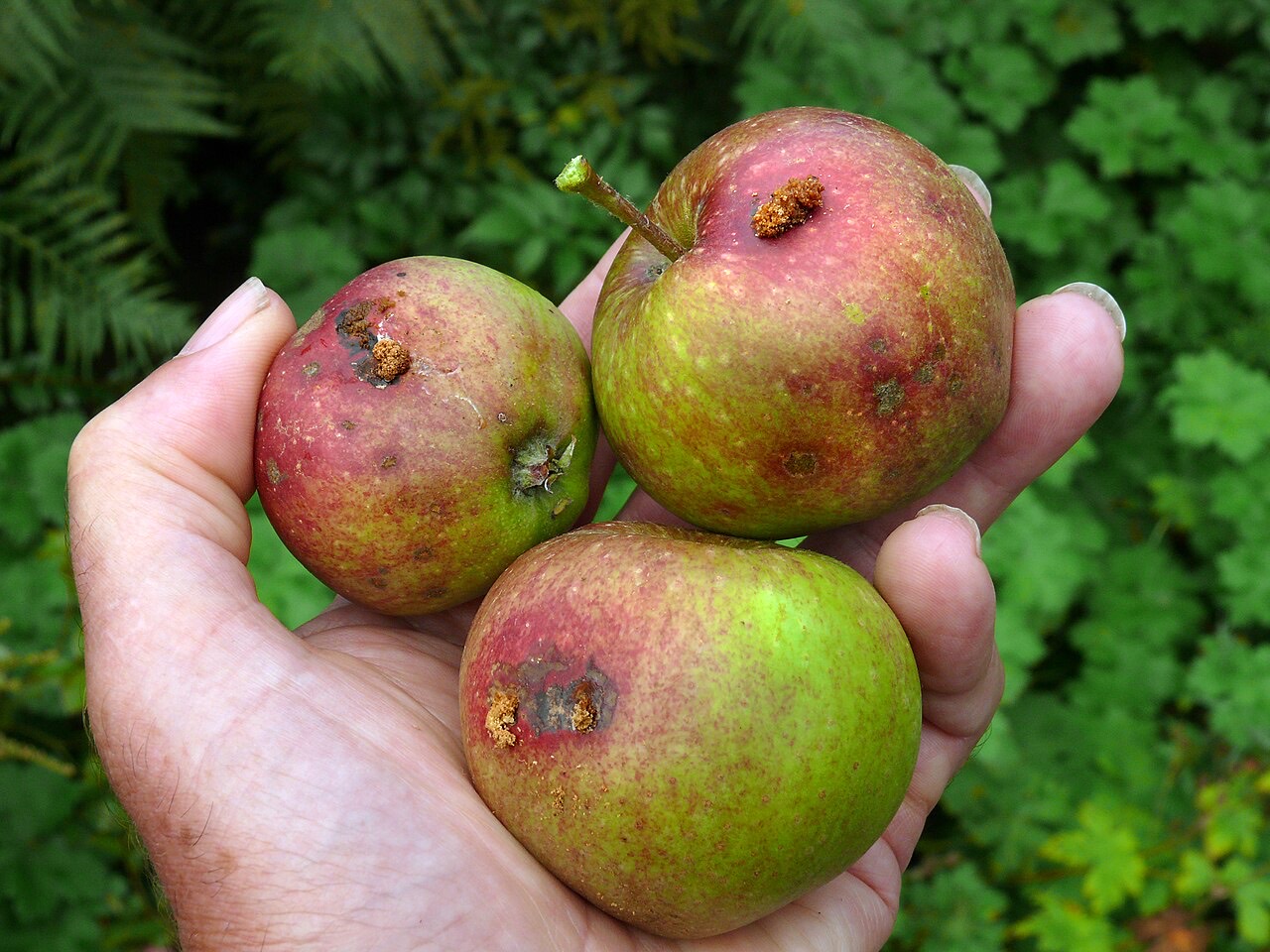
Codling moth is a small moth whose larvae tunnel into apple fruit, feeding on the flesh and seeds and leaving a characteristic frass-filled entry hole. It is one of the most significant pests of apple production in temperate growing regions worldwide.
Because larvae are protected inside the fruit for most of their development, management relies heavily on well-timed monitoring during the brief window when eggs and newly hatched larvae are exposed, using pheromone traps and temperature-based degree-day models to predict adult flight and egg-hatch timing.
Identification
Adult moths have mottled grey-brown wings with a distinctive coppery patch near the wingtip. Larvae are pinkish-white with a brown head and tunnel into fruit, often near the calyx end, leaving a small entry hole plugged with reddish-brown frass as the main external sign.
Biology and life cycle
Codling moth overwinters as a mature larva in a silken cocoon under bark or in soil debris, pupating in spring. Adult moths emerge, mate, and females lay eggs on leaves or fruit. Newly hatched larvae bore into fruit within a short time, after which they are protected from most external factors.
The number of generations completed each year, typically one to three, depends on accumulated temperature, and degree-day models are widely used to track development and predict the timing of each generation.
Damage and hosts
Larval tunneling directly damages fruit, often reaching the core and seeds, rendering it unmarketable and more prone to secondary rot, and can trigger premature fruit drop before harvest.
Apple is the principal host crop worldwide, with the pest also affecting other pome fruit in some growing regions.
Monitoring
Pheromone traps detect and track adult flight activity, while degree-day models predict egg-hatch timing so that monitoring and any decisions can target the brief window before larvae enter fruit. Regular fruit inspection for entry holes and frass supplements trap data through the season.
Management principles
Codling moth management combines mating disruption, monitoring, and orchard sanitation within an integrated approach.
- Use pheromone-based mating disruption where locally established as a practice
- Time monitoring and any action around degree-day-predicted egg-hatch windows
- Conserve parasitoid wasps and other natural enemies
- Remove and destroy fallen and infested fruit to reduce carry-over
- Scrape or otherwise manage bark crevices where larvae overwinter
Relationships
Evidence-backed connections in the knowledge graph.
Affects
Risk increases under
Scope & limitations
Geographic scope: Established in most apple-growing regions worldwide; generation number, timing, and pressure vary by regional climate.
Climate context: Development speed and the number of generations per year rise with accumulated warm-season temperature, tracked through growing-degree-day models.
- This is a general overview of a well-studied orchard pest, not region-specific guidance for a particular cultivar or growing area.
- Thresholds and control-product recommendations are jurisdiction-specific and are not provided here.
Sources
This article draws on the following authoritative sources. See our sources & methodology for how they are selected.
- [1]UC Statewide Integrated Pest Management Program (UC IPM) (opens in a new tab)High
University of California Agriculture and Natural Resources (UC ANR)
Cited for: Identification, degree-day models, and IPM principles
- Type:
- University extension service
- Jurisdiction:
- United States (California)
- Accessed:
- 2026-07-12
- [2]CABI Digital Library — Crop Protection Compendium (opens in a new tab)High
CABI (Centre for Agriculture and Bioscience International)
Cited for: Biology, hosts, and distribution
- Type:
- Reference database
- Jurisdiction:
- Global
- Accessed:
- 2026-07-12
- [3]EPPO Global Database (opens in a new tab)Authoritative
European and Mediterranean Plant Protection Organization (EPPO)
Cited for: Species nomenclature and distribution
- Type:
- Reference database
- Jurisdiction:
- Global
- Accessed:
- 2026-07-12
- [4]AHDB — Agriculture and Horticulture Development Board (opens in a new tab)High
Agriculture and Horticulture Development Board (AHDB)
Cited for: Orchard monitoring and management context
- Type:
- Government agency
- Jurisdiction:
- United Kingdom
- Accessed:
- 2026-07-12