Pest · Insect pest
Fall Armyworm
Spodoptera frugiperda (Lepidoptera: Noctuidae)
Also known as: FAW
Fall armyworm is a highly mobile moth whose caterpillars feed in the whorl and ear of maize and other cereals, and which has spread to become a major pest across much of the world.
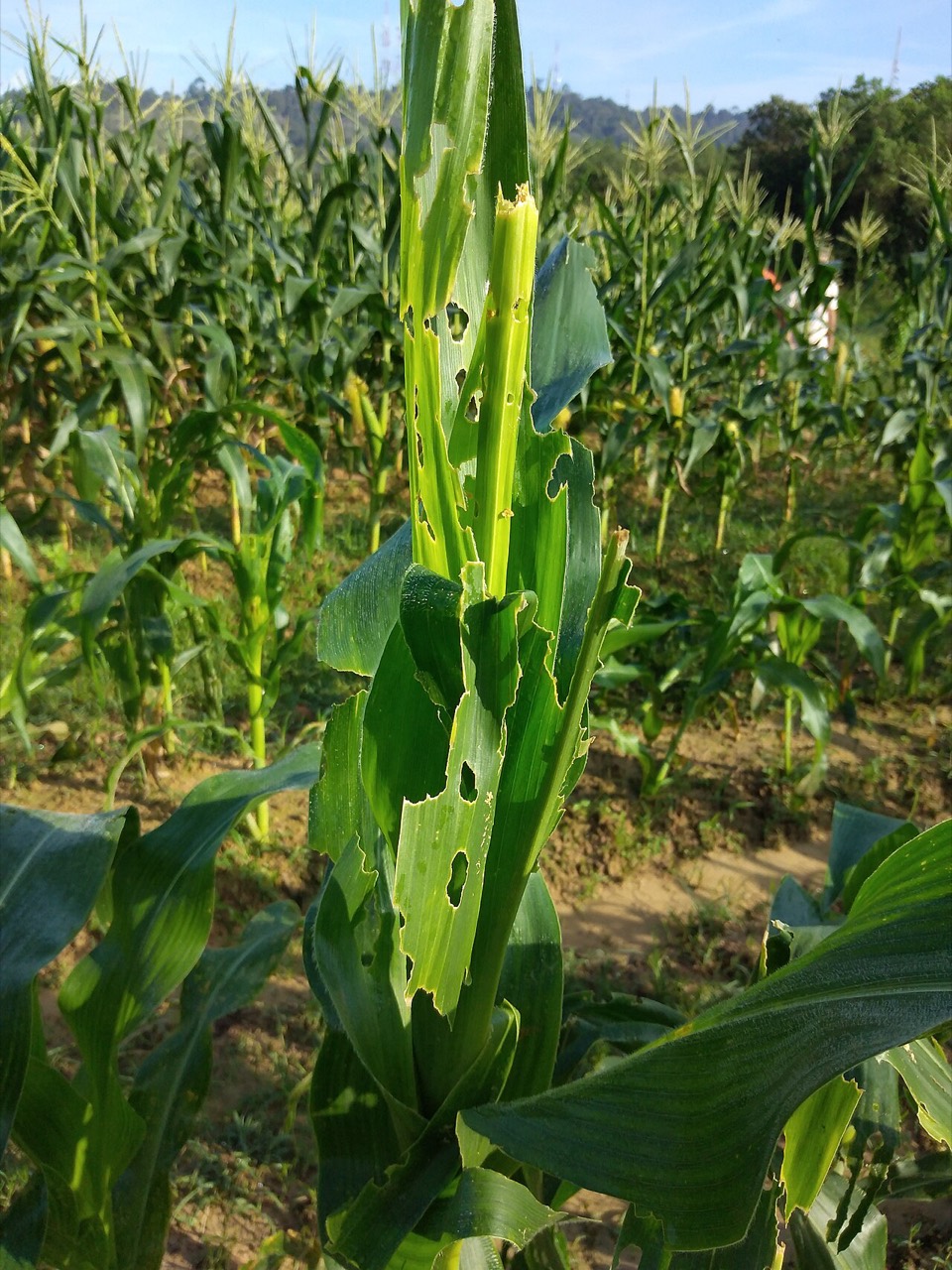
Fall armyworm is the caterpillar stage of a night-flying moth native to the Americas. Adult moths are strong fliers capable of migrating long distances on seasonal winds, which has allowed the species to establish across Africa, Asia, and Oceania since 2016 after previously being confined to the Americas.
Larvae feed on a wide range of grasses and cereals but are best known as a major pest of maize, where feeding in the whorl and later in the ear can cause substantial yield loss if left unmanaged. Rapid reproduction and long-distance migration make it a particularly challenging pest to track and manage regionally.
Identification
Larvae vary in colour from light green to nearly black but usually show longitudinal stripes along the body. Two features help distinguish fall armyworm from similar caterpillars: a pale, inverted Y-shaped marking on the head capsule, and four dark spots arranged in a square on the segment just before the last.
| Feature | Fall armyworm | Many similar caterpillars |
|---|---|---|
| Head capsule marking | Pale, inverted Y shape | Marking usually absent or different |
| Segment before the last | Four dark spots forming a square | Spots, if present, not arranged in a square |
Biology and life cycle
Females lay egg masses covered in protective fuzzy scales, usually on leaves. Larvae pass through six instars before pupating in the soil, and in warm conditions a generation can complete in under a month, allowing several overlapping generations per growing season.
Fall armyworm cannot survive prolonged freezing temperatures, so in cooler regions populations typically recolonize each season through migration from warmer areas rather than overwintering locally.
Damage and hosts
Young larvae scrape the leaf surface, producing a translucent "window-pane" effect, while older larvae chew ragged holes and burrow into the whorl, leaving characteristic coarse frass. Larvae can also feed directly on developing ears, adding to yield impact.
The host range spans many grasses and cereals. Maize is the most heavily affected crop in most regions, with sorghum and rice also recognized as significant hosts among many others.
Monitoring
Pheromone traps are widely used to track adult moth flight activity and help anticipate egg-laying periods. Field scouting focuses on the whorl stage, looking for early feeding signs and frass, with local economic thresholds guiding whether intervention is warranted.
Because of its migratory capacity, fall armyworm is also tracked through regional and international monitoring networks that share flight and outbreak information across borders.
Management principles
Fall armyworm management combines biological, cultural, and monitoring-based tactics within an integrated pest management framework.
- Conserve parasitoid wasps, predators, and naturally occurring pathogens
- Scout regularly at the whorl stage, when early intervention is most effective
- Use locally recommended resistant or biotech varieties where authorized
- Practise field sanitation and timely planting to reduce carry-over
- Participate in area-wide monitoring given the pest’s migratory behaviour
Regulatory status
Official listings recorded for this organism. Listing is a regulatory fact and is separate from where the organism actually occurs.
EPPO A2 Listversion 2025-09
Listed as: Spodoptera frugiperda
EPPO region · recorded status: recommended for regulation · verified 2026-08-20
- EPPO A1 and A2 entries are recommendations to EPPO member countries, not statutory quarantine status in any particular country. Confirm the position with the national plant health authority.
- A2 pests are listed by EPPO as present but locally distributed in the EPPO region. Listing does not establish presence in any particular country.
EPPO A2 List of pests recommended for regulation as quarantine pestsEPPO Global Database
Regulatory status is jurisdiction-specific and changes. Confirm the current position with the responsible plant health authority before acting on it. All recorded listings
Official extension guidance
1 resource indexed from public extension publishers. Each was written for a particular place; read it at the source.
Fall Armyworm in Ohio Field Crops
Factsheet published by Ohio State University Extension for Ohio. It addresses fall armyworm. The source is organised around “For More Information”, “Search form” and “ENT-0093”.
Ohio State University Extension · Pest management · publisher states no date; reachable 2026-08-27
These are pointers to guidance published by others. Each was written for a particular place and season and is revised by its publisher; read it at the source, and check it applies where you farm.
Relationships
Evidence-backed connections in the knowledge graph.
Risk increases under
Managed with
Scope & limitations
Geographic scope: Global overview of a highly mobile pest now established across the Americas, Africa, Asia, and parts of Oceania; local hosts, pressure, and guidance vary by region.
Climate context: Warm temperatures speed development and allow more generations per season, while seasonal winds carry moths into cooler regions where the pest cannot overwinter.
- This is a general overview of a widely distributed migratory pest, not region-specific guidance for a particular country or cropping system.
- Thresholds and control-product recommendations are jurisdiction-specific and are not provided here.
Sources
This article draws on the following authoritative sources. See our sources & methodology for how they are selected.
- [1]FAO — Food and Agriculture Organization (opens in a new tab)Authoritative
Food and Agriculture Organization of the United Nations (FAO)
Cited for: Global distribution and monitoring guidance
- Type:
- Intergovernmental organization
- Jurisdiction:
- Global
- Accessed:
- 2026-07-12
- [2]USDA APHIS — Animal and Plant Health Inspection Service (opens in a new tab)Authoritative
USDA Animal and Plant Health Inspection Service (APHIS)
Cited for: Pest status and regulatory context
- Type:
- Government agency
- Jurisdiction:
- United States
- Accessed:
- 2026-07-12
- [3]CABI Digital Library — Crop Protection Compendium (opens in a new tab)High
CABI (Centre for Agriculture and Bioscience International)
Cited for: Biology, hosts, and identification
- Type:
- Reference database
- Jurisdiction:
- Global
- Accessed:
- 2026-07-12
- [4]CIMMYT — International Maize and Wheat Improvement Center (opens in a new tab)High
International Maize and Wheat Improvement Center (CIMMYT)
Cited for: Maize-specific impact and management research
- Type:
- Research institute
- Jurisdiction:
- Global
- Accessed:
- 2026-07-12