Pest · Insect pest
Sawflies
Suborder Symphyta (order Hymenoptera)
Also known as: Sawfly larvae
Sawflies are hymenopteran insects whose caterpillar-like larvae feed on foliage or fruit of tree and field crops, including apple, pear, and oilseed rape, causing direct feeding damage rather than acting as disease vectors.
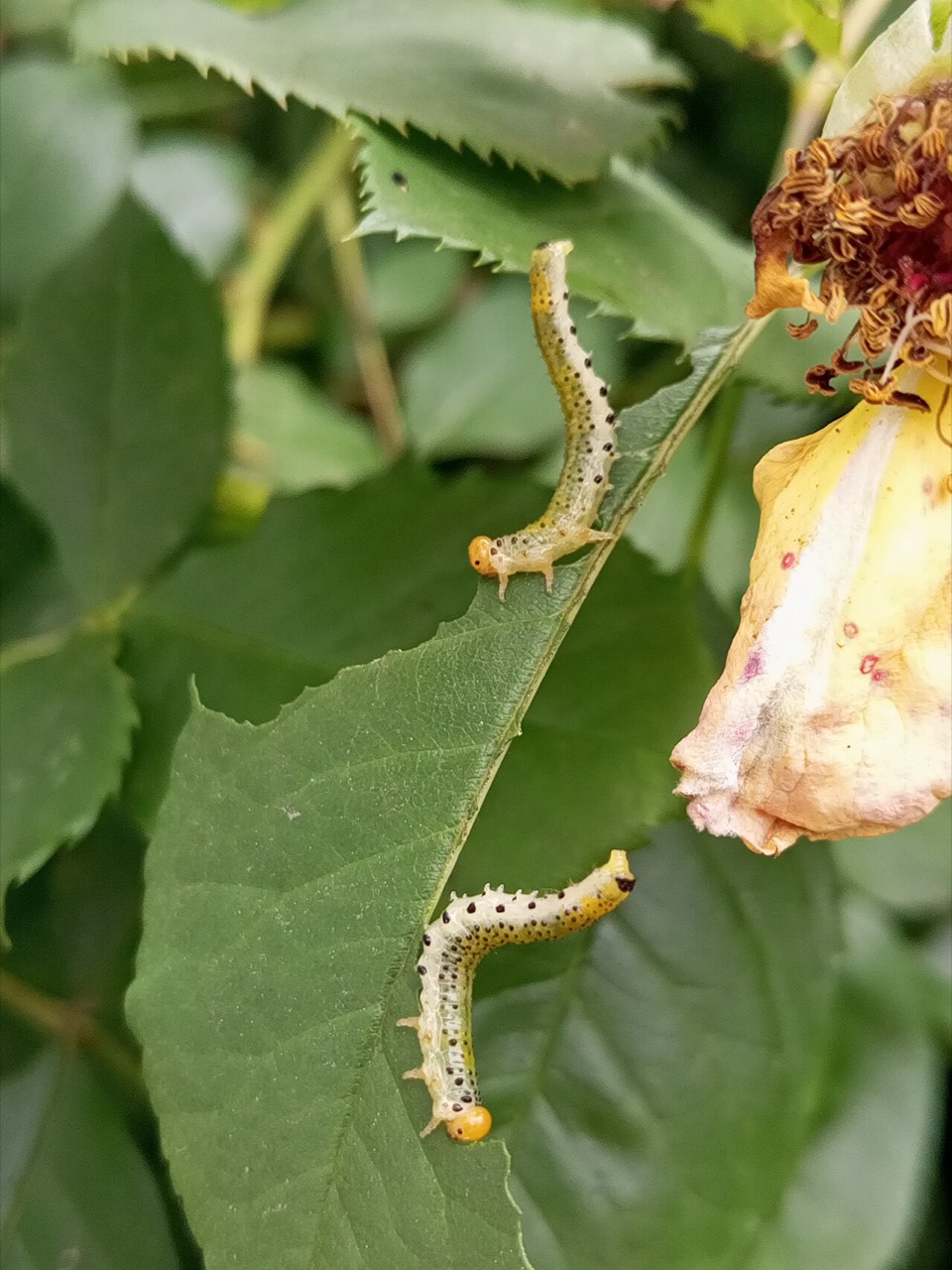
Sawflies are primitive, non-stinging members of the order Hymenoptera, named for the saw-like ovipositor females use to insert eggs into plant tissue. Their larvae resemble caterpillars and feed on foliage, developing fruit, or, in some species, mine within the stems and pods of field crops.
Unlike many sap-feeding pests, sawflies are not significant disease vectors; their impact comes from direct larval feeding, which can defoliate trees, scar or spoil developing fruit, and reduce yield in oilseed and other field crops depending on the species and timing of attack.
Identification
Sawfly larvae resemble butterfly or moth caterpillars but typically have more pairs of fleshy prolegs along the abdomen and often curl into a distinctive "S" or coiled shape when disturbed. Adults are non-stinging wasp-like insects rarely noticed causing damage themselves.
Signs of infestation include skeletonised or ribbon-like feeding patterns on leaves, scarring or tunnelling on developing fruit, and groups of larvae feeding together on affected foliage.
Biology and life cycle
Female sawflies use their saw-like ovipositor to insert eggs into leaf tissue, developing fruit, or stems, depending on species. Larvae feed for several weeks before many species drop to the soil to pupate, overwintering there until adults emerge the following season.
The number of generations per year and the timing of larval activity vary by species and region, often tracking crop phenology such as bloom or pod development.
Damage and hosts
Larval feeding can defoliate trees and shrubs, scar or tunnel into developing fruit, or damage stems and pods in field crops, with economic impact depending heavily on crop stage and species involved.
Host crops include apple, pear, and oilseed rape, among other tree fruit and field crops attacked by particular sawfly species.
Monitoring
Scouting for larvae and characteristic feeding damage during bloom and early fruit or pod development, alongside degree-day models where available, helps time monitoring to periods of greatest risk.
Management principles
Sawfly management fits within integrated pest management, combining several tactics rather than relying on any single approach.
- Conserve parasitoid wasps, birds, and ground beetles
- Time monitoring to bloom or pod-development stages when larvae are most likely to establish
- Consider tillage or soil disturbance where it disrupts soil-overwintering pupae without harming beneficial organisms
- Monitor and use local thresholds to guide any intervention
Official extension guidance
1 resource indexed from public extension publishers. Each was written for a particular place; read it at the source.
Sawflies, wasps, ants and bees - natural enemies of field crop pests
Guide published by AHDB for Great Britain. It addresses sawflies. The source is organised around “Sawflies, wasps, ants and bees (Order: Hymenoptera)”, “1. Apocrita-Aculeata” and “2. Apocrita-Parasitica”.
Agriculture and Horticulture Development Board · Pest management · publisher states no date; reachable 2026-08-27
These are pointers to guidance published by others. Each was written for a particular place and season and is revised by its publisher; read it at the source, and check it applies where you farm.
Relationships
Evidence-backed connections in the knowledge graph.
Affects
Risk increases under
Managed with
Related topics
Scope & limitations
Geographic scope: Found in temperate fruit- and oilseed-growing regions worldwide; species and severity vary by crop and region.
Climate context: Larval development rate follows temperature and growing-degree-day accumulation, and cold winters can affect survival of soil-overwintering pupae.
- This is a general overview of a diverse group of species, not species-level guidance for a specific crop or region.
- Thresholds and control-product recommendations are jurisdiction-specific and are not provided here.
Sources
This article draws on the following authoritative sources. See our sources & methodology for how they are selected.
- [1]UC Statewide Integrated Pest Management Program (UC IPM) (opens in a new tab)High
University of California Agriculture and Natural Resources (UC ANR)
Cited for: Identification and IPM principles
- Type:
- University extension service
- Jurisdiction:
- United States (California)
- Accessed:
- 2026-07-12
- [2]CABI Digital Library — Crop Protection Compendium (opens in a new tab)High
CABI (Centre for Agriculture and Bioscience International)
Cited for: Sawfly biology, hosts, and importance
- Type:
- Reference database
- Jurisdiction:
- Global
- Accessed:
- 2026-07-12
- [3]EPPO Global Database (opens in a new tab)Authoritative
European and Mediterranean Plant Protection Organization (EPPO)
Cited for: Species nomenclature and distribution
- Type:
- Reference database
- Jurisdiction:
- Global
- Accessed:
- 2026-07-12
- [4]AHDB — Agriculture and Horticulture Development Board (opens in a new tab)High
Agriculture and Horticulture Development Board (AHDB)
Cited for: Field crop risk assessment and monitoring guidance
- Type:
- Government agency
- Jurisdiction:
- United Kingdom
- Accessed:
- 2026-07-12