Crop · Tree fruit crop
Apple
Malus domestica (syn. Malus pumila)
Also known as: Domestic apple, Orchard apple
Apple is a temperate deciduous tree fruit grown worldwide for fresh consumption, juice, and processed products. Orchards are established from grafted trees and cropped for many years before replanting.
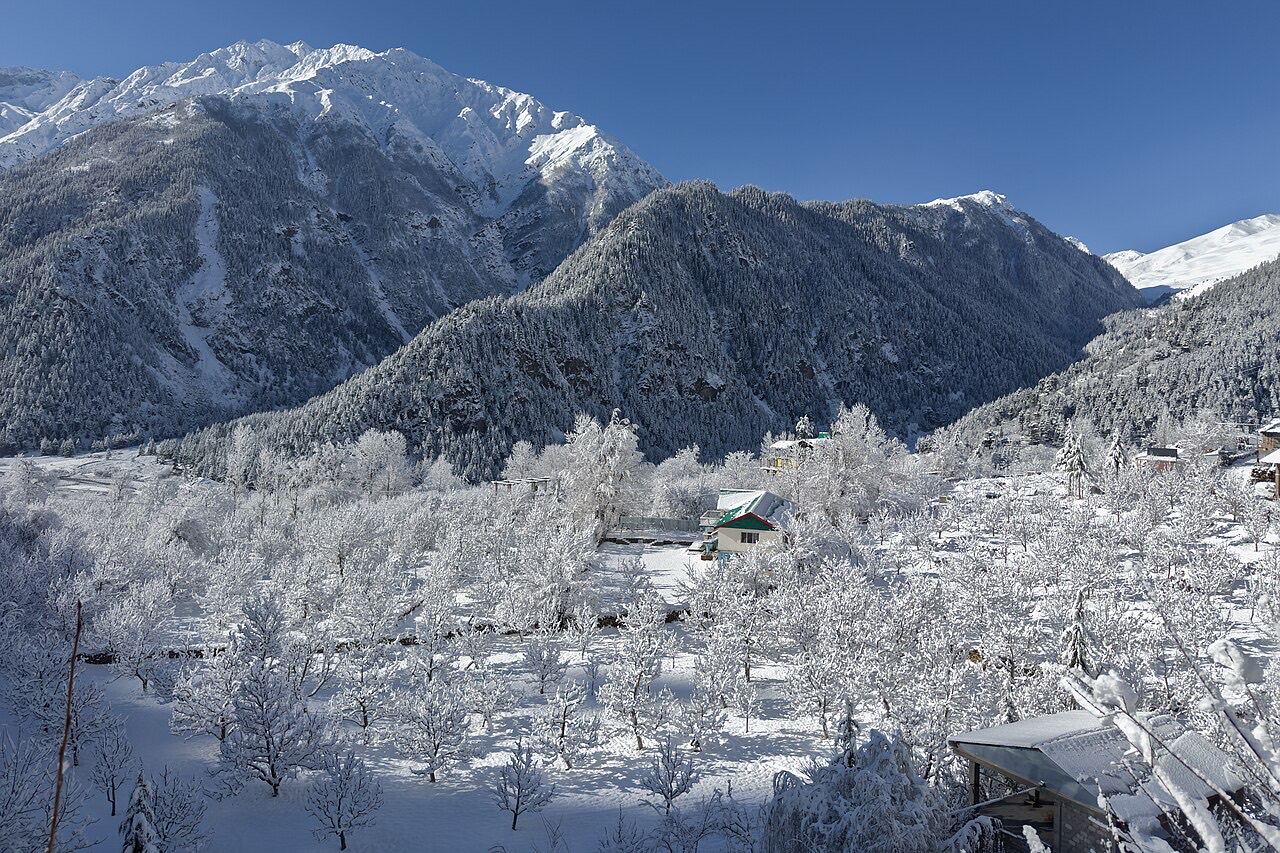
Apple is one of the most widely grown temperate tree fruits, cultivated across cool and cold-temperate regions for fresh eating, juice, cider, and processed foods. Commercial orchards are built from grafted trees rather than seedlings, since apple does not reliably come true from seed and grafting allows growers to combine a chosen fruiting variety with a rootstock selected for size control, anchorage, and disease tolerance.
Most apple cultivars require cross-pollination from a different, compatible variety to set a commercial crop, so orchard design typically includes pollinizer trees and relies on insect pollinators. Once established, an orchard can remain productive for decades, making rootstock choice, spacing, and training system long-term decisions.
Overview
Apple trees are grown as grafted, long-lived perennials rather than as an annually replanted crop. Global production spans large commercial orchards using dwarfing rootstocks and high-density plantings, as well as traditional standard-tree orchards still found in many regions.
Because apple is propagated clonally and cropped over many seasons, orchard-level decisions such as rootstock, cultivar, and training system are made once at establishment and shape management for the life of the planting. Regional agronomic detail is therefore highly site- and market-specific.
Botanical classification
- Family
- Rosaceae (rose family)
- Genus
- Malus
- Principal species
- Malus domestica (cultivated apple)
- Growth habit
- Deciduous tree, commercially propagated by grafting a fruiting cultivar onto a selected rootstock
Origin and distribution
The cultivated apple traces much of its ancestry to wild Malus populations native to Central Asia, with subsequent hybridization and selection as the crop moved along historical trade routes into Europe and, eventually, worldwide. It is now grown commercially across temperate regions on every populated continent.
Climate requirements
Apple trees require a period of winter chilling to break dormancy and flower normally the following spring; the chilling requirement varies by cultivar and is a key factor in matching varieties to a given climate.
Spring frost during bloom is one of the most significant climate risks for apple, since flowers and young fruitlets are frost-sensitive and damage can substantially reduce or eliminate a season's crop.
Soil requirements
Apple carries its own replant problem, and it is a different organism from the peach one. Apple replant disease is a complex — root lesion nematodes together with Rhizoctonia, Ilyonectria, Pythium and Phytophthora — and it stunts replanted trees rather than killing them, so an affected block underperforms for years without an obvious cause.
Orchard establishment and management
Establishing an apple orchard begins with choosing a rootstock and cultivar combination suited to the site, market, and desired tree size, since rootstock largely determines vigor, precocity, and the training system used.
- Rootstock selection for size control, anchorage, and site adaptation
- Cultivar and pollinizer selection for cross-pollination and fruit quality
- Training and pruning system matched to planting density (e.g. tall spindle, central leader)
- Long-term orchard floor and canopy management across many productive years
Nutrient considerations
Nitrogen influences vegetative vigor and must be balanced against excessive shoot growth that can shade fruit and delay flowering. Potassium supports fruit size and quality, while calcium status is closely linked to fruit firmness and storage disorders such as bitter pit.
Water and irrigation
The apple crop's water year has a decisive early window. Cell division in the fruitlet finishes within roughly the first month after bloom and sets the number of cells a fruit will ever have; everything afterwards is expansion of cells that already exist. Stress in that first window costs size that no later irrigation recovers, which is why high-density orchards on dwarfing rootstocks — shallow-rooted by design — are irrigated from bloom rather than from the first sign of stress.
Irrigation scheduling aims to avoid water stress during critical fruit-growth stages while preventing waterlogging, which apple tolerates poorly.
Common diseases and pests
Apple scab is one of the most economically important diseases of apple in humid growing regions, causing lesions on leaves and fruit. Powdery mildew is also widespread, affecting shoots, leaves, and fruit finish. Insect pests include codling moth, whose larvae bore into fruit, and aphids, which can distort growth and transmit viruses.
Management combines resistant or tolerant cultivars, orchard sanitation, monitoring, and — where justified — locally authorized control products applied according to their labels.
Harvest
Apple is picked by hand at a maturity stage assessed through indicators such as background color, firmness, and starch conversion, since fruit intended for long-term storage is typically harvested at a different maturity than fruit for immediate sale. Controlled-atmosphere storage is widely used to extend the marketing season.
Uses
- Fresh-market eating apples
- Juice, cider, and other beverages
- Processing into sauce, pie filling, and dried products
- Cull fruit and pomace used in animal feed or as a soil amendment
Botanical identity
Species- Accepted name
- Malus domestica
- Family
- Rosaceae
- Genus
- Malus
- Harvested part
- fruit
- Agricultural use
- human food, beverage
- Crop group
- Fruit
What the authorities say
- World Flora Online — Taxonomic Backbone
- Malus domestica
- Plants of the World Online
- Malus domestica
Botanical identity here is what the consulted taxonomic authorities publish, on the date they were read. Where authorities disagree, both readings are shown rather than one being chosen silently.
Traded as
This crop is traded as one commodity in this corpus.
What AgricultureID holds for this crop
- 5 crop calendar records
- 10 published cultivars
- 56 official variety registrations
- 7 verified extension resources
- 8 pests and diseases naming this crop as a host
- 2 soil references
- 2 climate references
- 342 market price series
- 2 related crops
Not held
- No farm economics observations — source exists not mapped
An absence here means this corpus holds no such record, not that none exists.
How to read figures on this page
Production, area and trade figures for any crop change from season to season and are compiled by FAO and by national agricultural statistics agencies. Take current numbers from those primary sources, dated to the period you mean, rather than from a secondary summary — including this one.
Crop water requirements are estimated from reference evapotranspiration and local climate data, following methods published by FAO and national agricultural agencies. A requirement quoted without the reference method and the local climate behind it is not a number that can be applied to a field.
Part of
Related crops
Planting and harvest calendar
Usual sowing and harvest windows across 5 jurisdictions, covering apple.
Official extension guidance
7 resources indexed from public extension publishers. Each was written for a particular place; read it at the source.
Black Rot and Frogeye Leaf Spot of Apple
Factsheet published by Ohio State University Extension for Ohio. It addresses apple. The source is organised around “Symptoms”, “Causal Organism and Disease Cycle” and “Search form”.
Ohio State University Extension · Disease management · publisher states no date; reachable 2026-08-27
High Density Apple Orchard Management
Factsheet published by NC State Extension for North Carolina. It addresses apple. The source is organised around “What Is a High Density Orchard?”, “Advantages and Disadvantages of High Density Planting Systems” and “Site Selection”.
NC State Extension · Crop establishment, Nutrient management · publisher states 2026-07-24
Necrotic Leaf Blotch of Golden Delicious Apples
Factsheet published by Ohio State University Extension for Ohio. It addresses apple. The source is organised around “Search form”, “PLPATH-FRU-12” and “Social Media”.
Ohio State University Extension · Disease management · publisher states no date; reachable 2026-08-27
Factsheet published by Ohio State University Extension for Ohio. It addresses apple. The source is organised around “Disease Development and Symptoms”, “Apple Scab Management” and “Useful Reference”.
Ohio State University Extension · Disease management · publisher states no date; reachable 2026-08-27
Soil and Plant Analysis for Apple Trees
Factsheet published by NC State Extension for North Carolina. It addresses apple. The source is organised around “Sampling for Soil Analysis”, “Sampling for Tissue Analysis” and “Interpretation of Soil and Plant Analysis”.
NC State Extension · Farm management · publisher states no date; reachable 2026-08-27
Tree Fruit Insect Pest - Green Aphids (Apple and Spirea Aphid)
Factsheet published by Penn State Extension for Pennsylvania. It addresses apple. The source is organised around “Description and life cycle”, “Cultural management” and “Chemical management”.
Penn State Extension · Pest management · publisher states 2026-02-25
White Rot and Botryosphaeria Canker of Apple
Factsheet published by Ohio State University Extension for Ohio. It addresses apple. The source is organised around “Causal Organism and Disease Cycle”, “Search form” and “PLPATH-FRU-42”.
Ohio State University Extension · Disease management · publisher states no date; reachable 2026-08-27
These are pointers to guidance published by others. Each was written for a particular place and season and is revised by its publisher; read it at the source, and check it applies where you farm.
Authorised inputs (France)
The French register records 1 currently authorised products whose authorised use names this crop, held by 1 authorisation holders. This is a count of what exists on the register, not a recommendation and not a shortlist.
By function
- Subst. Croiss. 1
Targets named on the register
- Act. Rhizogénèse 1
Use scope is recorded as the register writes it. Collective terms cover several crops at once and are left unmapped rather than expanded, because expanding one entry into several would invent authorisations that were never granted.
Authorisation is specific to one jurisdiction, one legal object and one moment. It is not a recommendation, and it says nothing about how a product may be used: always read the current official label at the source before acting.
Tools for this
Each tool shows its formula, constants and sources, and starts empty — nothing is filled in from this page.
- Seed-rate calculator
Convert a target plant stand into a seed rate, allowing for germination and establishment.
- Row spacing calculator
Work out in-row spacing and plants per metre of row for a target density.
- Production, area and yield calculator
Relate a harvested area and a yield to a production total, in either direction.
- Growing degree-days calculator
Accumulate heat units against a base temperature.
Relationships
Evidence-backed connections in the knowledge graph.
Susceptible to
Suitable soils
Climate sensitivity
Irrigation methods
Machinery
Managed with
Farming systems
Notable cultivars
Documented varieties tied to this species, with registry status and sources on each page. Not an exhaustive list.
- BraeburnBraeburn is a firm, crisp, sweet-tart bicolour dessert apple that arose as a chance seedling in New Zealand around 1952. It was one of the first modern commercial successes among richly flavoured, well-storing bicolour apples.
- Bramley's SeedlingBramley's Seedling is the pre-eminent English culinary (cooking) apple, grown from a pip planted in Nottinghamshire in the early 1800s. Sharp and acidic, it cooks down to a light, well-flavoured purée and is a triploid.
- Cox's Orange PippinCox's Orange Pippin is a richly aromatic English dessert apple raised near London around 1825, widely regarded as a benchmark for complex apple flavour. It is prized for eating quality but considered demanding to grow.
- FujiFuji is a very sweet, dense, late-maturing dessert apple bred in Japan from a cross of Ralls Janet and Red Delicious and introduced to market in 1962. It is prized for high sugar, crisp flesh, and long storage life.
- GalaGala is a sweet, aromatic, red-striped dessert apple bred in New Zealand by J. H. Kidd from a cross of Kidd’s Orange Red and Golden Delicious, and released around 1965. It is one of the most widely produced apples in the world.
- Golden DeliciousGolden Delicious is a yellow-skinned dessert and all-purpose apple that arose as a chance seedling in West Virginia and was introduced commercially in 1914. It is one of the most influential parents in modern apple breeding.
- Granny SmithGranny Smith is a bright-green, tart, late-maturing apple that arose as a chance seedling in New South Wales, Australia, around 1868. It is a long-keeping, dual-purpose cultivar used both fresh and for cooking.
- HoneycrispHoneycrisp is a dessert apple released by the University of Minnesota in 1991, famous for its distinctively coarse, crisp, juicy texture. It was formerly protected in the United States by a plant patent that has since expired.
- McIntoshMcIntosh is a cold-hardy, aromatic, red-and-green apple discovered as a chance seedling in Ontario, Canada, around 1811. A foundational North American cultivar, it is used both fresh and for sauce and is a parent of many later apples.
- Red DeliciousRed Delicious is a deep-red, elongated dessert apple that began as an Iowa chance seedling named "Hawkeye" and was introduced by Stark Brothers as "Delicious" in 1895. Over the twentieth century it was selected heavily for colour and shipping quality.
Harvested commodities
The traded commodities harvested from this crop. A commodity is the harvested lot, described by its own quality, grading, and storage evidence — not by the agronomy of the plant.
Scope & limitations
Geographic scope: Global overview. Rootstock, cultivar, and chilling requirements are region- and site-specific.
Climate context: Temperate deciduous tree fruit requiring winter chill; vulnerable to spring frost during bloom.
- Rootstock, spacing, and chilling-hour specifics are cultivar- and region-specific decisions not covered by universal values here.
- Production and cultivar-popularity statistics change over time and should be taken from primary datasets such as FAOSTAT.
Sources
This article draws on the following authoritative sources. See our sources & methodology for how they are selected.
- [1]FAO — Food and Agriculture Organization (opens in a new tab)Authoritative
Food and Agriculture Organization of the United Nations (FAO)
Cited for: Global apple production and trade context
- Type:
- Intergovernmental organization
- Jurisdiction:
- Global
- Accessed:
- 2026-07-12
- [2]FAOSTAT — FAO statistical database (opens in a new tab)Authoritative
Food and Agriculture Organization of the United Nations (FAO)
Cited for: Production and area statistics
- Type:
- Intergovernmental organization
- Jurisdiction:
- Global
- Accessed:
- 2026-07-12
- Authoritative
Cited for: Classification and nomenclature
- Type:
- Reference database
- Jurisdiction:
- United States
- Accessed:
- 2026-07-12
- [4]CABI Digital Library — Crop Protection Compendium (opens in a new tab)High
CABI (Centre for Agriculture and Bioscience International)
Cited for: Apple scab and codling moth compendium data
- Type:
- Reference database
- Jurisdiction:
- Global
- Accessed:
- 2026-07-12
- [5]UC Statewide Integrated Pest Management Program (UC IPM) (opens in a new tab)High
University of California Agriculture and Natural Resources (UC ANR)
Cited for: Integrated pest management guidelines for apple
- Type:
- University extension service
- Jurisdiction:
- United States (California)
- Accessed:
- 2026-07-12
- [6]Cornell CALS — Plant pathology and crop resources (opens in a new tab)High
Cornell University College of Agriculture and Life Sciences
Cited for: Apple cultivar and orchard management research
- Type:
- University extension service
- Jurisdiction:
- United States (New York)
- Accessed:
- 2026-07-12
Related topics
Soils
Plant Diseases
Pests
Livestock
Fertilizers
Machinery
Farming Systems
Post-Harvest
- Bulk Bin Produce Storage
- Cold Storage
- Controlled Atmosphere Storage
- Ethylene Management
- Fibreboard Carton
- Fruit Ripening
- Harvest Maturity Assessment
- Liners and Wraps
- Modified Atmosphere Storage
- Packing and Packaging
- Palletisation
- Refrigerated Container
- Refrigerated Warehouse
- Sorting and Grading
- Washing and Sanitising
- Waxing
- Wooden Crate