Plant Disease · Plant disease
Common Smut
Ustilago maydis
Also known as: Corn smut, Boil smut
Common smut is a fungal disease of maize caused by Ustilago maydis, producing large, greyish-white galls on ears, tassels, and other actively growing tissue. It survives in soil and residue for years and infects mainly through wounds.
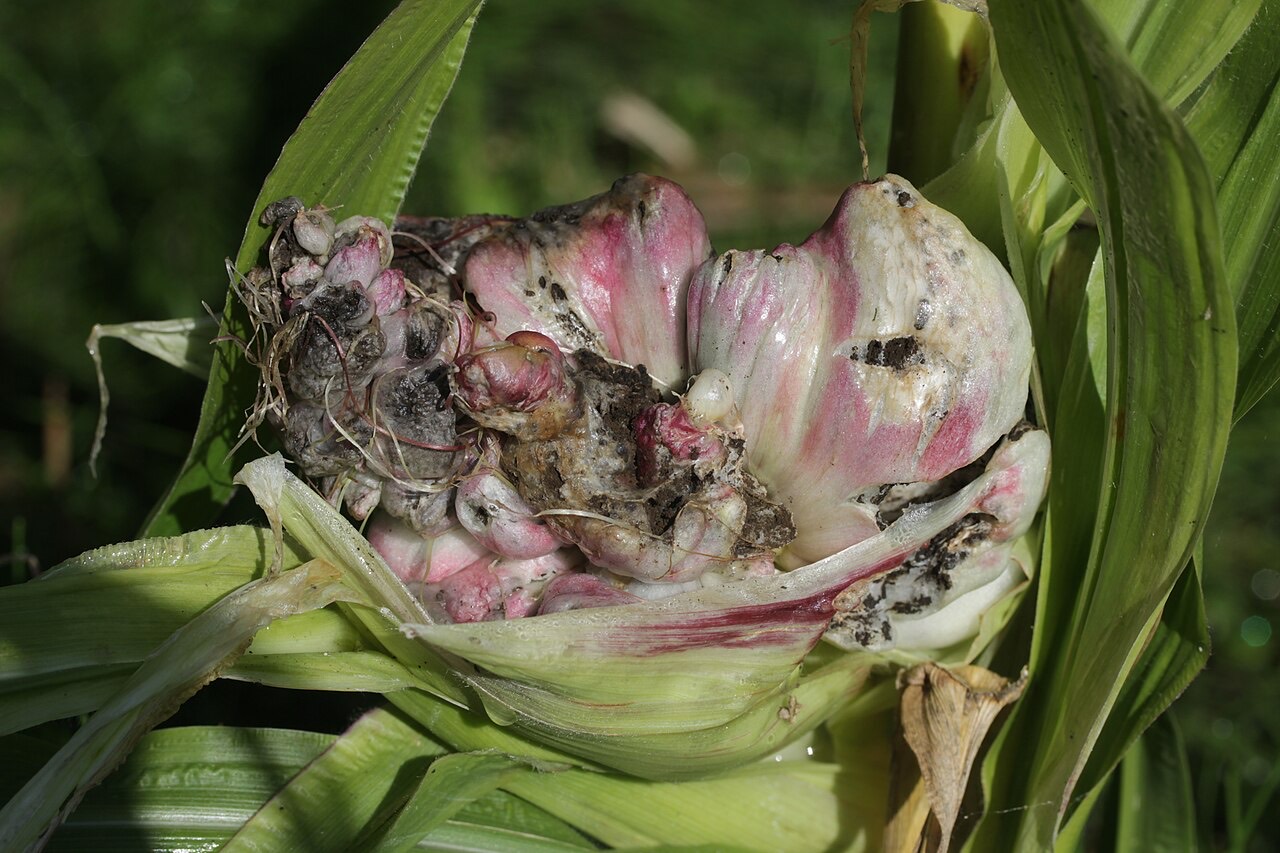
Common smut, caused by the fungus Ustilago maydis, is a widespread disease of maize recognisable by the swollen, tumour-like galls it forms on ears, tassels, leaves, and stalks. Unlike many cereal diseases that spread mainly through the air onto intact leaf surfaces, common smut typically requires a wound or otherwise vulnerable meristematic tissue to establish infection.
The fungus survives readily in soil and crop residue as durable teliospores, which can persist for a number of years even in the absence of a host, making field history and residue management relevant to long-term disease pressure.
Identification
Common smut forms galls that start small and pale but can grow considerably larger than the tissue they replace, developing a shiny, greyish-white membrane. As galls mature internally, the membrane darkens and eventually ruptures, releasing a mass of powdery black spores.
Biology and disease cycle
Teliospores surviving in soil or crop residue germinate under suitable conditions to produce infective structures that penetrate young, actively growing maize tissue, most often through wounds. Common wounding sources include hail damage, insect feeding, wind-whipped leaves, and mechanical injury from cultivation.
- Soil- and residue-borne teliospores
- Persist for a number of years, providing inoculum for future maize crops on the same land
- Wound-dependent infection
- Meristematic tissue exposed by hail, insects, or mechanical damage is particularly susceptible
- Local gall development
- Infection typically produces localised galls rather than a systemic, whole-plant disease
Affected hosts
Maize is the primary agricultural host of Ustilago maydis. The fungus is highly adapted to this host, and disease pressure is closely tied to the frequency of maize in a field's cropping history and to local conditions that create wounding opportunities.
Risk factors
- Wounding events such as hail, insect feeding, or mechanical damage during the growing season
- Excess nitrogen supply promoting succulent, more susceptible tissue
- Frequent maize in the rotation, building up soil and residue inoculum over time
- Warm temperatures with intermittent moisture during susceptible growth stages
Prevention and monitoring
Because infection depends heavily on wounding and on soil-borne inoculum, prevention focuses on reducing plant injury, managing nitrogen, and lowering inoculum load through rotation.
- Choose resistant or tolerant hybrids where available
- Rotate away from maize to reduce soil and residue inoculum over time
- Avoid excessive nitrogen applications that promote succulent, susceptible tissue
- Where practical, remove and destroy galls before they rupture to limit local spore release
Relationships
Evidence-backed connections in the knowledge graph.
Affects
Risk increases under
Related topics
Scope & limitations
Geographic scope: Global; common smut occurs wherever maize is grown, with local severity tied to wounding events and cropping history rather than broad climatic zones.
Climate context: Wounding events such as hail are a key trigger for infection; warm temperatures with intermittent moisture favour spore germination and gall development.
- This is a general overview and does not replace field diagnosis or region-specific extension guidance.
- Wound-related risk factors such as hail are unpredictable and cannot be generalised to fixed schedules or thresholds.
- Control-product recommendations are jurisdiction-specific and are deliberately not provided here.
Sources
This article draws on the following authoritative sources. See our sources & methodology for how they are selected.
- [1]CABI Digital Library — Crop Protection Compendium (opens in a new tab)High
CABI (Centre for Agriculture and Bioscience International)
Cited for: Pathogen biology, disease cycle, and host range
- Type:
- Reference database
- Jurisdiction:
- Global
- Accessed:
- 2026-07-12
- [2]EPPO Global Database (opens in a new tab)Authoritative
European and Mediterranean Plant Protection Organization (EPPO)
Cited for: Pathogen nomenclature and distribution
- Type:
- Reference database
- Jurisdiction:
- Global
- Accessed:
- 2026-07-12
- [3]Iowa State University Extension and Outreach (opens in a new tab)High
Iowa State University Extension and Outreach
Cited for: Field-level identification and risk factors
- Type:
- University extension service
- Jurisdiction:
- United States (Iowa)
- Accessed:
- 2026-07-12
- [4]Cornell CALS — Plant pathology and crop resources (opens in a new tab)High
Cornell University College of Agriculture and Life Sciences
Cited for: Maize disease management principles
- Type:
- University extension service
- Jurisdiction:
- United States (New York)
- Accessed:
- 2026-07-12