Crop · Spice crop
Cumin
Cuminum cyminum
Cumin is a low-growing annual herb of the carrot family grown for its small, ridged seeds, dried and used whole or ground as one of the most widely traded culinary spices.
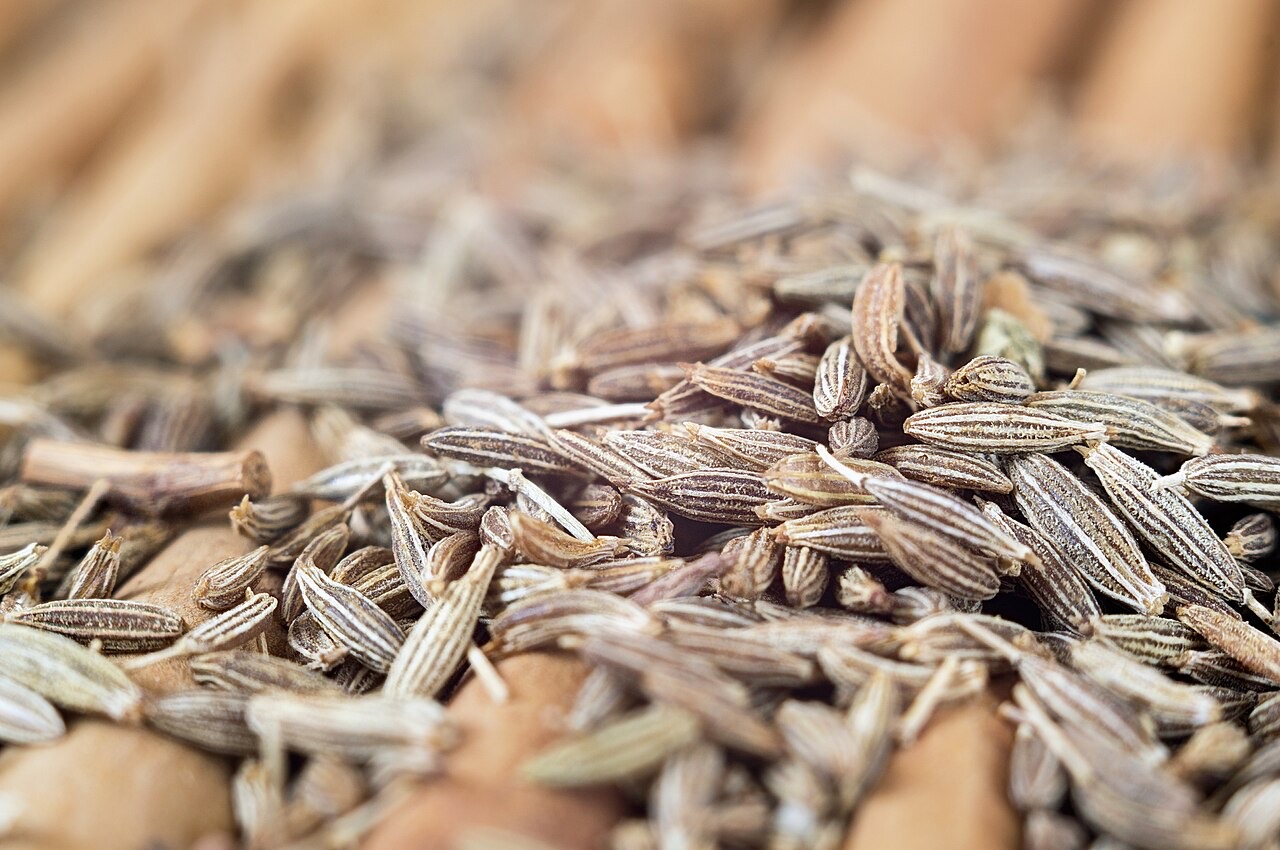
Cumin is a compact annual herb adapted to hot, dry growing conditions, historically associated with semi-arid production regions of the eastern Mediterranean, the Middle East, and South Asia.
The plant produces small umbels of flowers followed by ridged, elongated seeds that are hand- or machine-harvested, dried, and cleaned before sale as whole seed or ground spice.
Overview
Cumin is grown mainly by smallholder and commercial farmers in semi-arid regions where its relatively low water requirement compared with many other spice crops makes it a viable dryland or lightly irrigated option.
India is among the world’s largest producers and consumers of cumin, with cultivation concentrated in specific semi-arid states where the crop is grown in the cooler part of the year.
Botanical classification
- Family
- Apiaceae (carrot family)
- Genus
- Cuminum
- Principal species
- Cuminum cyminum
- Growth habit
- Slender annual herb with thread-like leaves and small umbels bearing ridged, aromatic seeds
Origin and distribution
Cumin is native to the eastern Mediterranean and parts of the Middle East and has been used as a spice since antiquity, referenced in some of the earliest surviving written records of trade and cuisine.
Today, India, alongside countries in the Middle East and North Africa, accounts for a large share of global production and trade.
Climate and soil requirements
Cumin is adapted to hot, dry conditions and is typically grown as a cool-season crop in semi-arid regions, relying on residual soil moisture or limited irrigation rather than high rainfall. Excess humidity and rainfall during flowering and seed set can favor disease and reduce yield and quality.
Well-drained sandy loams and loams are preferred; the crop generally tolerates soils of moderate fertility but performs poorly under waterlogging.
Cultivation and management
- Sowing timed to the cooler, drier part of the growing season in semi-arid production areas
- Relatively low seeding rates and wide spacing to reduce humidity within the canopy and limit disease
- Weed control important during early establishment, as young cumin seedlings compete poorly with weeds
- Crop rotation used to manage soil-borne disease pressure, particularly Fusarium wilt
Nutrient considerations
Nitrogen and phosphorus support early establishment and flowering, though cumin is generally considered a modest-input crop compared with many other spice and vegetable crops.
Water and irrigation
Cumin has a relatively low overall water requirement and is often grown with limited irrigation, applied mainly at establishment and key growth stages, in semi-arid production regions.
Furrow irrigation is traditional in many production areas, while deficit irrigation strategies, applying less than full crop water demand, are used in some regions to conserve water without unacceptable yield loss.
Common diseases and pests
Fusarium wilt is one of the most significant diseases of cumin in major production regions, causing wilting and plant death, particularly under warm soil conditions. Powdery mildew can also affect foliage, especially under humid conditions. Aphids and thrips are common pests affecting foliage and flower heads.
| Problem | Type | Notes |
|---|---|---|
| Fusarium wilt | Disease | Major yield-limiting disease in warm soils |
| Powdery mildew | Disease | Common under humid conditions |
| Aphids | Pest | Sap-feeding insects on foliage and flower heads |
| Thrips | Pest | Feed on leaves and flowers |
Harvest
Cumin is harvested when seed heads mature and begin to dry, typically by cutting whole plants, which are then further dried, threshed, and cleaned before the seed is sold or processed.
Uses
- Whole and ground seed used as a widely traded culinary spice
- Key ingredient in many regional spice blends
- Cumin seed oil and oleoresin extracted for the flavor industry
- By-products such as chaff sometimes used as livestock feed in producing regions
Botanical identity
Species- Accepted name
- Cuminum cyminum
- Family
- Apiaceae
- Genus
- Cuminum
- Harvested part
- seed
- Agricultural use
- spice
- Crop group
- Spices and herbs
What the authorities say
- World Flora Online — Taxonomic Backbone
- Cuminum cyminum
- Plants of the World Online
- Cuminum cyminum
Botanical identity here is what the consulted taxonomic authorities publish, on the date they were read. Where authorities disagree, both readings are shown rather than one being chosen silently.
What AgricultureID holds for this crop
- 5 crop calendar records
- 2 soil references
- 2 climate references
Not held
- No published cultivars — not researched
- No official variety registrations — source exists not mapped
- No verified extension resources — source exists not ingested
- No pests and diseases naming this crop as a host — source exists not ingested
- No farm economics observations — source exists not mapped
- No market price series — source exists not mapped
- No related crops — not applicable
An absence here means this corpus holds no such record, not that none exists.
How to read figures on this page
Production, area and trade figures for any crop change from season to season and are compiled by FAO and by national agricultural statistics agencies. Take current numbers from those primary sources, dated to the period you mean, rather than from a secondary summary — including this one.
Crop water requirements are estimated from reference evapotranspiration and local climate data, following methods published by FAO and national agricultural agencies. A requirement quoted without the reference method and the local climate behind it is not a number that can be applied to a field.
Planting and harvest calendar
Usual sowing and harvest windows across 5 jurisdictions, covering cumin and cumin — season 1 and cumin — season 2.
Tools for this
Each tool shows its formula, constants and sources, and starts empty — nothing is filled in from this page.
- Seed-rate calculator
Convert a target plant stand into a seed rate, allowing for germination and establishment.
- Row spacing calculator
Work out in-row spacing and plants per metre of row for a target density.
- Production, area and yield calculator
Relate a harvested area and a yield to a production total, in either direction.
- Growing degree-days calculator
Accumulate heat units against a base temperature.
Relationships
Evidence-backed connections in the knowledge graph.
Susceptible to
Nutrients required
Suitable soils
Climate sensitivity
Irrigation methods
Managed with
Related topics
Scope & limitations
Geographic scope: Global overview; India and countries in the Middle East and North Africa account for a large share of global production and trade.
Climate context: Hot, dry, semi-arid annual crop with a comparatively low water requirement; sensitive to excess humidity and rainfall around flowering.
- Water requirements and disease pressure vary by region and season and are not quantified here.
- Production and price statistics change annually and should be taken from primary datasets such as FAOSTAT.
Sources
This article draws on the following authoritative sources. See our sources & methodology for how they are selected.
- [1]FAO — Food and Agriculture Organization (opens in a new tab)Authoritative
Food and Agriculture Organization of the United Nations (FAO)
Cited for: Global spice crop production context
- Type:
- Intergovernmental organization
- Jurisdiction:
- Global
- Accessed:
- 2026-07-12
- [2]FAOSTAT — FAO statistical database (opens in a new tab)Authoritative
Food and Agriculture Organization of the United Nations (FAO)
Cited for: Production and area statistics
- Type:
- Intergovernmental organization
- Jurisdiction:
- Global
- Accessed:
- 2026-07-12
- [3]CABI Digital Library — Crop Protection Compendium (opens in a new tab)High
CABI (Centre for Agriculture and Bioscience International)
Cited for: Cumin disease and pest compendium data
- Type:
- Reference database
- Jurisdiction:
- Global
- Accessed:
- 2026-07-12
- Authoritative
Cited for: Classification and nomenclature
- Type:
- Reference database
- Jurisdiction:
- United States
- Accessed:
- 2026-07-12