Plant Disease · Plant disease
Powdery Mildew
Fungi of the order Erysiphales (e.g. Blumeria graminis)
Also known as: White mildew
Powdery mildew is a group of common fungal diseases producing white, powdery growth on leaves and stems. Host-specific species affect many crops, and management relies mainly on prevention and monitoring.
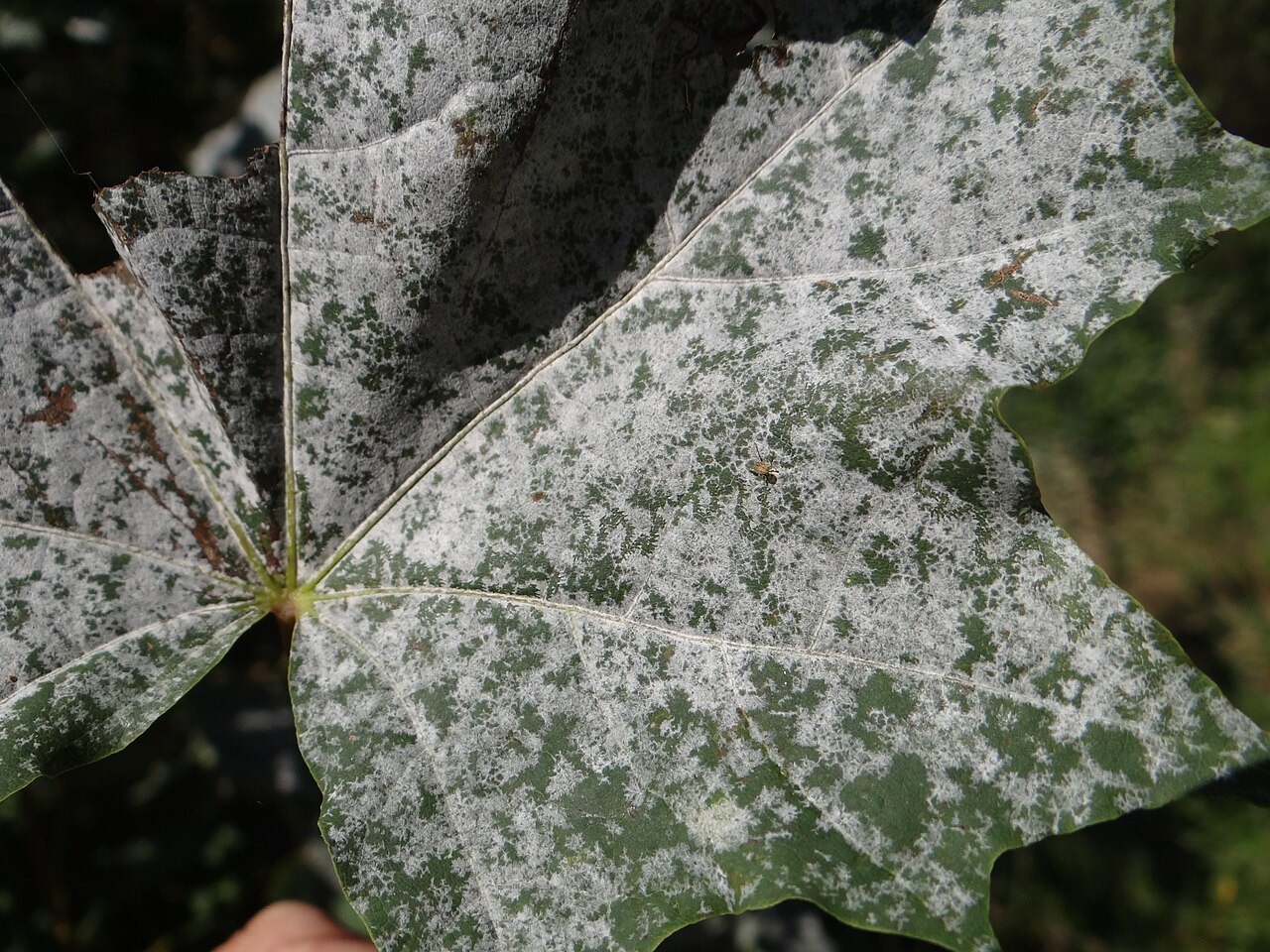
Powdery mildew is not a single disease but a group of closely related fungal diseases caused by species in the order Erysiphales. They are among the most recognisable plant diseases because of the characteristic white to grey powdery coating they produce on the surface of leaves, shoots, and sometimes fruit.
Individual powdery mildew fungi tend to be highly host-specific: the species that affects cereals differs from those affecting cucurbits, grapes, or ornamentals. The general biology and management principles, however, are broadly similar across hosts.
Identification
The clearest sign of powdery mildew is a white or greyish, powdery or felt-like growth on the upper or lower surfaces of leaves, on stems, and sometimes on flowers or fruit. Affected leaves may yellow, distort, or drop prematurely as infection progresses.
Biology and disease cycle
Powdery mildew fungi are obligate parasites, meaning they require living host tissue to grow. They colonise the plant surface and draw nutrients through specialised structures that penetrate epidermal cells. Spores produced on the powdery growth are carried by air currents to new tissue and other plants.
Unusually among fungal diseases, many powdery mildews are favoured by high humidity but do not require free water on the leaf to infect, which allows them to develop under drier conditions than many other foliar pathogens.
Affected hosts
Powdery mildews affect a wide range of agricultural and horticultural plants, including cereals such as wheat and barley, many vegetables and cucurbits, grapevine, and numerous ornamentals. Because the fungi are largely host-specific, the presence of powdery mildew on one crop does not necessarily threaten unrelated crops nearby.
Risk factors
- Moderate temperatures combined with high humidity
- Dense canopies and poor air circulation
- Shaded, sheltered conditions that keep humidity high
- Susceptible varieties and excessive, lush growth
Prevention and monitoring
Because powdery mildews are widespread and spread readily, management emphasises prevention and early detection rather than eradication.
- Choose resistant or tolerant varieties where available
- Improve air movement through appropriate spacing and canopy management
- Avoid conditions that produce dense, humid canopies
- Scout regularly so that any response can be timely and targeted
Official extension guidance
1 resource indexed from public extension publishers. Each was written for a particular place; read it at the source.
Management of powdery mildew in cereals
Guide published by AHDB for Great Britain. It addresses powdery mildew. The source is organised around “Cereal yield losses associated with powdery mildew”, “Classic cereal powdery mildew symptoms” and “The powdery mildew pathogen and its life cycle”.
Agriculture and Horticulture Development Board · Disease management · publisher states no date; reachable 2026-08-27
These are pointers to guidance published by others. Each was written for a particular place and season and is revised by its publisher; read it at the source, and check it applies where you farm.
Relationships
Evidence-backed connections in the knowledge graph.
Related topics
Scope & limitations
Geographic scope: Global overview of a widespread disease group; specific species, severity, and guidance vary by region and host.
Climate context: Favoured by moderate temperatures and high humidity; can develop without free leaf moisture.
- This is a general overview of a disease group, not a diagnosis for any specific crop or region.
- Control-product recommendations are jurisdiction-specific and are deliberately not provided here.
Sources
This article draws on the following authoritative sources. See our sources & methodology for how they are selected.
- [1]CABI Digital Library — Crop Protection Compendium (opens in a new tab)High
CABI (Centre for Agriculture and Bioscience International)
Cited for: Powdery mildew biology and host range
- Type:
- Reference database
- Jurisdiction:
- Global
- Accessed:
- 2026-07-12
- [2]EPPO Global Database (opens in a new tab)Authoritative
European and Mediterranean Plant Protection Organization (EPPO)
Cited for: Pathogen nomenclature and distribution
- Type:
- Reference database
- Jurisdiction:
- Global
- Accessed:
- 2026-07-12
- [3]UC Statewide Integrated Pest Management Program (UC IPM) (opens in a new tab)High
University of California Agriculture and Natural Resources (UC ANR)
Cited for: Identification and management principles
- Type:
- University extension service
- Jurisdiction:
- United States (California)
- Accessed:
- 2026-07-12
- Moderate
Cited for: General symptoms and horticultural context
- Type:
- Reference database
- Jurisdiction:
- United Kingdom
- Accessed:
- 2026-07-12
Related topics
Crops
- Adzuki Bean
- Alfalfa
- Anise
- Apple
- Apricot
- Asian Pear
- Bambara Groundnut
- Barley
- Berseem Clover
- Birdsfoot Trefoil
- Bitter Gourd
- Black Cumin
- Black Gram
- Blackcurrant
- Bottle Gourd
- Brussels Sprouts
- Buckwheat
- Cape Gooseberry
- Caraway
- Chamomile
- Chayote
- Cherry
- Chia
- Chicory
- Cocksfoot
- Coriander
- Cucumber
- Cumin
- Dill
- Einkorn
- Fennel
- Fenugreek
- Flax
- Grape
- Grass Pea
- Greenleaf Desmodium
- Hops
- Horse Gram
- Italian Ryegrass
- Jack Bean
- Jerusalem Artichoke
- Jicama
- Kenaf
- Lablab
- Lima Bean
- Lowbush Blueberry
- Mango
- Mashua
- Melon
- Mint
- Moth Bean
- Mulberry
- Mung Bean
- Niger Seed
- Oats
- Oca
- Oilseed rape
- Okra
- Oregano
- Parsley
- Pea
- Peach
- Perennial Ryegrass
- Perilla
- Plum
- Pumpkin
- Quince
- Ramie
- Red Clover
- Rice Bean
- Rosemary
- Rubber
- Sage
- Sainfoin
- Sour Cherry
- Strawberry
- Sugar beet
- Swede
- Tall Fescue
- Tamarind
- Timothy
- Tomatillo
- Tomato
- Triticale
- Turnip
- Ulluco
- Velvet Bean
- Watermelon
- Wheat
- White Clover
- Winged Bean
- Yardlong Bean
- Zucchini