Pest · Insect pest
Aphids
Family Aphididae (order Hemiptera)
Also known as: Plant lice, Greenfly, Blackfly
Aphids are small sap-feeding insects that attack many crops. They damage plants directly by feeding and indirectly as vectors of plant viruses, and management centres on monitoring and natural enemies.
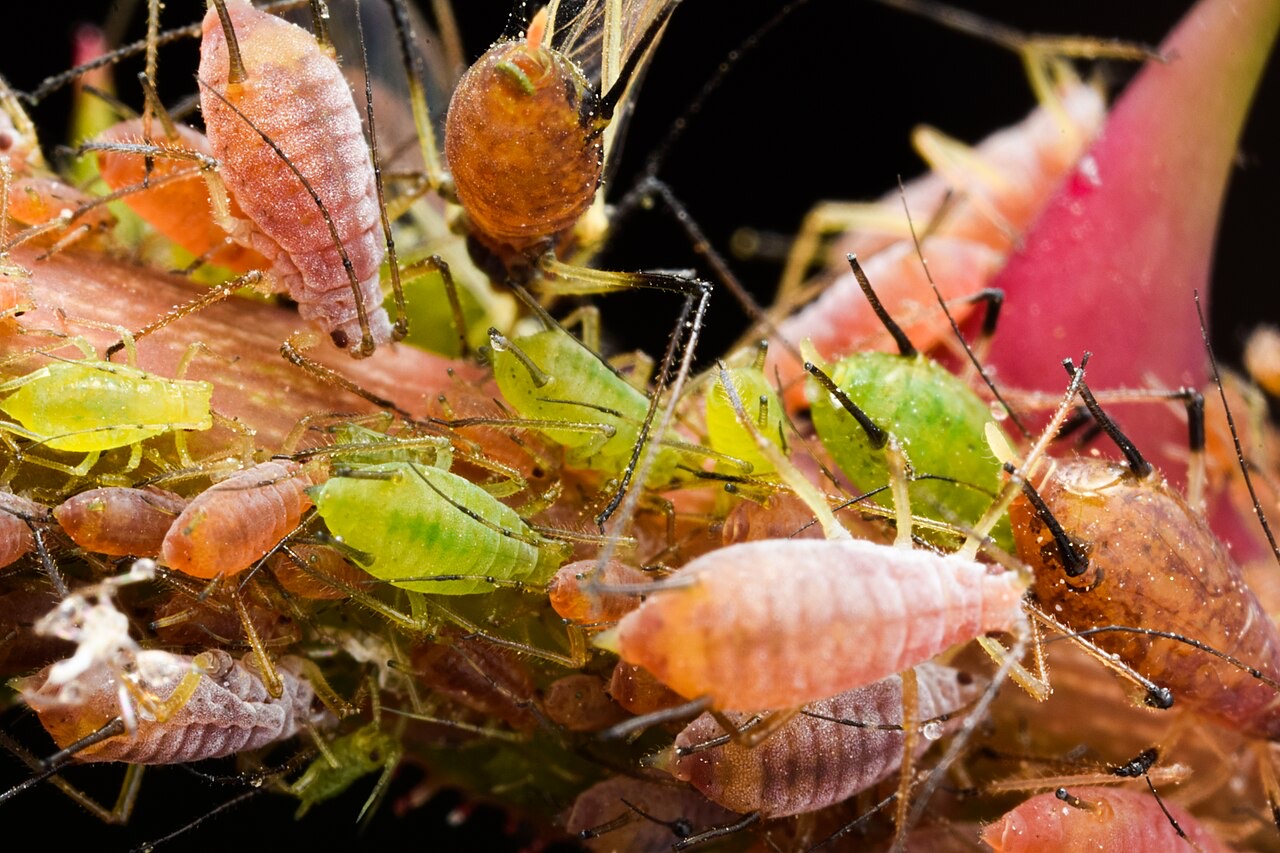
Aphids are a large family of small, soft-bodied insects that feed by sucking sap from plants. Several hundred species are of agricultural importance, attacking cereals, vegetables, legumes, fruit, and ornamentals. Individual aphids are only a few millimetres long, but their capacity for rapid reproduction means colonies can build quickly.
Beyond the direct effects of feeding, many aphids transmit plant viruses, and this role as a virus vector is often more damaging than the feeding itself. Aphid management is therefore an important part of integrated pest management in many cropping systems.
Identification
Aphids are small, pear-shaped insects that may be green, black, yellow, pink, or grey depending on species. A distinctive feature is a pair of tube-like structures (cornicles) projecting from the rear of the body. Colonies are often found on new growth and the undersides of leaves.
Signs of infestation include clusters of insects, sticky honeydew on leaves and surfaces below, black sooty mould growing on the honeydew, and distorted or curled young leaves.
Biology and life cycle
Many aphids have complex life cycles. During favourable conditions, females often reproduce without mating and give birth to live young, allowing populations to increase very rapidly. Winged forms are produced that disperse to new plants, which is important both for spread and for virus transmission.
Life cycles and host relationships vary widely among species, and some alternate between different host plants at different times of year.
Damage and hosts
Aphids damage crops in several ways: direct removal of sap can weaken plants and distort growth; honeydew and sooty mould reduce photosynthesis and can affect quality; and, most importantly for many crops, aphids transmit plant viruses as they feed.
Host crops include cereals such as wheat, many vegetables including tomato and potato, and a wide range of other plants. The economic importance of aphids varies greatly by crop, region, and the viruses present.
Monitoring
Regular scouting is central to aphid management. Monitoring the presence, abundance, and location of colonies — and the activity of natural enemies — informs whether and when action is warranted, using local economic thresholds where they exist.
Management principles
Aphid management fits within integrated pest management, which combines several approaches rather than relying on any single tactic.
- Conserve natural enemies such as ladybirds, lacewings, and parasitoid wasps
- Use resistant or tolerant varieties where available
- Manage nitrogen and growth to avoid excessively lush, attractive foliage
- Monitor and use local thresholds to guide any intervention
Official extension guidance
1 resource indexed from public extension publishers. Each was written for a particular place; read it at the source.
Tree Fruit Insect Pest - Green Aphids (Apple and Spirea Aphid)
Factsheet published by Penn State Extension for Pennsylvania. It addresses apple. The source is organised around “Description and life cycle”, “Cultural management” and “Chemical management”.
Penn State Extension · Pest management · publisher states 2026-02-25
These are pointers to guidance published by others. Each was written for a particular place and season and is revised by its publisher; read it at the source, and check it applies where you farm.
Relationships
Evidence-backed connections in the knowledge graph.
Related topics
Scope & limitations
Geographic scope: Global overview of a diverse insect family; species, hosts, viruses, and guidance vary by region.
Climate context: Aphid populations respond strongly to temperature and can build rapidly in mild conditions.
- This is a general overview of a large family, not species-level guidance for a specific crop or region.
- Thresholds and control-product recommendations are jurisdiction-specific and are not provided here.
Sources
This article draws on the following authoritative sources. See our sources & methodology for how they are selected.
- [1]UC Statewide Integrated Pest Management Program (UC IPM) (opens in a new tab)High
University of California Agriculture and Natural Resources (UC ANR)
Cited for: Aphid identification and IPM principles
- Type:
- University extension service
- Jurisdiction:
- United States (California)
- Accessed:
- 2026-07-12
- [2]CABI Digital Library — Crop Protection Compendium (opens in a new tab)High
CABI (Centre for Agriculture and Bioscience International)
Cited for: Aphid biology, hosts, and importance
- Type:
- Reference database
- Jurisdiction:
- Global
- Accessed:
- 2026-07-12
- [3]EPPO Global Database (opens in a new tab)Authoritative
European and Mediterranean Plant Protection Organization (EPPO)
Cited for: Species nomenclature and distribution
- Type:
- Reference database
- Jurisdiction:
- Global
- Accessed:
- 2026-07-12
- [4]University of Minnesota Extension — Crop and pest resources (opens in a new tab)High
University of Minnesota Extension
Cited for: Monitoring and management context
- Type:
- University extension service
- Jurisdiction:
- United States (Minnesota)
- Accessed:
- 2026-07-12
Related topics
Crops
- Abaca
- Adzuki Bean
- Alfalfa
- Almond
- Amaranth
- Anise
- Apple
- Apricot
- Artichoke
- Asian Pear
- Asparagus
- Bambara Groundnut
- Barley
- Barnyard Millet
- Basil
- Beetroot
- Berseem Clover
- Birdsfoot Trefoil
- Bitter Gourd
- Black Cumin
- Black Gram
- Blackberry
- Blackcurrant
- Blueberry
- Bottle Gourd
- Brussels Sprouts
- Buckwheat
- Cabbage
- Camelina
- Cape Gooseberry
- Caraway
- Cardamom
- Carrot
- Cashew
- Celery
- Chamomile
- Chayote
- Cherry
- Chestnut
- Chia
- Chickpea
- Chicory
- Chili pepper
- Chinese Cabbage
- Chives
- Citrus
- Clove
- Cocksfoot
- Common Bean
- Coriander
- Cotton
- Cowpea
- Cranberry
- Cucumber
- Cumin
- Daikon
- Dill
- Eggplant
- Einkorn
- Emmer
- Faba Bean
- Fennel
- Fenugreek
- Flax
- Gboma Eggplant
- Grass Pea
- Greenleaf Desmodium
- Groundnut
- Guar
- Hausa Potato
- Hazelnut
- Hemp
- Hops
- Horse Gram
- Italian Ryegrass
- Jack Bean
- Jerusalem Artichoke
- Jicama
- Job's Tears
- Jojoba
- Jute
- Kale
- Kapok
- Kenaf
- Kohlrabi
- Lablab
- Lavender
- Lentil
- Lettuce
- Lima Bean
- Loquat
- Lowbush Blueberry
- Lupin
- Maize
- Makrut Lime
- Malabar Spinach
- Mandarin
- Mango
- Mashua
- Melon
- Mint
- Moth Bean
- Mulberry
- Mung Bean
- Mustard
- Napier Grass
- Niger Seed
- Oats
- Oca
- Oilseed rape
- Okra
- Orange
- Oregano
- Pak Choi
- Parsley
- Passion Fruit
- Pea
- Peach
- Pear
- Pecan
- Perennial Ryegrass
- Perilla
- Pigeon Pea
- Pistachio
- Plum
- Pomegranate
- Pomelo
- Potato
- Pumpkin
- Purslane
- Quince
- Quinoa
- Ramie
- Raspberry
- Red Clover
- Rice
- Rice Bean
- Rocket
- Rosemary
- Rye
- Safflower
- Saffron
- Sage
- Sainfoin
- Scarlet Eggplant
- Sea Buckthorn
- Sesame
- Sorghum
- Sour Cherry
- Soybean
- Spelt
- Spinach
- Stevia
- Sugar beet
- Sugarcane
- Sunflower
- Swede
- Sweet Pepper
- Sweetcorn
- Swiss Chard
- Switchgrass
- Tall Fescue
- Taro
- Thyme
- Timothy
- Tobacco
- Tomatillo
- Tomato
- Triticale
- Turnip
- Ulluco
- Vanilla
- Velvet Bean
- Walnut
- Wasabi
- Water Spinach
- Watercress
- Waterleaf
- Watermelon
- Wheat
- White Clover
- Wild Rice
- Winged Bean
- Yardlong Bean
- Yerba Mate
- Zucchini