Crop · Spice crop
Saffron
Crocus sativus
Saffron is a perennial corm-forming plant grown for the dried stigmas of its autumn-flowering blooms, hand-harvested in a labor-intensive process that makes it one of the most valuable spices by weight.
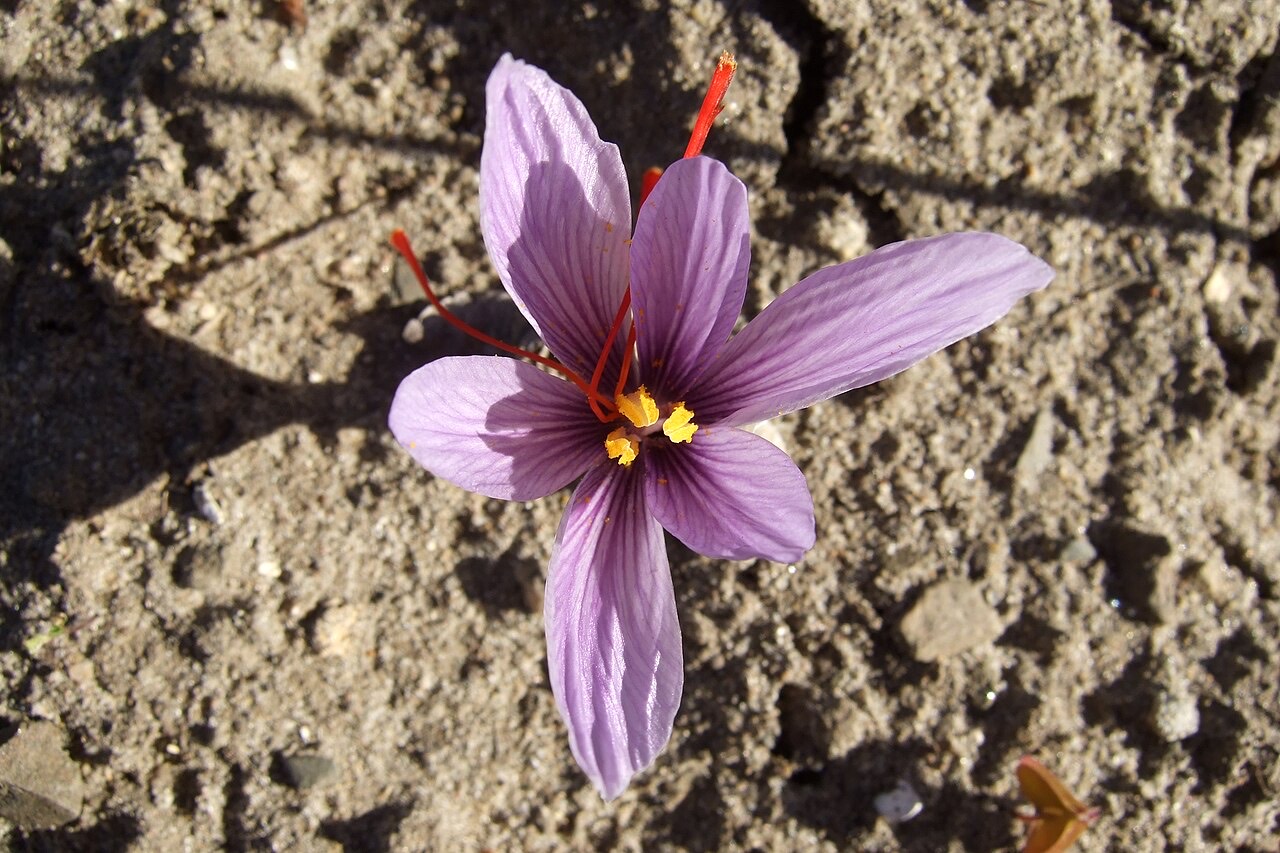
Saffron is propagated from underground corms rather than seed and produces purple, autumn-blooming flowers, each containing just three thread-like stigmas that are hand-picked and dried to produce the spice.
Because each flower yields only a tiny amount of usable stigma, and because harvesting and separating the stigmas must be done entirely by hand within a short flowering window, saffron requires an exceptionally large amount of labor relative to the quantity of spice produced.
Overview
Saffron is grown mainly by smallholder farmers in a limited number of regions with suitable climate, most notably Iran, which accounts for the large majority of global production, along with smaller producing areas in India, Spain, Greece, and Afghanistan.
Fields are established from corms and flower for several years before productivity declines and corms are lifted, divided, and replanted, making saffron cultivation a multi-year cycle built around this corm renewal.
Botanical classification
- Family
- Iridaceae (iris family)
- Genus
- Crocus
- Principal species
- Crocus sativus
- Growth habit
- Perennial corm-forming plant producing autumn flowers with three long stigmas per bloom; propagated vegetatively via corms rather than seed
Origin and distribution
Saffron crocus is believed to have originated in the eastern Mediterranean or Southwest Asia, where it was likely selectively bred from a wild crocus ancestor. It has been cultivated and traded as a valuable spice for thousands of years.
Iran is by far the world’s leading producer of saffron today, with additional production in India, Afghanistan, Spain, Greece, and Morocco.
Climate and soil requirements
Saffron is adapted to semi-arid Mediterranean to continental climates with cold winters, which the corms require for dormancy and flower initiation, and hot, dry summers, during which the corms rest underground.
Well-drained loams and sandy loams are essential, since corms are highly susceptible to rot if waterlogged, particularly during their summer dormant period.
Cultivation and management
- Establishment from healthy, disease-free corms planted at an appropriate depth and spacing
- Fields typically maintained for several years before corms are lifted and replanted, as flowering productivity declines with clump crowding over time
- Minimal soil disturbance during the flowering and stigma-harvesting period
- Weed control important during establishment, since young plantings compete poorly with weeds
Nutrient considerations
Nitrogen, phosphorus, and potassium all contribute to corm development and flowering, though saffron is generally considered a modest-input crop relative to many other spice and vegetable crops.
Water and irrigation
Saffron has a comparatively low overall water requirement and is traditionally grown with minimal irrigation, relying on autumn and winter moisture to support flowering and vegetative growth.
Deficit irrigation strategies, applying limited supplemental water at key growth stages, are used in some production regions to support flowering without promoting the excess moisture that risks corm rot.
Common diseases and pests
Corm rot, caused by soil fungi and worsened by waterlogging, is the most significant disease risk in saffron cultivation, and Fusarium-associated wilt and corm decay are well documented in several producing regions. Aphids and spider mites are occasional pests of foliage, though overall pest pressure on saffron is generally lower than on many other crops.
| Problem | Type | Notes |
|---|---|---|
| Root/corm rot | Disease | Most significant risk, worsened by waterlogging |
| Fusarium wilt | Disease | Associated with corm decay in several regions |
| Aphids | Pest | Occasional pest of foliage |
| Spider mites | Pest | Occasional pest under dry conditions |
Harvest
Flowers are hand-picked each morning during the short autumn flowering period, and the three stigmas are then carefully separated by hand from each flower before being dried to produce the finished spice.
Uses
- Dried stigmas used as a culinary spice for color, flavor, and aroma in a wide range of dishes
- Used in traditional rice, seafood, and baked dishes across many cuisines
- Saffron extracts used in some food coloring and flavoring applications
- Corms and flower petals sometimes used as secondary products in producing regions
Botanical identity
Species- Accepted name
- Crocus sativus
- Family
- Iridaceae
- Genus
- Crocus
- Harvested part
- flower
- Agricultural use
- spice
- Crop group
- Spices and herbs
What the authorities say
- World Flora Online — Taxonomic Backbone
- Crocus sativus
- Plants of the World Online
- Crocus sativus
Botanical identity here is what the consulted taxonomic authorities publish, on the date they were read. Where authorities disagree, both readings are shown rather than one being chosen silently.
What AgricultureID holds for this crop
- 2 soil references
- 2 climate references
Not held
- No crop calendar records — source exists not mapped
- No published cultivars — not researched
- No official variety registrations — source exists not mapped
- No verified extension resources — source exists not ingested
- No pests and diseases naming this crop as a host — source exists not ingested
- No farm economics observations — source exists not mapped
- No market price series — source exists not mapped
- No related crops — not applicable
An absence here means this corpus holds no such record, not that none exists.
How to read figures on this page
Production, area and trade figures for any crop change from season to season and are compiled by FAO and by national agricultural statistics agencies. Take current numbers from those primary sources, dated to the period you mean, rather than from a secondary summary — including this one.
Crop water requirements are estimated from reference evapotranspiration and local climate data, following methods published by FAO and national agricultural agencies. A requirement quoted without the reference method and the local climate behind it is not a number that can be applied to a field.
Tools for this
Each tool shows its formula, constants and sources, and starts empty — nothing is filled in from this page.
- Seed-rate calculator
Convert a target plant stand into a seed rate, allowing for germination and establishment.
- Row spacing calculator
Work out in-row spacing and plants per metre of row for a target density.
- Production, area and yield calculator
Relate a harvested area and a yield to a production total, in either direction.
- Growing degree-days calculator
Accumulate heat units against a base temperature.
Relationships
Evidence-backed connections in the knowledge graph.
Susceptible to
Nutrients required
Suitable soils
Climate sensitivity
Irrigation methods
Managed with
Farming systems
Scope & limitations
Geographic scope: Global overview; Iran accounts for the large majority of global production, with smaller production in India, Afghanistan, Spain, Greece, and Morocco.
Climate context: Semi-arid Mediterranean to continental perennial crop requiring cold winters for corm dormancy and flowering, and hot, dry summers.
- Stigma yield per flower and per corm is inherently very small and varies with corm age, density, and growing conditions, which is not quantified here.
- Production statistics and market prices change considerably year to year and should be taken from primary datasets such as FAOSTAT.
Sources
This article draws on the following authoritative sources. See our sources & methodology for how they are selected.
- [1]FAO — Food and Agriculture Organization (opens in a new tab)Authoritative
Food and Agriculture Organization of the United Nations (FAO)
Cited for: Global saffron production context
- Type:
- Intergovernmental organization
- Jurisdiction:
- Global
- Accessed:
- 2026-07-12
- [2]FAOSTAT — FAO statistical database (opens in a new tab)Authoritative
Food and Agriculture Organization of the United Nations (FAO)
Cited for: Production and area statistics
- Type:
- Intergovernmental organization
- Jurisdiction:
- Global
- Accessed:
- 2026-07-12
- [3]CABI Digital Library — Crop Protection Compendium (opens in a new tab)High
CABI (Centre for Agriculture and Bioscience International)
Cited for: Saffron disease and pest compendium data
- Type:
- Reference database
- Jurisdiction:
- Global
- Accessed:
- 2026-07-12
- Authoritative
Cited for: Classification and nomenclature
- Type:
- Reference database
- Jurisdiction:
- United States
- Accessed:
- 2026-07-12