Pest · Insect pest
Colorado Potato Beetle
Leptinotarsa decemlineata
Also known as: CPB, Potato bug
The Colorado potato beetle is a defoliating beetle that can strip potato and other solanaceous crops of foliage. It is notorious for developing resistance to insecticides, making integrated management especially important.
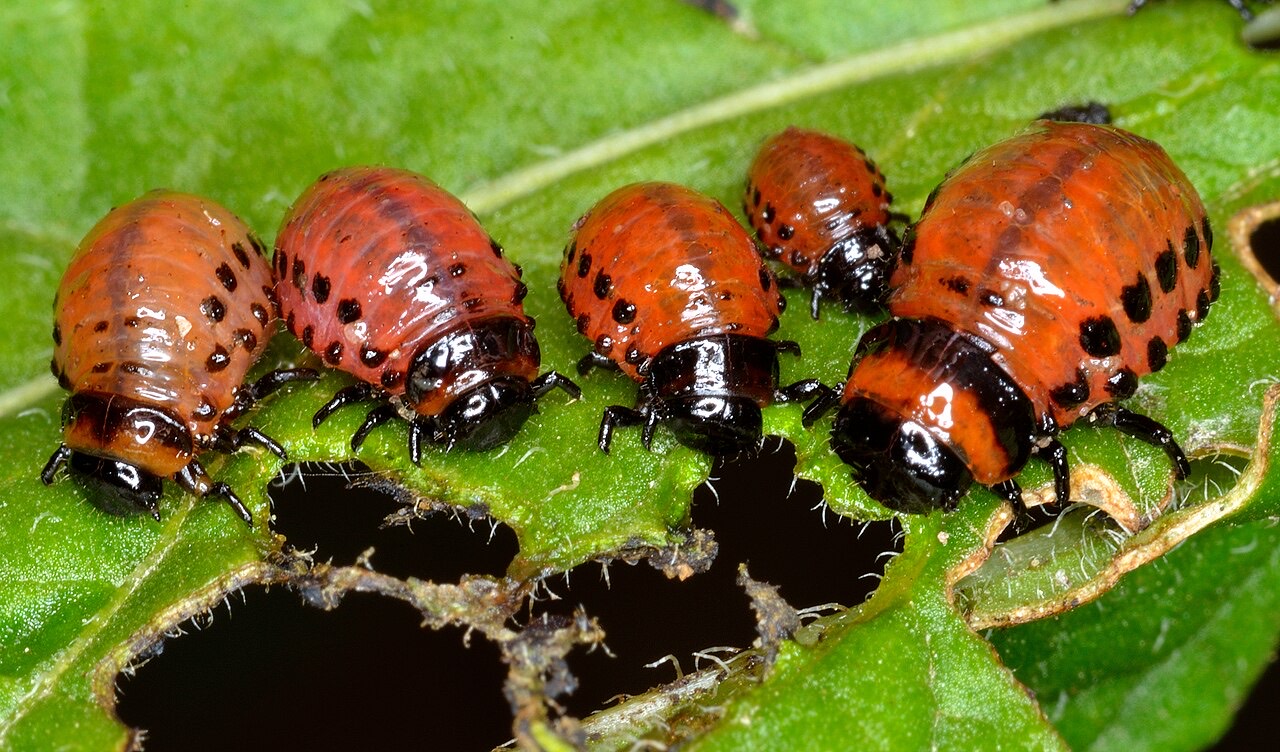
The Colorado potato beetle (Leptinotarsa decemlineata) is a leaf beetle in the family Chrysomelidae, native to parts of North America and now established across much of the potato-growing regions of North America, Europe, and Asia. Both adults and larvae feed on foliage, and heavy infestations can defoliate potato plants and reduce yield.
The species is particularly notable in pest-management circles for its well-documented ability to develop resistance to a wide range of insecticide classes over successive generations. This history of resistance is a central reason integrated pest management — combining monitoring, cultural practices, natural enemies, and judicious, rotated use of authorized products — is emphasized for this pest rather than repeated reliance on a single control tactic.
Identification
Adults are rounded, roughly one centimetre long, and yellow-orange with ten black longitudinal stripes running down the wing covers. Larvae are humpbacked, orange-red to pink, with two rows of black spots along each side of the body and a dark head. Eggs are bright yellow-orange and laid upright in tight clusters on the undersides of leaves.
- Adults: yellow-to-orange beetles about 1 cm long with ten black stripes along each wing cover
- Larvae: humpbacked, orange-red to pink grubs with two rows of black spots along each side and a black head
- Eggs: bright yellow-orange, laid upright in clusters on the undersides of leaves
Biology and life cycle
Adults overwinter in soil, often near the previous year's host plantings, and emerge in spring as host plants become available. After feeding and mating, females lay clusters of eggs on the undersides of leaves. Larvae pass through four progressively larger instars, feeding heavily throughout, before dropping to the soil to pupate. Depending on climate and the length of the growing season, one to several generations can occur in a single year.
- Egg
- Laid in upright clusters on leaf undersides; hatching is faster in warm weather.
- Larva (four instars)
- Increasingly large, humpbacked stages that feed heavily on foliage before dropping to the soil.
- Pupa
- A non-feeding stage in the soil during which the adult form develops.
- Adult
- Emerges from the soil to feed and mate, and, in temperate regions, later overwinters.
Damage and hosts
Both larvae and adults chew foliage, and heavy populations can strip plants of leaves entirely — a process known as defoliation. Defoliation reduces the plant's capacity for photosynthesis and can significantly affect tuber yield if it occurs during critical growth stages. The beetle's primary host is potato, but it also feeds on other solanaceous plants, including tomato, and on related solanaceous weeds.
| Life stage | Feeding behaviour |
|---|---|
| Early instar larvae | Feed on leaf undersides, causing small holes and skeletonizing tissue. |
| Late instar larvae | Consume large amounts of foliage; typically the most damaging feeding stage. |
| Adults | Feed on foliage after emerging in spring and again later in the season. |
Monitoring
Regular field scouting for eggs, larvae, and adults — especially early in the season, as overwintered adults colonize emerging plants — allows management decisions to be made before defoliation becomes severe.
- Inspect leaf undersides for egg clusters and young larvae
- Scout field edges first, where colonizing overwintered adults often concentrate
- Track larval instar stages, since later instars cause most of the defoliation
- Compare counts or defoliation levels against locally established thresholds
Management principles
Because of its history of resistance, Colorado potato beetle management relies on combining several tactics rather than repeated use of any single insecticide.
- Rotate potato plantings away from the previous year's fields where practical, to delay colonization by overwintered adults
- Conserve natural enemies such as predatory stink bugs and ground beetles
- Use physical barriers, such as trench barriers or row covers, where feasible
- Monitor populations closely and, where any insecticide is used, follow guidance on rotating modes of action to slow further resistance development
Regulatory status
Official listings recorded for this organism. Listing is a regulatory fact and is separate from where the organism actually occurs.
EPPO A2 Listversion 2025-09
Listed as: Leptinotarsa decemlineata
EPPO region · recorded status: recommended for regulation · verified 2026-08-20
- EPPO A1 and A2 entries are recommendations to EPPO member countries, not statutory quarantine status in any particular country. Confirm the position with the national plant health authority.
- A2 pests are listed by EPPO as present but locally distributed in the EPPO region. Listing does not establish presence in any particular country.
EPPO A2 List of pests recommended for regulation as quarantine pestsEPPO Global Database
Regulatory status is jurisdiction-specific and changes. Confirm the current position with the responsible plant health authority before acting on it. All recorded listings
Official extension guidance
2 resources indexed from public extension publishers. Each was written for a particular place; read it at the source.
Colorado Potato Beetle on Vegetables
Factsheet published by University of Maryland Extension for Maryland. It addresses potato. The source is organised around “Life cycle/habits”, “Host plants” and “Signs/symptoms”.
University of Maryland Extension · Pest management · publisher states 2023-07-05
What to do if you see the Colorado potato beetle (a UK notifiable quarantine pest)
Guide published by AHDB for Great Britain. It addresses potato. The source is organised around “The history of Colorado beetle” and “What to do if you see Colorado beetle”.
Agriculture and Horticulture Development Board · Pest management, Biosecurity · publisher states no date; reachable 2026-08-27
These are pointers to guidance published by others. Each was written for a particular place and season and is revised by its publisher; read it at the source, and check it applies where you farm.
Relationships
Evidence-backed connections in the knowledge graph.
Scope & limitations
Geographic scope: Overview applicable to regions where Colorado potato beetle is established, including much of North America, Europe, and parts of Asia; regulatory status and pest pressure vary by country.
Climate context: Development is faster in warm conditions, and the number of generations per season increases with a longer, warmer growing season.
- This is a species-level overview and does not substitute for region-specific scouting protocols or resistance-management plans.
- Insecticide resistance patterns vary by population and region and are not detailed here.
- Thresholds and control-product recommendations are jurisdiction-specific and are not provided here.
Sources
This article draws on the following authoritative sources. See our sources & methodology for how they are selected.
- [1]UC Statewide Integrated Pest Management Program (UC IPM) (opens in a new tab)High
University of California Agriculture and Natural Resources (UC ANR)
Cited for: Identification and IPM principles
- Type:
- University extension service
- Jurisdiction:
- United States (California)
- Accessed:
- 2026-07-12
- [2]CABI Digital Library — Crop Protection Compendium (opens in a new tab)High
CABI (Centre for Agriculture and Bioscience International)
Cited for: Biology, hosts, and importance, including resistance
- Type:
- Reference database
- Jurisdiction:
- Global
- Accessed:
- 2026-07-12
- [3]EPPO Global Database (opens in a new tab)Authoritative
European and Mediterranean Plant Protection Organization (EPPO)
Cited for: Nomenclature and distribution
- Type:
- Reference database
- Jurisdiction:
- Global
- Accessed:
- 2026-07-12
- [4]Penn State Extension — Plant disease and pest resources (opens in a new tab)High
Penn State Extension, The Pennsylvania State University
Cited for: Monitoring and management context
- Type:
- University extension service
- Jurisdiction:
- United States (Pennsylvania)
- Accessed:
- 2026-07-12
- High
Cited for: Scientific name and taxonomic classification
- Type:
- Reference database
- Jurisdiction:
- Global
- Accessed:
- 2026-07-12