Pest · Insect pest
Flea Beetles
Subfamily Alticinae, family Chrysomelidae (order Coleoptera)
Also known as: Flea beetle
Flea beetles are small, jumping leaf beetles whose adults create characteristic "shot-hole" feeding damage, posing the greatest risk to young seedlings of cabbage, broccoli, radish, and eggplant.
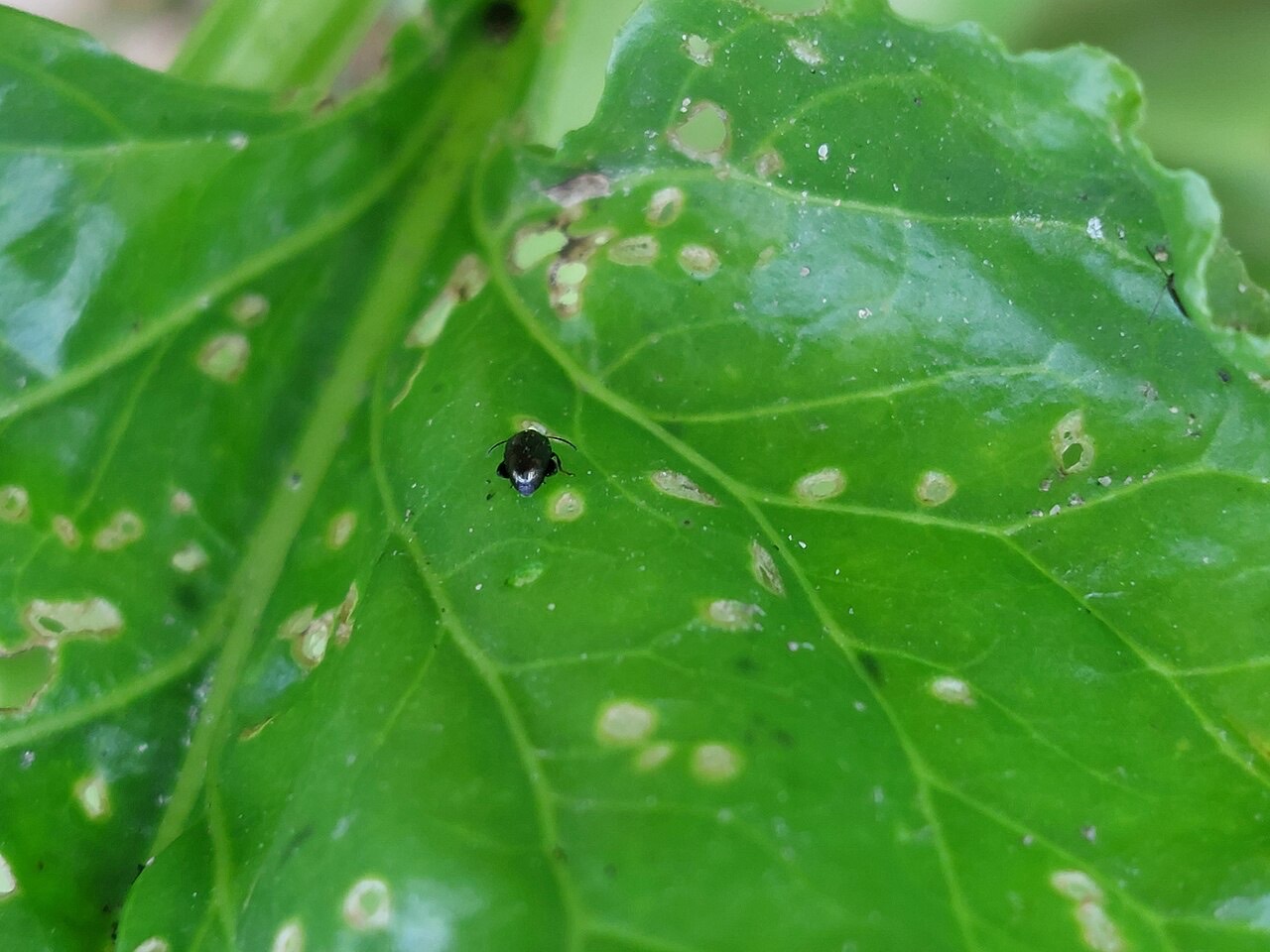
Flea beetles are small beetles, usually just a few millimetres long, named for their enlarged hind legs, which let them jump readily when disturbed, much like fleas. Adults chew small, rounded holes in leaves, producing a distinctive "shot-hole" pattern, while larvae of some species feed on roots below ground.
Damage is usually most serious on young seedlings and transplants, where even modest adult feeding can kill or severely stunt plants before they establish, making the seedling stage the period of greatest concern.
Identification
Adult flea beetles are small, shiny, and often black, bronze, or striped, with noticeably enlarged hind femurs used for jumping. Feeding produces numerous small, rounded holes across the leaf surface, giving foliage a characteristic shot-hole appearance, most damaging on cotyledons and young true leaves.
Biology and life cycle
Adults typically overwinter in soil, leaf litter, or field margins and become active as temperatures warm in spring, when they move into emerging crops. Eggs are laid in soil near host plants, and larvae of many species feed on roots before pupating; several generations can occur per season in warm climates.
Damage and hosts
Adult feeding on cotyledons and young leaves can kill seedlings outright or slow establishment, while damaged leaf tissue also increases susceptibility to disease entry and moisture loss. Root feeding by larvae of some species adds further stress, particularly in root and tuberous vegetables.
Host crops include cabbage, broccoli, radish, and eggplant, along with many other brassica and solanaceous vegetables.
Monitoring
Inspecting seedlings soon after emergence or transplanting, particularly on warm, sunny days when adults are most active, helps detect early shot-hole damage before stands are seriously affected. Yellow sticky traps can supplement visual counts in some settings.
Management principles
Because young seedlings are most vulnerable, flea beetle management emphasises protecting the crop during establishment.
- Use row covers or similar physical barriers during the vulnerable seedling stage
- Time planting to avoid peak adult emergence where local patterns are known
- Conserve parasitic wasps and flies and predatory natural enemies
- Manage crop residue and weedy hosts that can support overwintering adults
Relationships
Evidence-backed connections in the knowledge graph.
Risk increases under
Scope & limitations
Geographic scope: Found worldwide on brassica and other vegetable crops; species present, generation number, and seasonal timing vary by region.
Climate context: Adult activity and feeding intensity increase with warm, sunny conditions, and damage is often worse on stressed seedlings during dry spells.
- This is a general overview of a large subfamily of leaf beetles, not species-level guidance for a specific crop or region.
- Thresholds and control-product recommendations are jurisdiction-specific and are not provided here.
Sources
This article draws on the following authoritative sources. See our sources & methodology for how they are selected.
- [1]UC Statewide Integrated Pest Management Program (UC IPM) (opens in a new tab)High
University of California Agriculture and Natural Resources (UC ANR)
Cited for: Identification and IPM principles
- Type:
- University extension service
- Jurisdiction:
- United States (California)
- Accessed:
- 2026-07-12
- [2]CABI Digital Library — Crop Protection Compendium (opens in a new tab)High
CABI (Centre for Agriculture and Bioscience International)
Cited for: Biology, hosts, and distribution
- Type:
- Reference database
- Jurisdiction:
- Global
- Accessed:
- 2026-07-12
- [3]University of Minnesota Extension — Crop and pest resources (opens in a new tab)High
University of Minnesota Extension
Cited for: Seedling protection and monitoring guidance
- Type:
- University extension service
- Jurisdiction:
- United States (Minnesota)
- Accessed:
- 2026-07-12
- [4]Penn State Extension — Plant disease and pest resources (opens in a new tab)High
Penn State Extension, The Pennsylvania State University
Cited for: Field scouting and cultural management context
- Type:
- University extension service
- Jurisdiction:
- United States (Pennsylvania)
- Accessed:
- 2026-07-12