Crop · Tuber crop
Potato
Solanum tuberosum
Also known as: White potato, Irish potato
Potato is a tuber crop grown for its starchy underground tubers, a major staple food and vegetable crop cultivated across temperate regions and highland areas of the tropics.
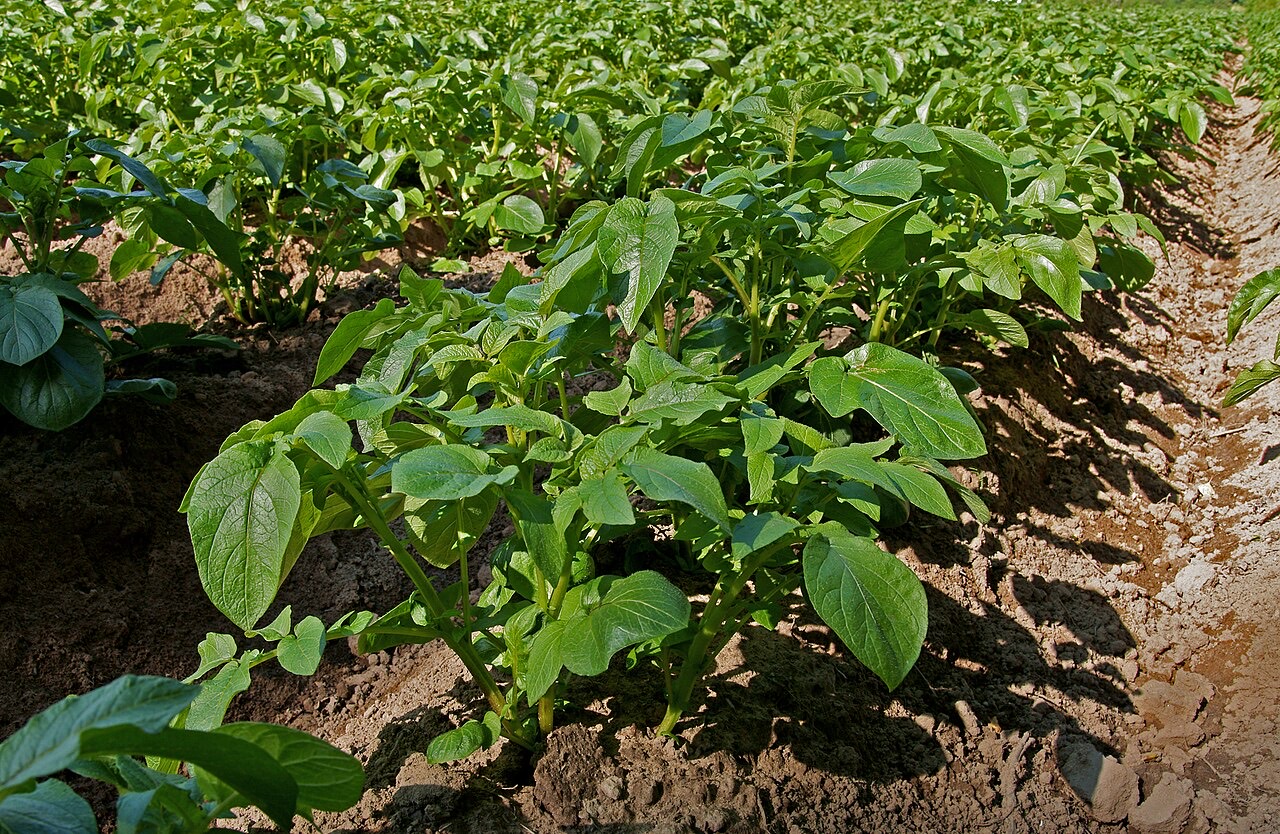
Potato is one of the most widely grown food crops in the world, valued for its high yield of edible energy per unit area and its versatility in cooking and processing. Unlike most major crops, it is propagated commercially not from true seed but from seed tubers, or pieces of tubers, each carrying viable buds known as eyes.
The edible tuber is a swollen underground stem, not a root, that develops at the tip of underground stolons. Tuber initiation and bulking are influenced by day length and temperature, and thousands of varieties exist, reflecting the crop’s long history of selection in its Andean center of origin and subsequent breeding worldwide.
Overview
Potato is grown from seed tubers rather than true seed in almost all commercial production, which makes seed tuber quality and health a central agronomic concern. The crop is notable for converting a large share of its growth into harvestable tuber yield relative to many other staple crops.
Because potato is propagated vegetatively, seed tuber sourcing, certification, and disease status are especially important, and practices differ by region depending on local seed systems and regulation.
Botanical classification
- Family
- Solanaceae (nightshade family)
- Genus and species
- Solanum tuberosum
- Edible organ
- Tuber — a swollen underground stem formed at the tip of a stolon, not a root
- Growth habit
- Herbaceous annual with a sprawling above-ground stem and compound leaves
Origin and distribution
Potato was domesticated in the Andean highlands of what is now Peru and Bolivia, where wild and cultivated relatives show the greatest genetic diversity. It was introduced to Europe following contact with the Americas and subsequently spread worldwide, becoming a staple crop in many temperate and highland regions.
Potato is now grown across a wide range of countries and climates.
Climate requirements
Potato is a cool-season crop that grows best with moderate day temperatures and cool nights, conditions that favor tuber initiation and bulking. It is sensitive to frost, particularly to foliage, and to prolonged heat, which can reduce tuber set and quality.
In tropical regions, potato is often grown at higher elevations where temperatures are cooler, illustrating how climate suitability depends on both latitude and elevation rather than latitude alone.
Soil requirements
Potato performs best on loose, well-drained soils such as sandy loams that allow tubers to expand freely and support even tuber shape. Compacted or heavy soils can restrict tuber development and increase the risk of misshapen tubers.
Establishment and crop management
Potato is established by planting whole seed tubers or cut seed pieces, each bearing at least one viable eye, into a prepared seedbed. Plants are typically hilled or ridged during the season to cover developing tubers and protect them from light exposure, which causes greening.
- Use of certified, disease-tested seed tubers where available
- Crop rotation away from potato and related solanaceous crops to manage soilborne diseases and pests
- Hilling or ridging to cover developing tubers and support drainage
- Variety selection matched to local climate, disease pressure, and intended market or use
Nutrient considerations
Potato has a relatively high potassium requirement, which supports tuber development and quality, alongside nitrogen and phosphorus needs that influence canopy growth and early root and tuber establishment. Requirements depend on soil supply, target yield, and variety.
Water and irrigation
Potato has a relatively shallow root system and benefits from consistent soil moisture, particularly during tuber initiation and bulking. Both water deficit and waterlogging during this period can reduce yield and tuber quality.
Common diseases and pests
Late blight, caused by the oomycete Phytophthora infestans, is one of the most historically significant potato diseases and remains an important production risk in many regions under humid conditions. The Colorado potato beetle is a major defoliating pest in parts of its range, and aphids can reduce vigor and transmit viruses that degrade seed tuber quality.
Management typically combines resistant or tolerant varieties, certified disease-free seed, crop rotation, field monitoring, and, where warranted, locally authorized control measures used according to their labels.
Harvest
Potato is typically harvested after the foliage has died back or been deliberately desiccated, which allows tuber skins to set and reduces bruising during lifting. Harvested tubers are often cured under controlled conditions before long-term storage to promote wound healing.
Uses
- Fresh consumption, boiled, baked, roasted, or fried
- Processed products such as frozen fries, chips, and dehydrated potato products
- Starch extraction for food and industrial applications
- Lower-grade tubers and processing by-products used in animal feed
Botanical identity
Species- Accepted name
- Solanum tuberosum
- Family
- Solanaceae
- Genus
- Solanum
- Harvested part
- tuber
- Agricultural use
- human food, starch, animal feed
- Crop group
- Roots and tubers, Vegetables
What the authorities say
- World Flora Online — Taxonomic Backbone
- Solanum tuberosum
- Plants of the World Online
- Solanum tuberosum
Botanical identity here is what the consulted taxonomic authorities publish, on the date they were read. Where authorities disagree, both readings are shown rather than one being chosen silently.
Traded as
This crop is traded as one commodity in this corpus.
What AgricultureID holds for this crop
- 254 crop calendar records
- 10 published cultivars
- 58 official variety registrations
- 3 verified extension resources
- 16 pests and diseases naming this crop as a host
- 2 soil references
- 377 market price series
- 5 related crops
Not held
- No climate references — not researched
- No farm economics observations — source exists not mapped
An absence here means this corpus holds no such record, not that none exists.
How to read figures on this page
Production, area and trade figures for any crop change from season to season and are compiled by FAO and by national agricultural statistics agencies. Take current numbers from those primary sources, dated to the period you mean, rather than from a secondary summary — including this one.
Crop water requirements are estimated from reference evapotranspiration and local climate data, following methods published by FAO and national agricultural agencies. A requirement quoted without the reference method and the local climate behind it is not a number that can be applied to a field.
Part of
Roots and tubers · Solanaceae — the nightshade family · Vegetables
Related crops
- Same genus
- Eggplant, Gboma Eggplant, Scarlet Eggplant, Tomato
- Shared pest and disease pressure
- Maize
Planting and harvest calendar
Usual sowing and harvest windows across 254 jurisdictions, covering potato and potato — season 1 and potato — season 2 and potato — season 3 and potato — season 4.
Official extension guidance
3 resources indexed from public extension publishers. Each was written for a particular place; read it at the source.
Colorado Potato Beetle on Vegetables
Factsheet published by University of Maryland Extension for Maryland. It addresses potato. The source is organised around “Life cycle/habits”, “Host plants” and “Signs/symptoms”.
University of Maryland Extension · Pest management · publisher states 2023-07-05
Factsheet published by NC State Extension for North Carolina. It addresses potato. The source is organised around “Blister Beetles” and “Colorado Potato Beetle”.
NC State Extension · Pest management · publisher states 2024-06-13
What to do if you see the Colorado potato beetle (a UK notifiable quarantine pest)
Guide published by AHDB for Great Britain. It addresses potato. The source is organised around “The history of Colorado beetle” and “What to do if you see Colorado beetle”.
Agriculture and Horticulture Development Board · Pest management, Biosecurity · publisher states no date; reachable 2026-08-27
These are pointers to guidance published by others. Each was written for a particular place and season and is revised by its publisher; read it at the source, and check it applies where you farm.
Authorised inputs (France)
The French register records 184 currently authorised products whose authorised use names this crop, held by 65 authorisation holders. This is a count of what exists on the register, not a recommendation and not a shortlist.
By function
- Fongicide 78
- Herbicide 64
- Insecticide 30
- Régulateur de croissance 6
- Bactéricide 2
- Subst. Croiss. 1
Targets named on the register
- Mildiou(s) 64
- Champignons (autres que pythiacées) 11
- Ravageurs du sol 10
- Maladies des taches brunes 10
- Limit. Destruct. Germes 8
- Coléoptères phytophages 8
Use scope is recorded as the register writes it. Collective terms cover several crops at once and are left unmapped rather than expanded, because expanding one entry into several would invent authorisations that were never granted.
Authorisation is specific to one jurisdiction, one legal object and one moment. It is not a recommendation, and it says nothing about how a product may be used: always read the current official label at the source before acting.
Tools for this
Each tool shows its formula, constants and sources, and starts empty — nothing is filled in from this page.
- Seed-rate calculator
Convert a target plant stand into a seed rate, allowing for germination and establishment.
- Row spacing calculator
Work out in-row spacing and plants per metre of row for a target density.
- Production, area and yield calculator
Relate a harvested area and a yield to a production total, in either direction.
- Growing degree-days calculator
Accumulate heat units against a base temperature.
Relationships
Evidence-backed connections in the knowledge graph.
Susceptible to
Suitable soils
Notable cultivars
Documented varieties tied to this species, with registry status and sources on each page. Not an exhaustive list.
- AtlanticAtlantic is a white-fleshed American maincrop potato released by the USDA in 1978, valued for its high specific gravity and long a leading chipping (crisping) variety in the United States.
- BintjeBintje is a yellow-fleshed Dutch potato bred by Kornelis Lieuwes de Vries in Friesland in the early twentieth century, historically one of the most important frying and all-purpose varieties in north-west Europe.
- CharlotteCharlotte is a French-bred, yellow-fleshed salad potato with a waxy, firm texture that holds its shape, widely used for boiling and salads.
- DésiréeDésirée is a red-skinned, yellow-fleshed Dutch maincrop potato, a widely grown, versatile all-rounder used for boiling, roasting, mashing, and chips.
- KennebecKennebec is a white-fleshed American maincrop potato released by the USDA in 1948, a widely adapted, general-purpose variety used for the table and for processing.
- King EdwardKing Edward is a British heritage maincrop potato introduced in 1902, recognised for its party-coloured skin and floury, cream-fleshed tubers favoured for roasting, baking, and mashing.
- Maris PeerMaris Peer is a British second-early potato bred at the Plant Breeding Institute in Cambridge, a firm, waxy variety used for new potatoes, salads, and boiling.
- Maris PiperMaris Piper is a British maincrop potato bred at the Plant Breeding Institute in Cambridge and released in 1966, one of the most widely grown UK varieties and a popular floury potato for chips and roasting.
- Russet BurbankRusset Burbank is a late-maturing, russet-skinned potato with white, floury flesh and high dry-matter content, long the dominant processing variety in North America for French fries and baking.
- Yukon GoldYukon Gold is a yellow-fleshed potato bred at the University of Guelph and released in 1980, notable as one of the first widely marketed yellow-fleshed varieties in North America.
Harvested commodities
The traded commodities harvested from this crop. A commodity is the harvested lot, described by its own quality, grading, and storage evidence — not by the agronomy of the plant.
Scope & limitations
Geographic scope: Global overview. Variety choice, seed tuber sourcing, and disease management are strongly region-specific given the wide range of environments in which potato is produced.
Climate context: Cool-season crop sensitive to frost and heat; grown in temperate zones and at elevation in highland tropical regions.
- Variety selection, seed tuber sourcing, and planting depth are region-specific decisions not covered by universal values here.
- Production and trade statistics change annually and should be taken from primary datasets such as FAOSTAT.
- Late blight risk and severity vary greatly with local climate and should be monitored through local disease forecasting services where available.
Sources
This article draws on the following authoritative sources. See our sources & methodology for how they are selected.
- [1]FAO — Food and Agriculture Organization (opens in a new tab)Authoritative
Food and Agriculture Organization of the United Nations (FAO)
Cited for: Role of potato in global food security and agronomy
- Type:
- Intergovernmental organization
- Jurisdiction:
- Global
- Accessed:
- 2026-07-12
- [2]FAOSTAT — FAO statistical database (opens in a new tab)Authoritative
Food and Agriculture Organization of the United Nations (FAO)
Cited for: Production, area, and trade statistics
- Type:
- Intergovernmental organization
- Jurisdiction:
- Global
- Accessed:
- 2026-07-12
- High
Cited for: Potato genetic resources and agronomy research
- Type:
- Research institute
- Jurisdiction:
- Global
- Accessed:
- 2026-07-12
- [4]USDA ARS — Agricultural Research Service (opens in a new tab)Authoritative
USDA Agricultural Research Service (ARS)
Cited for: Potato disease and pest research
- Type:
- Government agency
- Jurisdiction:
- United States
- Accessed:
- 2026-07-12
- Authoritative
Cited for: Classification and nomenclature
- Type:
- Reference database
- Jurisdiction:
- United States
- Accessed:
- 2026-07-12
- [6]Cornell CALS — Plant pathology and crop resources (opens in a new tab)High
Cornell University College of Agriculture and Life Sciences
Cited for: Regional potato agronomy and disease guidance
- Type:
- University extension service
- Jurisdiction:
- United States (New York)
- Accessed:
- 2026-07-12